
Category page optimization is one of the most overlooked growth levers in e-commerce SEO, despite category pages often attracting the highest-intent search traffic across online stores. Unlike blog pages or individual product pages, category pages sit at the intersection of discovery, comparison, and purchase readiness, making them critical for both organic visibility and revenue.
For ecommerce brands running on Shopify, WooCommerce, or custom-built platforms, category pages are usually the first commercial touchpoint a potential buyer interacts with. Yet many stores either leave these pages thin, over-optimized, or locked behind technical limitations that restrict SEO performance. This guide breaks down how category page SEO actually works, why it matters more than ever, and how to build category pages that rank, scale, and convert.
Is your website actually built to convert?
Twenty two checks covering Core Web Vitals, user experience, and conversion paths. The exact list we run before every website audit.
What is category page optimization in ecommerce?
Category page optimization refers to the process of improving ecommerce category pages so they rank for commercial and transactional keywords while delivering a strong user experience. These pages typically list multiple products under a shared theme, such as product type, use case, or attribute, and act as the gateway between search intent and individual product detail pages.
When done correctly, ecommerce category page optimization balances three core elements: search intent alignment, crawl and indexation efficiency, and conversion-focused design.
Category page SEO meaning in simple terms
From an SEO perspective, category pages are designed to capture broader, high-volume keywords that users search when they are comparing options rather than looking for a single product. Examples include terms like “running shoes for men” or “wireless headphones,” which naturally map to category-level intent.
Category page SEO focuses on:
- Structuring URLs, headings, and internal links to signal relevance
- Adding supportive content without overwhelming product listings
- Ensuring search engines can crawl and index the right variations of the page
Unlike blog content, category page content SEO must work within a commercial layout, where products remain the primary focus.
Why category pages drive high-intent ecommerce traffic
Category pages often outperform product pages in organic acquisition because they align closely with how users search. Shoppers typically begin with broad commercial queries before narrowing their choice. This makes category pages ideal for capturing users who are ready to buy but still evaluating options.
Well-optimized category pages help ecommerce stores:
- Rank for competitive, revenue-driving keywords
- Distribute authority internally to product pages
- Improve engagement metrics like time on site and pages per session
- Increase assisted and direct conversions
For Shopify and WooCommerce stores especially, category pages often become the strongest organic entry points once properly optimized.
Category vs product page SEO
Understanding category vs product page SEO is essential to avoid keyword cannibalization and weak rankings. Category pages should target broader, comparison-based keywords, while product pages should focus on specific, brand-led, or model-level terms.
In practical terms:
- Category pages target “what type” or “best for” queries
- Product pages target “exact product” or “buy now” queries
- Internal links should flow from category pages to product pages to pass relevance and authority
This separation becomes even more important on large ecommerce sites, where Shopify collections, WooCommerce product categories, or custom PLPs must scale without competing against each other in search results.
How search intent shapes category page SEO
Search intent is the foundation of category page optimization. If intent mapping is wrong, even technically perfect category pages will struggle to rank or convert. For ecommerce, category pages sit primarily in the commercial to transactional intent range, which makes intent alignment more critical than for blog content.
For stores built on Shopify, WooCommerce, or custom ecommerce frameworks, understanding intent determines which categories deserve SEO focus and how deep optimization should go.
Commercial vs transactional intent on category pages
Most ecommerce category pages target commercial investigation intent, not pure transactional intent. Users landing on category pages are usually comparing options, prices, features, or styles before making a final decision.
Examples of intent alignment:
- Commercial intent keywords belong on category pages, such as broad product types or use-case driven searches.
- Transactional intent keywords belong on product pages, where users already know what they want.
Trying to force transactional keywords onto category pages often leads to poor engagement and weaker rankings. Strong category page SEO respects this boundary and lets internal linking guide users deeper into the funnel.
Mapping primary and supporting keywords to categories
Effective ecommerce category page optimization starts with assigning the right keyword role to each page. Category pages should target:
- One primary commercial keyword
- A set of closely related supporting keywords
- Semantic variations that reinforce topical relevance
On Shopify and WooCommerce stores, this often means avoiding the temptation to create multiple categories targeting near-identical keywords. Instead, one strong category page should act as the authority hub, supported by subcategories or filters.
For custom ecommerce builds, keyword mapping can be more flexible, but the same rule applies. One intent equals one primary category page.
When a category should target head terms vs collection pages
Not every category should target highly competitive head terms. In many ecommerce stores, especially large catalogs, head terms should be reserved for top-level categories, while mid-tail terms are better served by curated collection pages.
Examples:
- Head terms belong to core category pages with long-term SEO investment.
- Mid-tail or seasonal terms work better on collection or landing-style category pages.
- Filters should rarely be used as standalone SEO targets unless intentionally designed.
This distinction is crucial when improving category page SEO at scale. Without it, keyword cannibalization becomes inevitable.
Ecommerce category page optimization fundamentals (the on-page stack)
Strong category page optimization starts with an on-page foundation that search engines can understand and users can navigate effortlessly. For ecommerce sites built on Shopify, WooCommerce, and custom frameworks, these fundamentals determine how efficiently category pages rank and scale.
This section focuses on the non-negotiable on-page elements that directly influence category page SEO performance.
URL structure and breadcrumbs
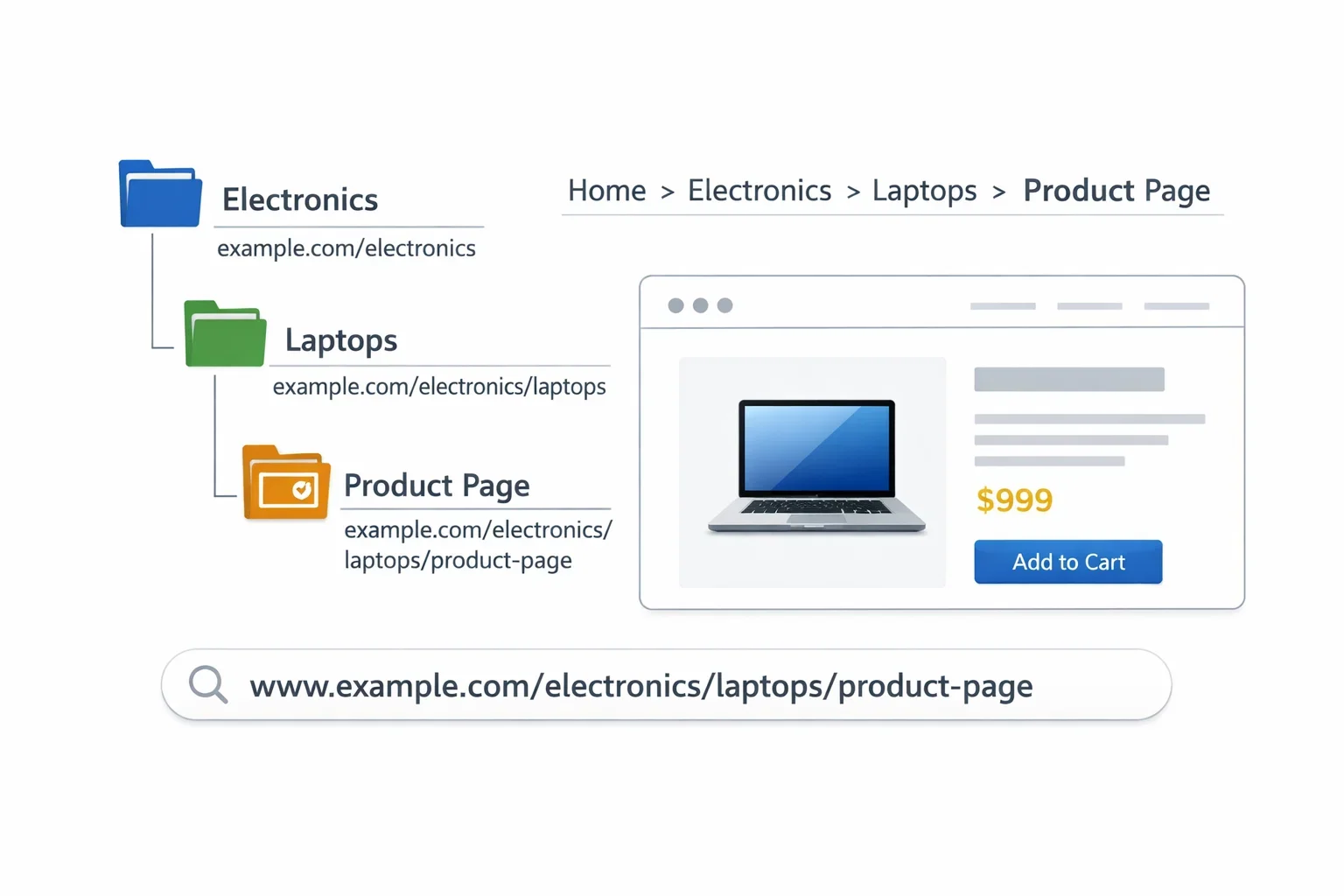
Clean and predictable URLs help search engines understand category hierarchy and topical relevance. Category page URLs should reflect logical structure rather than filters or session parameters.
Best practices include:
- Keep category URLs short and descriptive
- Avoid keyword repetition in URL paths
- Maintain a consistent hierarchy from parent category to subcategory
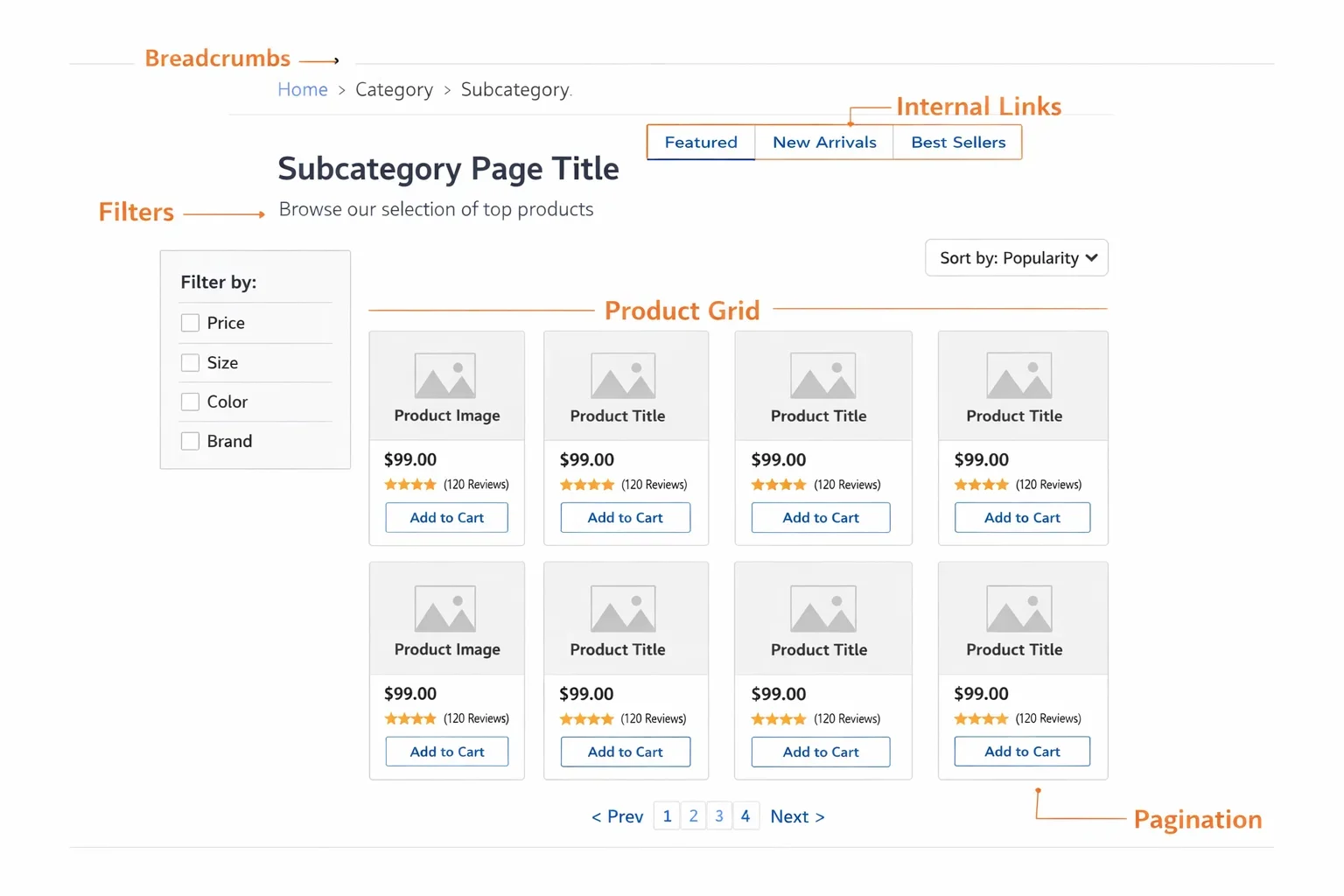
- Use breadcrumb navigation to reinforce structure and internal linking
On Shopify, collection URLs require extra care to avoid duplicate paths. On WooCommerce, taxonomy control is more flexible but still requires standardization. Custom builds should enforce URL rules at the framework level.
Title tags, meta descriptions, and H1 rules
Title tags and H1s remain critical ranking signals for category pages. Each category page should target one clear primary keyword without dilution.
Guidelines:
- Title tags should start with the primary category keyword
- Meta descriptions should emphasize selection, value, or use case
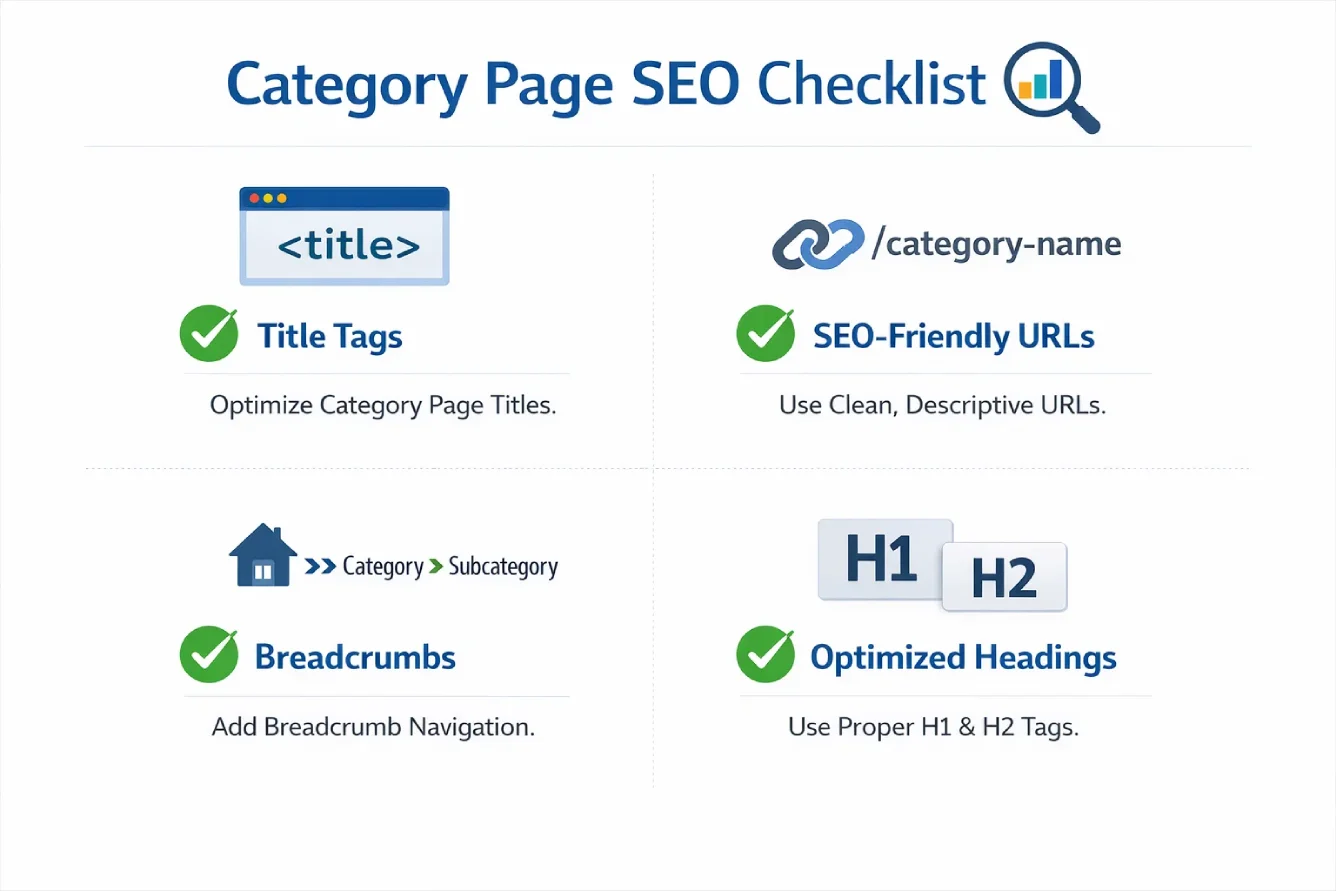
- Only one H1 per category page, matching the core intent
- Avoid stuffing filters or attributes into headings
Shopify templates often auto-generate titles, so manual overrides are essential for SEO. WooCommerce allows more control but still depends on theme implementation. Custom platforms should separate SEO fields from display logic.
Headings, subcategory blocks, and scannability
Category pages must balance SEO structure with usability. Headings should guide users while helping search engines understand topical depth.
Effective patterns include:
- H2s for subcategory groupings or buying themes
- Clear visual separation between content and product grids
- Avoid overusing headings for purely decorative elements
Subcategory blocks work especially well for large catalogs, helping users navigate while distributing internal link equity.
Internal linking that strengthens category authority
Internal linking is one of the most powerful levers for improving category page SEO. Category pages should act as authority hubs that pass relevance to subcategories and products.
Key principles:
- Link from high-authority pages to core categories
- Use descriptive anchor text naturally
- Ensure product pages link back to their parent category
- Avoid orphaned category pages
On large ecommerce sites, internal linking must be templated and governed. Custom builds have the advantage of full control, while Shopify and WooCommerce require careful theme and plugin coordination.
Structured data essentials for category pages
Structured data helps search engines better interpret category pages, even if rich results are not always visible. While product schema belongs on product pages, category pages benefit from contextual markup.
Recommended approaches:
- Breadcrumb schema to reinforce hierarchy
- Collection or item list markup where appropriate
- Avoid misusing product schema on category pages
Shopify apps, WooCommerce plugins, and custom implementations all differ in schema flexibility, so validation and testing are critical.
Category page content SEO that ranks and converts
Category page content SEO is where most ecommerce sites either unlock rankings or silently block growth. The challenge is not whether to add content, but how much, where, and in what format so SEO improves without hurting conversions.
For Shopify, WooCommerce, and custom ecommerce builds, the same rule applies. Content must support discovery and decision-making, not distract from products.
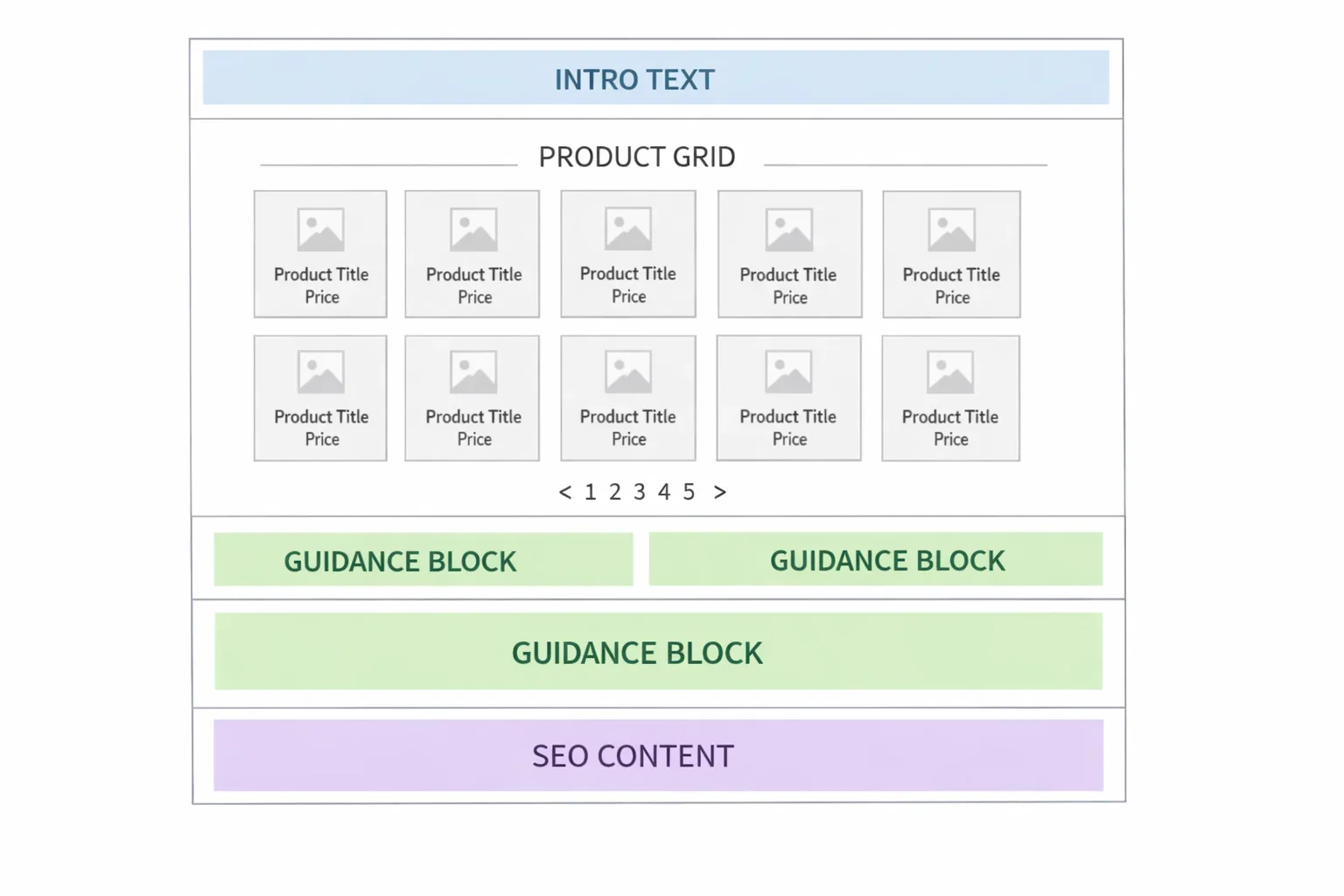
Where category page content should live (top vs mid vs bottom)
Content placement plays a major role in how category pages perform in search and how users engage.
Best placement patterns:
- Top of page: Very short context-setting copy for competitive categories
- Mid-page: Buying guidance or subcategory explanations between product blocks
- Bottom of page: Expanded SEO content, FAQs, and internal links
For most ecommerce stores, bottom-of-page content offers the safest balance. It allows category page SEO improvements without pushing products below the fold or increasing bounce rates.
Content modules you can standardize across categories
Scalability is critical for ecommerce category page optimization. Instead of writing unique long-form content for every category, high-performing stores rely on reusable content modules.
Effective modules include:
Your website might be losing customers before they even scroll
Slow load times, confusing navigation, and weak calls to action quietly cost businesses real revenue every month. See exactly what yours is missing.
No commitment, just a clear picture of where you stand.
- Short category introductions
- Buying guides or selection tips
- Trust signals such as delivery, returns, or guarantees
- FAQ blocks answering common category-level questions
Standardizing these modules ensures consistent category page SEO quality across Shopify collections, WooCommerce categories, or custom product listing pages.
Thin content vs helpful content on category pages
Thin content is one of the most common reasons category pages fail to rank. At the same time, overloading pages with keyword-heavy text can damage usability and conversions.
Helpful category content should:
- Answer real buyer questions
- Explain differences between products or subcategories
- Reinforce relevance without repeating keywords unnaturally
If content does not help a user choose, compare, or understand, it is unlikely to help SEO either. This mindset is essential when trying to improve category page SEO sustainably.
Content length and depth by catalog size
There is no universal word count for category pages. The right content depth depends on catalog size, competition, and search intent.
General guidance:
- Small catalogs need concise but clear explanations
- Medium catalogs benefit from structured guidance and FAQs
- Large catalogs require modular content to avoid overwhelming users
This approach helps ecommerce brands optimize category pages for SEO without creating bloated or repetitive layouts.
Faceted navigation, filters, pagination, and crawl control
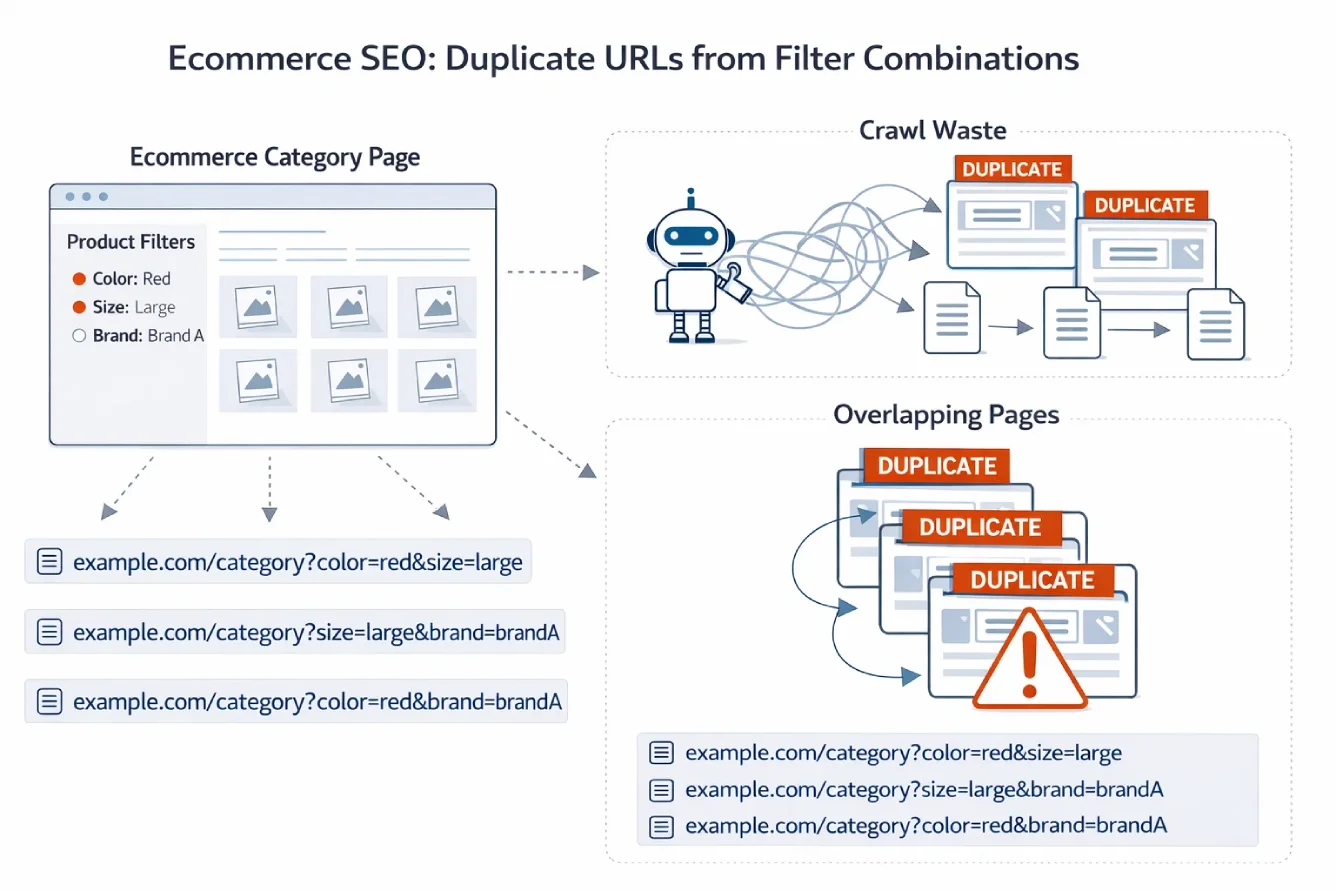
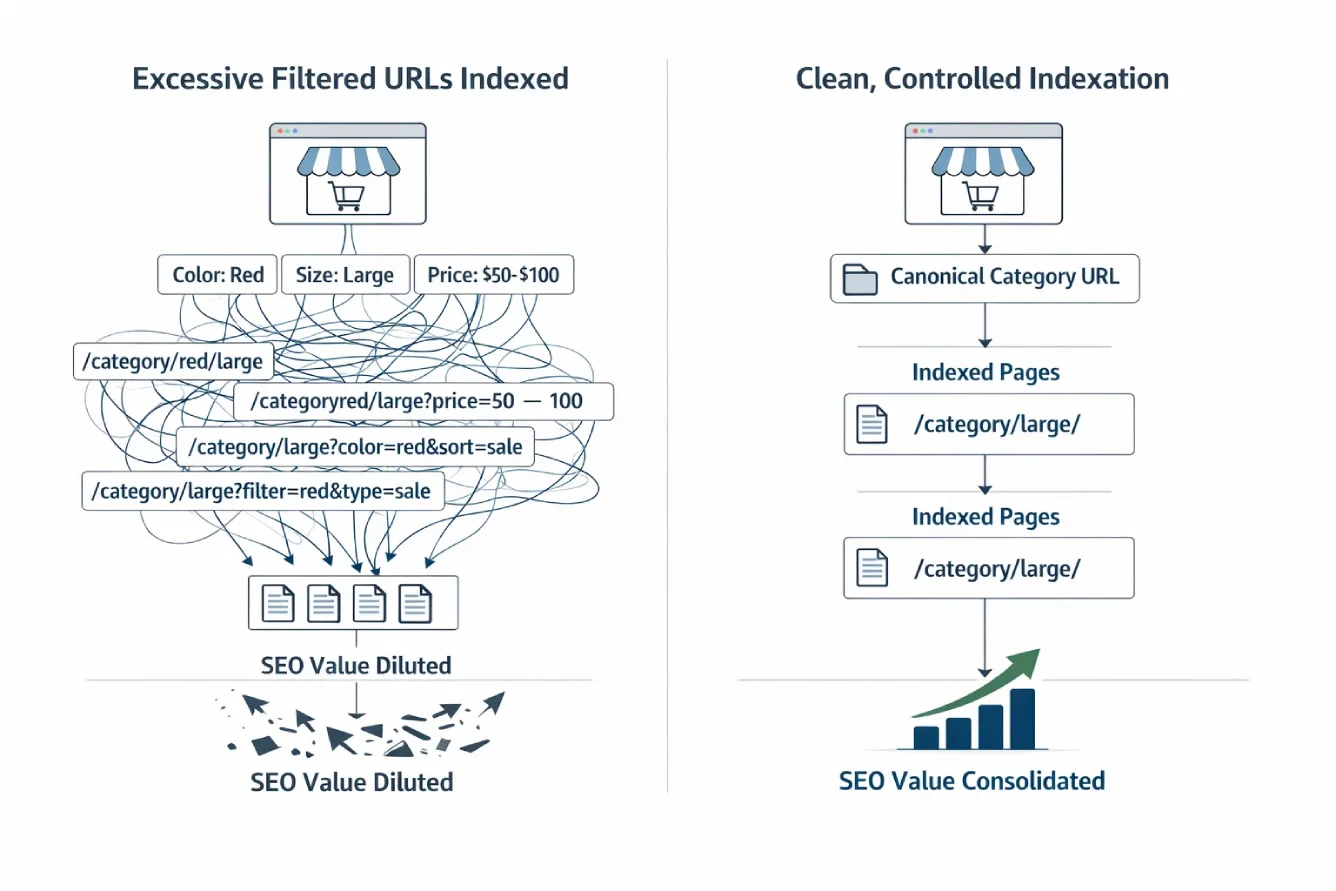
Faceted navigation is one of the biggest technical risks in category page optimization. Filters improve usability, but they can easily create thousands of low-value URLs that dilute crawl budget and weaken category page SEO if left unmanaged.
This section explains how to handle filters, pagination, and crawl control correctly for ecommerce stores on Shopify, WooCommerce, and custom-built platforms.
Faceted navigation allows users to filter products by attributes like size, color, price, or brand. From an SEO perspective, each filter combination can generate a new URL that competes with the main category page.
Common risks include:
- Duplicate or near-duplicate category URLs
- Crawl budget waste on low-intent filter pages
- Keyword cannibalization between filtered URLs and core categories
If unmanaged, faceted navigation can quickly become the reason category page SEO stalls, especially on large ecommerce catalogs.
Which filters should be indexable and which should not
Not all filters are harmful. The key is deciding which filtered pages deserve to be indexed and which should remain crawlable or blocked.
General rules:
- Index filters that represent strong, independent search intent
- Block filters that only refine results without standalone demand
- Avoid indexing combinations of multiple filters
On Shopify, indexation control is limited and often requires theme or app-level logic. WooCommerce provides more flexibility through taxonomy handling. Custom builds should define indexation rules at the architecture level.
Canonicals, parameters, and URL control
Canonical tags play a critical role in consolidating authority back to the primary category page. Without proper canonicals, filtered URLs can outrank the main category or split ranking signals.
Best practices include:
- Canonical filtered URLs back to the main category
- Use clean parameter handling for filters
- Avoid self-referencing canonicals on low-value filter pages
Shopify often requires custom solutions for canonical control. WooCommerce allows more granular control via plugins or custom code. Custom ecommerce builds should treat canonical logic as a core SEO requirement.
Pagination and infinite scroll SEO handling
Pagination is unavoidable on large category pages, but incorrect handling can block crawling or break internal linking.
Effective pagination strategies include:
- Use paginated URLs that are crawlable
- Maintain internal links between paginated pages
- Implement infinite scroll with crawlable fallback URLs
Search engines must be able to discover all products within a category. This is especially important for large Shopify and WooCommerce stores where product discovery relies heavily on pagination.
Category page SEO checklist (implementation order)
A strong category page SEO checklist turns strategy into execution. Instead of trying to fix everything at once, ecommerce teams should prioritize actions based on impact, effort, and platform constraints. This section translates category page optimization into a practical roadmap for stores built on Shopify, WooCommerce, and custom ecommerce systems.
Quick wins (1 to 2 weeks)
These actions deliver fast improvements without heavy development effort. They are ideal for stores starting category page optimization or fixing obvious gaps.
Checklist:
- Rewrite category titles and H1s to match primary intent
- Clean up category URLs and remove unnecessary parameters
- Add breadcrumb navigation with proper internal links
- Ensure each category page has one clear primary keyword
Fix duplicate meta data across similar categories
Quick wins are especially impactful on Shopify and WooCommerce stores where defaults often limit category page SEO performance.
High-impact projects (30 to 60 days)
Once the basics are stable, high-impact projects drive long-term category page SEO gains. These changes often require coordination between SEO, content, and development teams.
Checklist:
- Implement structured internal linking between categories and products
- Add modular category page content blocks and FAQs
- Define canonical rules for filtered URLs
- Improve page speed and Core Web Vitals on category templates
- Validate structured data and breadcrumb markup
These actions are where ecommerce category page optimization begins to scale across large catalogs.
Scale and governance for large catalogs (90 days and beyond)
As ecommerce stores grow, governance becomes essential. Without rules, category pages drift into duplication, thin content, and crawl inefficiency.
Checklist:
- Create category page templates with enforced SEO rules
- Define which filters can be indexed at scale
- Build QA checks for new category launches
- Monitor cannibalization between categories and collections
- Standardize content modules across all categories
Custom ecommerce platforms have the most flexibility here, but Shopify and WooCommerce stores can still enforce governance through disciplined processes and audits.
QA checklist before launching or updating a category page
Every category page should pass a final quality check before going live. This prevents common SEO issues from reappearing as catalogs evolve.
QA checklist:
- Correct indexation and canonical setup
- Clean URL with no unnecessary parameters
- Single H1 aligned with intent
- Internal links to and from relevant categories and products
- Content adds value without pushing products too far down
- Pagination and filters are crawl-safe
A repeatable QA process is one of the simplest ways to consistently improve category page SEO.
Measuring results and improving category page SEO over time
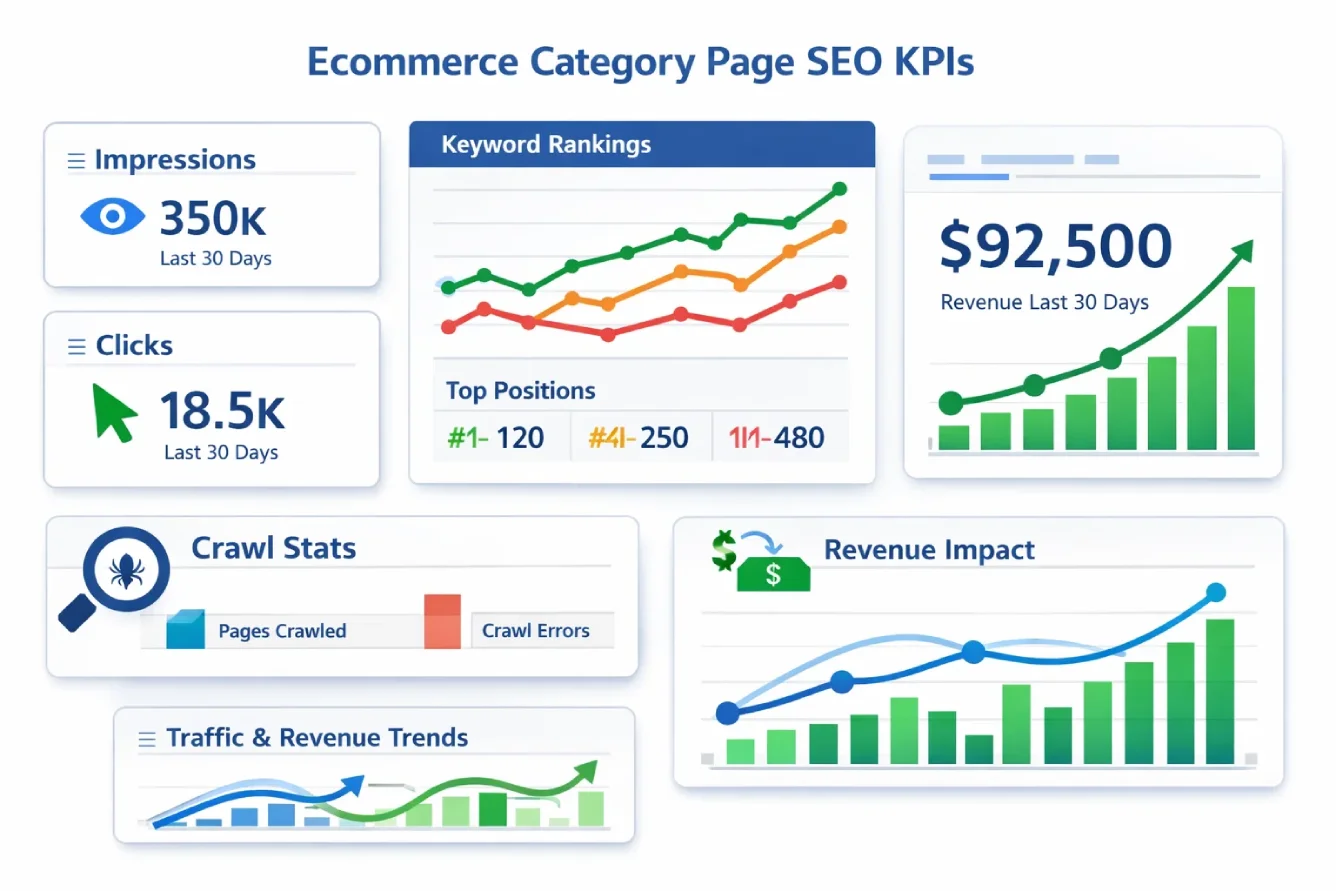
Category page optimization does not end at implementation. Continuous measurement is what separates temporary ranking gains from sustainable ecommerce growth. Category pages influence discovery, internal linking strength, and assisted conversions, so performance must be tracked beyond simple keyword positions.
For ecommerce stores on Shopify, WooCommerce, and custom platforms, measurement frameworks should combine SEO, UX, and revenue signals.
KPIs that actually matter for category pages
Category pages sit high in the ecommerce funnel, so success metrics should reflect both visibility and commercial impact.
The most reliable KPIs include:
- Organic impressions and clicks for category-level queries
- Average position and keyword coverage, not just one primary term
- Click-through rate from search results
- Crawl frequency and indexed URL count
- Assisted conversions and revenue contribution
Tools like Google Search Console and Google Analytics 4 help connect ranking signals with real business outcomes. Focusing only on rankings often hides deeper category page SEO issues.
Testing and iteration for continuous improvement
Improving category page SEO over time requires controlled testing rather than one-off changes. Small adjustments can compound into meaningful gains when measured correctly.
High-impact testing areas include:
- Content placement and depth changes
- Internal linking variations
- Indexation rules for filters
- Pagination and product grid layout
- Snippet optimization for better click-through rate
On Shopify and WooCommerce, testing often happens at the template level. Custom ecommerce builds allow more granular experimentation but still require discipline to avoid introducing crawl or duplication issues.
Common performance red flags and how to fix them
Even well-optimized category pages can regress over time. Identifying early warning signs helps prevent traffic loss.
Key red flags include:
- Rising indexed URLs without traffic growth
- Declining CTR despite stable rankings
- Cannibalization between categories or collections
- Crawl budget being consumed by filtered URLs
- High bounce rates caused by excessive content or slow load times
Each signal points back to a specific category page optimization issue, whether technical, content-related, or UX-driven. Regular audits help maintain SEO stability.
Common mistakes in ecommerce category page SEO (and how to fix them)
Even well-designed ecommerce sites lose rankings because of repeatable category page SEO mistakes. These issues usually stem from scaling too fast, relying on platform defaults, or treating category pages like blog posts. Fixing them requires discipline, not complexity.
This section highlights the most common failure patterns in category page optimization and the
Over-indexing filters and faceted URLs
One of the most damaging mistakes is allowing too many filtered URLs to be indexed. This creates duplicate content, splits ranking signals, and wastes crawl budget.
Why it happens:
- Default filter behavior on ecommerce platforms
- Lack of clear indexation rules
- Assuming more indexed pages equals more traffic
How to fix it:
- Define which filters represent real search demand
- Canonical non-essential filters back to the main category
- Block low-value combinations from indexing
Controlling indexation is foundational to improving category page SEO at scale.
Duplicate or near-duplicate category content
Duplicate category content often occurs when multiple categories target similar keywords or reuse the same descriptions with minor edits.
Why it hurts:
- Confuses search engines about which page should rank
- Leads to keyword cannibalization
- Weakens topical authority
How to fix it:
- Assign one primary intent per category
- Differentiate categories by use case, audience, or attributes
- Use internal linking to clarify hierarchy
Strong category page SEO depends on clear intent separation, not content repetition.
Weak or inconsistent internal linking
Category pages often exist in isolation, receiving little internal authority despite being revenue-critical pages.
Common problems:
- Categories not linked from navigation or content
- Product pages not linking back to parent categories
- Inconsistent anchor text usage
Fixing internal links:
- Promote core categories from high-authority pages
- Ensure bidirectional linking between categories and products
- Standardize anchor text around intent, not exact matches
Internal linking is one of the fastest ways to improve category page SEO without changing content.
Content that hurts UX and conversions
SEO-focused content that ignores user experience can reduce conversions and engagement, even if rankings improve temporarily.
Signs of harmful content:
- Long keyword-heavy paragraphs at the top of the page
- Content pushing products below the fold
- Irrelevant text that does not help buyers choose
How to fix it:
- Move longer content below product grids
- Use modular blocks and FAQs
- Write for decision-making, not keyword density
Effective category page content SEO supports users first and rankings second.
FAQ: Category Page Optimization for eCom
How much content should a category page have for SEO?
There is no fixed word count. Category page content SEO should provide enough context to support rankings while keeping products visible. Modular content placed below the product grid works best for most e-commerce stores.
Should filtered category pages be indexed?
Only filtered pages with independent search demand should be indexed. Most filter combinations should be canonicalised or blocked to protect the category page SEO strength.
What is the difference between category page SEO and product page SEO?
Category page SEO targets broader commercial intent, while product page SEO focuses on specific transactional queries. Mixing these roles often leads to weaker rankings for both.
Can category pages rank without written content?
Yes, but only in low-competition niches. In competitive e-commerce markets, category page content SEO is usually required to achieve stable rankings.
How often should category pages be updated for SEO?
Category pages should be reviewed quarterly. Updates are needed when filters change, products expand, or performance signals decline.
Ready to turn this into an actual growth plan?
Our team builds strategies across SEO, paid advertising, AI search visibility, and website performance, matched to your budget and your goals, not a generic package.
- A real thirty minute call, not a sales pitch
- Recommendations specific to your business
- A short list of what to fix first
Conclusion: Building scalable category page optimization
Category page optimization is one of the highest-leverage SEO investments for e-commerce brands. When category pages are structured correctly, aligned with intent, supported by clean technical foundations, and measured over time, they become powerful growth assets rather than maintenance liabilities.
By applying the frameworks in this guide across Shopify, WooCommerce, and custom ecommerce platforms, teams can build category page SEO systems that scale with catalog growth, adapt to changing search behavior, and consistently drive revenue.
Let's turn this into results for your business.
SEO, paid advertising, AI search visibility, website design, and conversion optimization, all under one roof, all pointed at the same goal: revenue.