According to verified industry data, companies using CRO tools report an average ROI of 223%, making it one of the most capital-efficient investments in digital marketing. Rather than spending more to acquire additional traffic, CRO extracts more value from every visitor your digital marketing strategy already delivers.
What Is Conversion Rate Optimisation?
Conversion rate optimisation is the process of increasing the percentage of website visitors who complete a desired action. A conversion is any action that moves a visitor closer to becoming a customer, including a purchase, a form submission, a free trial signup, a phone call, or a demo request. Your conversion rate is calculated by dividing the number of conversions by the total number of visitors, then multiplying by 100.
For example, if 5,000 people visited your landing page last month and 200 submitted an enquiry form, your conversion rate is 4%. The global average conversion rate across all industries is approximately 2.9%, according to research from multiple analytics platforms. The top 25% of websites convert at 5.31% or higher, and the top 10% exceed 11%, showing how much headroom most businesses have to improve.
CRO is not guesswork. It is a structured process combining data analysis, user behaviour research, and systematic experimentation to identify why visitors are not converting and what changes will fix that. Every improvement compounds: a 10% lift in one quarter followed by another 10% improvement the next is multiplicative, not additive.
Why CRO Matters More in 2026
Traffic has become more expensive across every digital channel. Google AI Overviews are reducing organic click-through rates. Paid media costs continue to rise. In this environment, getting more conversions from existing traffic is often the fastest path to revenue growth without increasing spend. For businesses in India investing in SEO, PPC, or any paid channel, CRO is what makes that spend work harder.
As one CRO strategist summarised it well: when CRO is weak, teams compensate with more spend. When CRO is strong, spend becomes a multiplier. Fixing your conversion funnel before scaling your traffic budget is the sequence that maximises return across every channel.
How to Calculate Your Conversion Rate
The basic formula is straightforward:
- Conversion Rate = (Number of Conversions divided by Total Visitors) multiplied by 100
However, the most important step before calculating is defining what counts as a conversion for your specific business. A conversion could be a purchase, a form submission, a phone call, a live chat initiated, or a file download. Define this clearly in Google Analytics 4 before measuring, because the metric is only meaningful when tied to an action that drives actual business value.
You can also segment your conversion rate by traffic source, device type, landing page, and user location to identify where the largest gaps exist. Most businesses find their highest-priority optimisation opportunities in this segmentation rather than in the blended site-wide average.
The Core Elements of a CRO Strategy
A structured CRO programme focuses on five areas that consistently produce the largest conversion improvements across industries.
Landing Page Optimisation
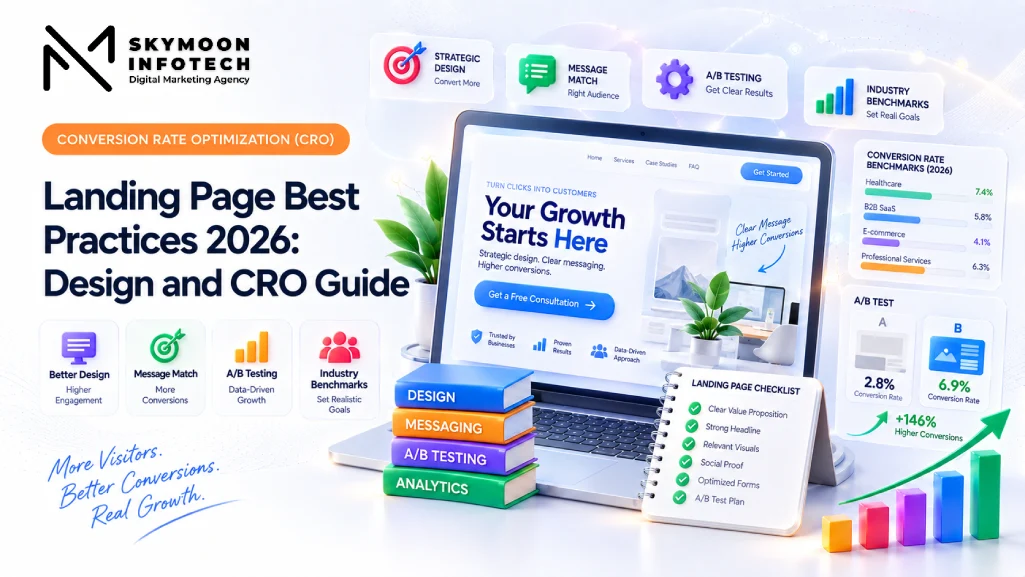
Landing pages are where conversion optimisation has the fastest and most measurable impact. Every element on a landing page, including the headline, hero image, body copy, call to action, and form, should serve one purpose: moving the visitor to the next step. Align your landing page content with the intent behind the traffic source. A visitor arriving from a Google search for "CRO agency in India" is looking for proof of expertise and a clear next step, not a general overview of services.
According to industry data, long-form landing pages generate 220% more leads than short-form ones when the additional content provides relevant context and builds trust. However, the rule is not length but relevance. Every section must earn its place by addressing a specific question, concern, or objection the visitor is likely to have.
A/B Testing
A/B testing is the practice of showing two versions of a page, headline, button, or form to different segments of your traffic and measuring which version produces more conversions. It is the most reliable method for making evidence-based decisions about what to change on your website, because it replaces opinion with data.
Effective A/B testing requires a clear hypothesis, sufficient traffic volume to reach statistical significance before drawing conclusions, and a defined primary metric. Run one meaningful test at a time on each page. Testing button colour when your headline is unclear will produce misleading results because you are measuring a minor variable while a major one remains broken.
Heatmap and Session Analysis
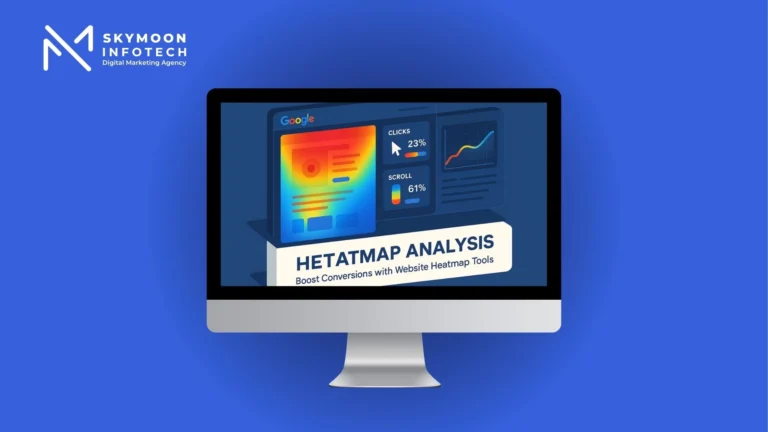
Heatmaps show where users click, scroll, and spend time on your pages, revealing exactly where attention drops off and where friction exists. Session recordings show individual user journeys through your site, making it possible to watch how real visitors navigate and where they leave. Our heatmap analysis guide covers the specific patterns to look for and how to act on what you find.
The most common findings from heatmap analysis include users ignoring calls to action that are placed too low on the page, key information being missed because it appears below the fold, and forms being abandoned at specific fields that are either confusing or asking for information users do not want to share.
Value Proposition Clarity
Every page on your site must answer one question immediately: why should this visitor choose you? A strong value proposition is specific, speaks directly to a real problem, and differentiates you from alternatives. Visitors who arrive on your page from a search result or ad have a specific question in mind. If your page does not answer that question within the first few seconds, most will leave without converting regardless of how well-designed the rest of the page is.
Trust Signals
Trust signals are elements that reduce the perceived risk of converting. These include client testimonials with named individuals and specific outcomes, case studies with measurable results, security badges on forms and checkout pages, clear privacy policies, visible contact information, and third-party reviews. For B2B service businesses in India, displaying logos of recognisable clients and specific results achieved for those clients consistently increases enquiry rates.
6 CRO Tips That Improve Conversion Rates Immediately
These are the optimisations that produce the fastest measurable improvements, based on consistent findings across CRO audits and testing programmes.
1. Reduce Form Fields to the Minimum Required
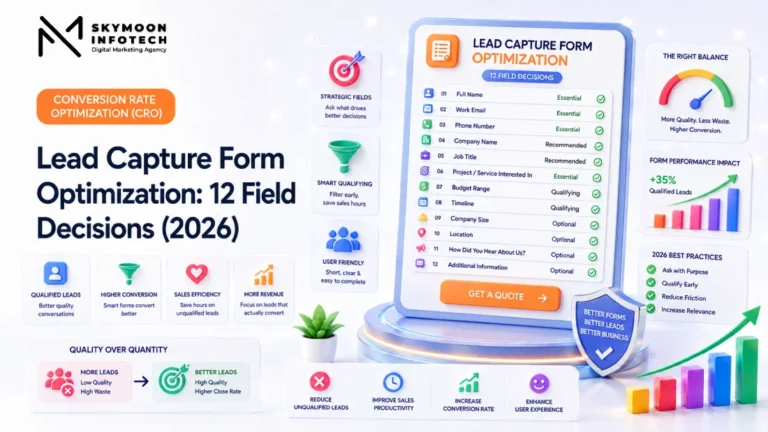
Every additional form field reduces the probability that a user will complete it. Research shows that forms with five or fewer fields consistently outperform longer forms in completion rate. Remove any field that your sales or operations team does not use in their initial response. Phone number as a required field, when not immediately necessary, is one of the most common causes of form abandonment. Make it optional or remove it entirely from top-of-funnel forms.
2. Match Your Headline to the Search Query or Ad
If a visitor arrives from a Google search for "conversion rate optimisation agency in India" and your landing page headline reads "We Help Businesses Grow Online", there is a relevance gap that will cost you conversions. Your headline should directly reflect the language and intent of the source that sent the visitor to your page. This single change, sometimes called message match, consistently produces conversion rate lifts of 20% to 50% without changing any other element of the page.
3. Place Your Call to Action Above the Fold
The fold is the bottom of the visible screen before a user scrolls. A significant portion of visitors never scroll at all, meaning any call to action placed below the fold is invisible to them. Your primary CTA button or form should be visible without scrolling on desktop, tablet, and mobile. Heatmap data consistently shows that the majority of clicks on most pages occur in the first visible screen, confirming that placement directly above the fold is one of the highest-impact CRO changes available.
4. Improve Page Load Speed
A one-second improvement in page load time can boost conversions by 7%, and keeping load times under two seconds can increase conversions by as much as 15%, according to industry benchmarks. Page speed also directly affects your Google rankings through Core Web Vitals, meaning slow pages lose traffic and conversions simultaneously. Compress images, eliminate render-blocking scripts, use a CDN, and review your hosting environment as a starting point for speed improvements.
5. Use Specific Social Proof, Not Generic Claims
"Trusted by 500+ businesses" is weaker than "Helped Ahmedabad-based logistics company reduce cost per lead by 43% in 90 days." Specific, verifiable proof converts better than broad claims because it is credible and gives the visitor a concrete picture of what working with you produces. Replace generic testimonials with named individuals, their company, their role, and a specific outcome wherever possible.
6. Optimise for Mobile Without Treating It as an Afterthought
Mobile devices account for over 62% of global web traffic. On mobile, cart abandonment rates are approximately 85.65% compared to lower rates on desktop, largely because mobile experiences on most business websites are slower, harder to navigate, and more prone to form errors. A mobile-first optimisation approach, where the mobile experience is designed first and the desktop version adapted from it, consistently produces better conversion rates across both platforms. Our full guide to landing page design best practices covers the specific elements that matter most for mobile conversion.
How Skymoon Infotech Approaches CRO
At Skymoon Infotech, our conversion rate optimisation services are built around identifying the specific points in your funnel where visitors drop off and removing those barriers through structured testing rather than assumptions. We begin every CRO engagement with a full audit combining analytics data, heatmap analysis, and session recordings to understand what is actually happening on your site before proposing a single change.
Our team has delivered CRO programmes for businesses across India in sectors including professional services, ecommerce, SaaS, and education, consistently reducing cost per acquisition while increasing the quality and volume of leads. We do not run isolated A/B tests and call it CRO. We build an ongoing optimisation programme that compounds improvements quarter over quarter.