e-commerce
Category Page Optimization for eCom – A Practical Blueprint
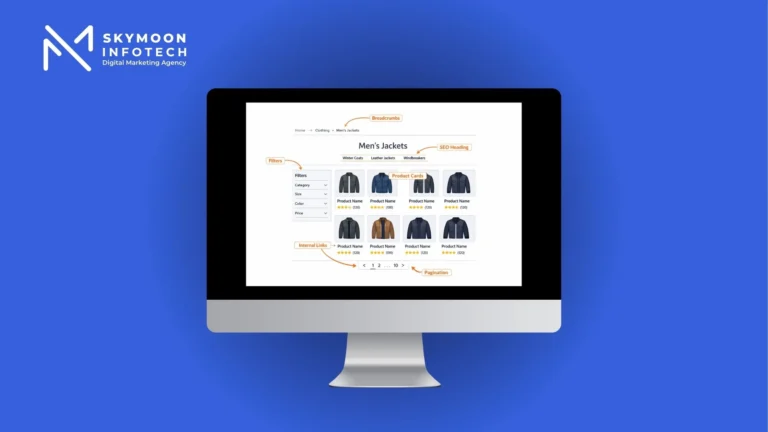
Category page optimization is one of the most overlooked growth levers in e-commerce SEO, despite category pages often a…
Read Article
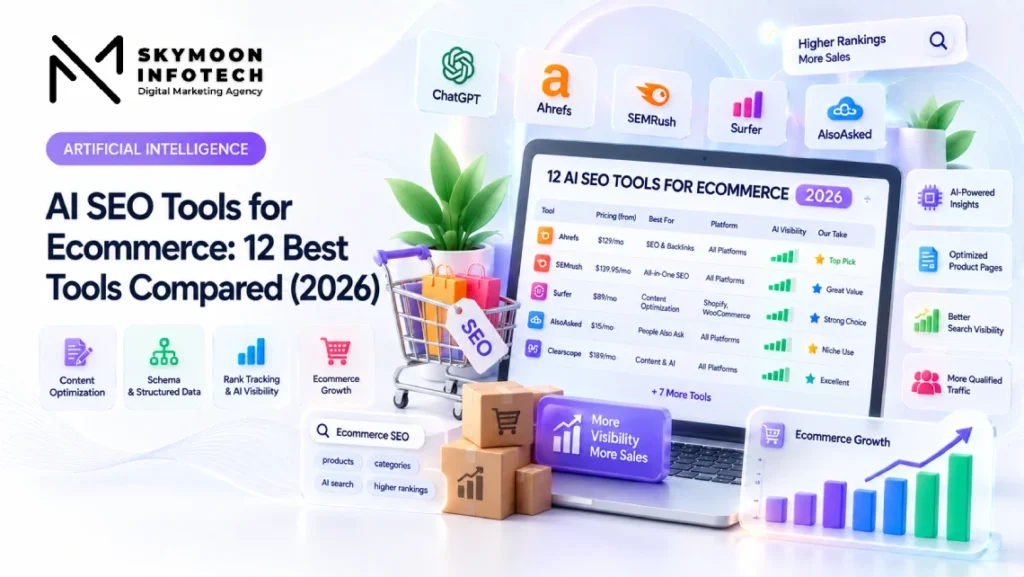
AI SEO tools cover a broad category. This post narrows to one specific problem: ecommerce catalogues with hundreds or thousands of product pages, where generic …
Read Article
Category page optimization is one of the most overlooked growth levers in e-commerce SEO, despite category pages often a…
Read Article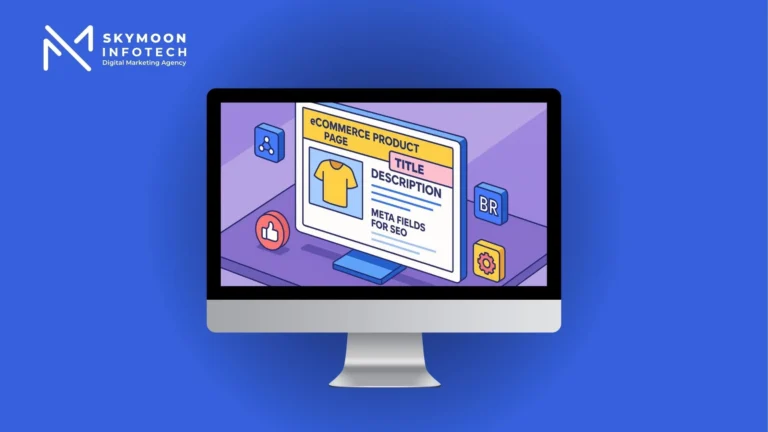
SEO product descriptions are the engine of high‑intent traffic and on‑page conversions. If you’ve wondered how…
Read Article
Why eCommerce SEO Is Critical for Long-Term Growth If you run an online store, ranking high in search results can direct…
Read ArticleWith 2.77 billion people shopping online and 28 million ecommerce websites competing for their attention, the difference between a store that grows and one that stagnates comes down to strategy. Whether you are launching an online store, scaling an existing one, or trying to reduce your dependence on paid advertising, the ecommerce marketing and development strategies in this guide are built on what is actually working in 2026.
Ecommerce marketing is the combination of strategies and channels used to drive qualified traffic to an online store, convert that traffic into customers, and retain those customers for repeat purchases. Unlike general digital marketing, ecommerce marketing is always measured against revenue outcomes cost per acquisition, average order value, conversion rate, and customer lifetime value.
The most effective ecommerce marketing programmes in 2026 combine organic channels including SEO and content with paid channels including Google Shopping and Meta Ads, supported by email for retention and conversion rate optimisation to maximise the value of every visitor. Each channel serves a different stage of the buyer journey, and the brands growing fastest are those that have all stages covered rather than relying on a single acquisition channel.
India's ecommerce market is growing at a faster rate than the global average, driven by rising smartphone penetration, UPI adoption, and expanding logistics infrastructure into tier 2 and tier 3 cities. However, Indian ecommerce audiences have distinct behaviour patterns: higher price sensitivity, stronger preference for vernacular content in some categories, and a dominant mobile-first browsing journey that often starts on Google and ends on a marketplace like Amazon or Flipkart. Understanding this context is essential before building an ecommerce marketing strategy for the Indian market.
Organic search is the most cost-efficient acquisition channel for ecommerce stores over the long term. A product or category page that ranks on page one continues receiving traffic without ongoing spend per click. Our ecommerce SEO services focus on the specific technical and content elements that move product and category pages up the SERP.
Product pages are where purchase decisions are made, yet most ecommerce sites treat them as afterthoughts with thin manufacturer descriptions and minimal unique content. A well-optimised product page has a keyword-rich unique title tag, a compelling meta description that addresses the purchase intent behind the search, a unique product description that goes beyond specifications to address how the product solves a real problem, and structured data including Product schema with price, availability, and review markup.
Product descriptions written for SEO and conversion simultaneously consistently outperform those written for one purpose alone. The key is addressing the top three questions a buyer has at the point of purchase decision: what exactly is this, why should I buy this specific version, and why should I trust this store to deliver it correctly.
Category pages are the highest-traffic pages on most ecommerce stores, yet they receive the least SEO attention. A well-structured category page targets the broad, high-volume search terms that product pages cannot rank for individually. It needs a clear H1 matching category-level search intent, 150 to 300 words of introductory content that helps both users and Google understand what the category contains, subcategory filters that do not create duplicate content issues, and internal links to top-performing product pages within the category.
Common mistakes include allowing faceted navigation to generate thousands of indexable URL variants with duplicate content, blocking crawl budget on filter combinations that have no search demand, and neglecting to add editorial content to category pages entirely. According to verified industry benchmarks, optimised category pages drive an average of 32% more organic traffic than unoptimised equivalents at equivalent domain authority.
Ecommerce sites have unique technical SEO challenges that standard websites do not face. These include managing pagination across large product catalogues, handling out-of-stock product pages without destroying rankings, preventing URL parameter combinations from creating crawl budget waste, and ensuring fast page load times across thousands of product image-heavy pages. Core Web Vitals thresholds are particularly important for ecommerce because slow pages directly reduce conversion rates as well as rankings.
A complete ecommerce marketing strategy covers multiple channels, each performing a different role in the customer acquisition and retention cycle.
Google Shopping ads remain the dominant paid channel for product-level ecommerce advertising. In 2026, Performance Max campaigns combine Shopping, Search, Display, and YouTube into a single AI-optimised campaign type. The quality of your product feed including accurate titles, descriptions, GTINs, and images directly determines how well Performance Max can optimise your spend. Stores with well-structured, attribute-rich product feeds consistently achieve 20 to 40% lower cost per sale compared to those with incomplete feeds.
Email remains the highest-ROI channel for ecommerce retention. Automated sequences covering abandoned cart recovery, post-purchase follow-up, win-back campaigns, and replenishment reminders generate revenue without ongoing creative investment once they are set up correctly. Abandoned cart sequences alone recover between 5 and 15% of otherwise-lost revenue for most stores, making them the single highest-priority automation for any ecommerce business that does not already have them running.
From 2024 to 2025, global revenue from social media ecommerce increased 19.9% to $819.8 billion. Meta's Advantage+ Shopping campaigns and Instagram Shopping allow direct product discovery and purchase within the platform. TikTok Shop is growing rapidly in markets where it is available. For Indian ecommerce businesses, social commerce through Instagram and WhatsApp Business is an increasingly important conversion channel, particularly for fashion, beauty, and lifestyle categories where visual discovery drives purchase intent.
The most common product title mistake is writing for internal categorisation rather than how customers actually search. A title like "Blue Slim Fit Men's Cotton Formal Shirt - M" tells Google very little. A title like "Men's Slim Fit Formal Cotton Shirt Blue Medium" matches how buyers search at the product-level intent stage. Keyword-rich titles with the primary search term within the first 60 characters consistently achieve higher click-through rates in both organic and Shopping results.
Buying guides, product comparisons, size guides, care guides, and "best of" lists drive top-of-funnel traffic that converts to product page visits with buying intent already established. A furniture store that ranks for "how to choose a sofa for a small living room" captures a buyer in research mode and naturally guides them toward relevant product pages. This content strategy builds domain authority, captures long-tail search traffic, and reduces dependence on paid acquisition for every new customer.
Smartphones account for nearly 80% of all ecommerce website visits worldwide. Mobile cart abandonment rates are approximately 85.65% compared to lower rates on desktop. For most Indian ecommerce stores, mobile traffic makes up an even higher proportion given smartphone-first browsing behaviour. A mobile experience that loads in under two seconds, has touch-friendly product image galleries, and simplifies checkout to as few steps as possible is the highest-ROI investment for most ecommerce businesses before any additional traffic spend.
Product schema markup enables Google to display price, availability, review ratings, and shipping information directly in the search result, before a user even clicks. These rich results consistently achieve higher click-through rates than standard blue links, particularly for product-level queries where the user is comparing options before clicking. Adding Product, Review, and BreadcrumbList schema to all product and category pages is a one-time technical investment that compounds in value as your pages gain rankings.
Internal linking in ecommerce is often neglected beyond basic navigation. Strategic internal links from category editorial content to top-performing product pages, from blog content to relevant product and category pages, and between related product pages all pass link equity to your highest-conversion pages. A store that consistently links its informational content to relevant product pages sees measurable lift in organic traffic to those pages without any external link building required.
A visitor arriving from a Google Shopping ad for a specific product has very different intent from someone arriving from a blog post about gift ideas. Sending all traffic to the homepage or a generic category page wastes the intent signal the visitor arrived with. Build dedicated landing pages for high-spend ad campaigns, seasonal promotions, and specific product ranges. This alignment between traffic source and landing page is one of the fastest ways to improve conversion rate without changing your product or pricing. Our ecommerce website development services include landing page design and optimisation as part of every ecommerce engagement.
At Skymoon Infotech, our ecommerce development and SEO services are designed around one outcome: building online stores that attract qualified traffic and convert it into revenue. We work across WooCommerce and custom ecommerce builds, delivering technical SEO foundations, product and category page optimisation, structured data implementation, and performance-driven paid campaigns that scale with your catalogue.
Our ecommerce clients in India have seen consistent improvements in organic product and category page rankings, reductions in cost per acquisition through better feed management and landing page alignment, and measurable revenue growth from SEO within six to twelve months of engagement. We do not treat ecommerce SEO as a standalone service we integrate it with development, CRO, and paid strategy so every element of your store works toward the same commercial outcome.
Ecommerce marketing is the combination of strategies used to drive traffic to an online store, convert visitors into customers, and retain them for repeat purchases. It matters because with 28 million ecommerce websites competing globally in 2026, organic discoverability and conversion efficiency determine which stores grow and which stagnate. E-commerce marketing encompasses SEO, paid advertising, email, social commerce, and content, each channel serving a distinct stage of the buyer's journey.
E-commerce SEO optimises product pages, category pages, and site architecture specifically to rank for purchase-intent search queries. It differs from regular SEO in the volume of pages that need optimisation, the specific technical challenges of large catalogues including faceted navigation, pagination, and out-of-stock handling, and the focus on commercial rather than purely informational keywords. E-commerce SEO also requires Product schema markup and feed optimisation that standard website SEO does not.
SEO-friendly product descriptions include the primary keyword naturally in the first sentence, address the top three questions a buyer has at the point of purchase, use unique content that differs from manufacturer descriptions, and incorporate secondary keywords in subheadings and bullet points. Descriptions of 150 to 300 words consistently outperform shorter descriptions in organic rankings for product-level queries. Adding structured Product schema data alongside the description enables rich results with price and availability in the SERP.
Category page SEO optimises the collection pages that group products together, such as "Men's Running Shoes" or "Kitchen Appliances". These pages target high-volume, broad search terms that individual product pages cannot rank for alone. A well-optimised category page has a keyword-rich H1, 150 to 300 words of editorial content, clean URL structure, internal links to top products, and breadcrumb navigation with schema. Category pages are typically the highest-traffic organic entry points on ecommerce stores.
Ecommerce website development in India varies widely based on platform, complexity, and features required. A standard WooCommerce store ranges from Rs. 50,000 to Rs. 2,00,000, depending on the number of products and customisation required. A fully custom-built ecommerce platform with advanced features, payment gateway integrations, and inventory management can range from Rs. 2,00,000 to Rs. 10,00,000 or more. Platform selection, hosting infrastructure, and ongoing maintenance costs should all be factored into the total investment.
Ecommerce SEO typically produces measurable improvements in organic traffic within three to six months for category-level keywords with moderate competition. High-competition product categories in established markets may take nine to twelve months for first-page rankings. Technical SEO fixes can produce ranking improvements within weeks once Google recrawls the affected pages. Content-led SEO, achieved through buying guides and comparison articles, typically ranks within two to four months for long-tail queries.
WooCommerce is the right choice for most small to medium-sized ecommerce businesses in India. It offers flexible product management, a large plugin ecosystem, and lower development costs. Custom builds make sense for stores with complex catalogue requirements, unique checkout flows, or B2B ordering systems that WooCommerce plugins cannot handle efficiently. For most businesses starting or scaling to mid-size, a well-built WooCommerce store with proper SEO configuration and performance optimisation outperforms a poorly executed custom build at a fraction of the cost. Our e-commerce development team can advise on the right platform for your specific catalogue, budget, and growth plan.