This guide covers everything from the basics of how paid advertising works to advanced tactics that top PPC companies in India use to deliver measurable results for their clients.
What Is Paid Advertisement in Digital Marketing?
Paid advertisement is a digital marketing model where businesses pay to place their message in front of targeted audiences across search engines, social platforms, and display networks. Unlike organic marketing, which builds visibility over months, paid advertising delivers immediate placement at the top of search results or social feeds.
The most widely used format is pay-per-click (PPC), where you pay only when someone clicks your ad. According to verified industry data, businesses earn an average of $2 for every $1 spent on Google Ads, giving PPC a 200% average ROI and making it one of the fastest channels to drive measurable results from a marketing budget.
How Paid Advertising Works
Paid ads operate on an auction model. When a user searches for a keyword, the advertising platform runs an instant auction among all advertisers bidding on that term. The winner is determined not just by bid amount but also by ad relevance, landing page quality, and expected click-through rate. This combination is called Quality Score on Google Ads.
A higher Quality Score means you can win ad placements at a lower cost than competitors bidding more money with lower-quality ads. This is why ad copy, keyword targeting, and landing page alignment matter as much as the budget you allocate.
The Core Channels of Paid Advertising
Paid advertising spans a growing ecosystem of platforms. Each channel serves a different stage of the buyer journey and requires a different creative approach.
Search Ads
Search ads appear at the top and bottom of Google or Bing results when someone searches for a relevant keyword. These capture high-intent audiences at the exact moment of decision. They are the strongest channel for driving direct conversions because the user is already looking for a solution.
Microsoft Ads consistently deliver 33% lower cost per click than Google while achieving comparable conversion rates, making them a highly underused opportunity for businesses that want to stretch their budget further.
Display Ads
Display ads are visual banner ads that appear across millions of websites within the Google Display Network and other ad networks. While click-through rates are lower than search, consumers exposed to display ads are 155% more likely to search for brand-related terms afterwards. This makes display a powerful tool for building brand recognition and supporting retargeting campaigns.
Google Demand Gen Ads
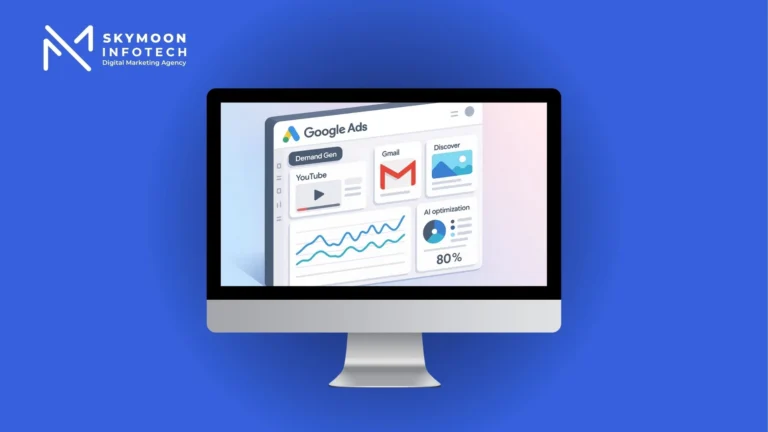
Demand Gen is one of the fastest-growing ad formats in 2026. It combines YouTube, Gmail, and Google Discover into a single campaign type, reaching audiences across multiple touchpoints before they ever search for your product. It sits between awareness and intent in the funnel and works particularly well for businesses with longer sales cycles.
Social Ads
Meta Ads on Facebook and Instagram and LinkedIn Ads allow targeting by demographics, interests, behaviour, and job title. Social advertising is ideal for building awareness among cold audiences and retargeting warm ones. For B2B businesses, LinkedIn Ads are especially effective for reaching decision-makers. You can learn more about how social ads fit into a full paid strategy through Skymoon's PPC services page.
What Paid Advertising Looks Like in 2026
The paid advertising landscape has shifted significantly in the past two years. Platforms now lean heavily into automation, creative diversity, and privacy-safe targeting. Google emphasises Performance Max campaigns and first-party audience signals, while Meta prioritises video-first placements and Advantage+ audiences that optimise automatically.
Campaigns that worked two years ago may now be wasting budget. The businesses winning in paid advertising today are not necessarily spending more. They are feeding AI bidding systems better quality data, building smarter audience segments, and aligning ad creative tightly with landing page messaging.
AI and Automation in Paid Advertising
In 2026, Google and other platforms interpret search intent the way humans do, understanding the meaning behind a query rather than simply matching keyword phrases exactly. This makes audience signals and intent-aligned copy more important than ever before.
Smart Bidding strategies like Target CPA and Maximize Conversions use machine learning to adjust bids in real time for every auction. These systems perform best when fed high-quality conversion signals, which means proper conversion tracking setup is no longer optional for any advertiser serious about performance.
First-Party Data and Privacy
With third-party cookie deprecation continuing across browsers, first-party data has become the most valuable targeting asset a business can own. Building Customer Match lists from your CRM, using Enhanced Conversions in Google Ads, and connecting offline conversion data are now essential practices for maintaining targeting precision without relying on third-party tracking.
7 Paid Advertisement Tips to Maximise Your ROI
These are the practices that separate profitable campaigns from wasted ad spend, based on what consistently delivers results across Google Ads, Meta Ads, and Demand Gen campaigns.
1. Define Your Conversion Goal Before You Spend
Every campaign needs a single, clearly defined conversion goal before the first rupee is spent. Whether that goal is a form submission, a phone call, a purchase, or a booking, your entire campaign structure, bidding strategy, and creative direction should be built around that one action.
Advertisers who run campaigns without a conversion goal end up optimising for clicks, not outcomes. Clicks without conversions are just an expense.
2. Match Your Ad Copy to the Landing Page
The message in your ad and the message on your landing page must be identical. If your ad promises a free audit and the landing page talks about general services, users will bounce immediately. This misalignment also reduces your Quality Score, which increases what you pay per click.
Build dedicated landing pages for each campaign rather than sending all traffic to your homepage. A single, focused page with one clear call to action consistently outperforms a general services page in paid campaigns.
3. Use Negative Keywords Aggressively
Negative keywords prevent your ads from showing for irrelevant searches. Without a strong negative keyword list, broad and phrase match campaigns will consistently spend budget on queries that will never convert.
Review your search terms report weekly, especially in the first 30 days of a new campaign. Add irrelevant terms as negatives immediately. This single practice can reduce wasted spend by 20 to 30% in most accounts.
4. Run Demand Gen Campaigns Alongside Search
Google Demand Gen campaigns reach users across YouTube, Gmail, and Google Discover before they are actively searching. Running Demand Gen alongside your search campaigns creates a full-funnel presence that builds awareness at the top and captures intent at the bottom. This is particularly effective for businesses with longer consideration periods. Learn more about Google Demand Gen ads and how to structure campaigns across both formats.
5. Test Creative Systematically
Creative testing is not optional in 2026. Run at minimum two to three ad variations per ad group at all times, varying the headline, description, and call to action. Let each variation collect enough impressions before making judgements, typically at least 500 impressions or more for statistically meaningful results.
Video creative on Demand Gen and Meta consistently outperforms static images for engagement. Even simple product or service demonstration videos of 15 to 30 seconds can dramatically improve cost per click and conversion rate.
6. Feed Your Bidding System Quality Conversion Data
Smart Bidding strategies depend entirely on the quality of conversion signals you provide. If you are only tracking form submissions but not phone calls or sales, the algorithm optimises for form submissions even when those leads never convert to customers.
Connect your ad platform to your CRM where possible, and import offline conversions so the algorithm knows which clicks actually became revenue. This data quality step is what separates accounts that plateau at average results from those that continue to improve over time.
7. Segment by Device and Audience
Mobile devices account for 63% of total Google ad clicks, but conversion rates on mobile are typically lower than desktop for most B2B and service businesses. Use device bid adjustments to reflect the actual conversion value of different device types in your specific account.
Build separate audience segments for cold traffic, warm visitors who have been to your site, and existing customers. Each segment deserves different messaging, different bids, and sometimes a completely different campaign structure.
How Skymoon Infotech Approaches Paid Advertising
At Skymoon Infotech, our PPC and paid advertising services are built around one objective: measurable return on your ad spend. We do not set up campaigns and leave them running. Every account we manage is reviewed weekly, with search terms audited, bids adjusted, and creative rotated based on what the data shows.
Our team works across Google Ads, Meta Ads, and Google Demand Gen campaigns, giving businesses in India the ability to reach their audience across every major paid channel from one integrated strategy. Whether you are running your first campaign or trying to fix a budget that is not delivering results, our approach starts with understanding your cost per acquisition target and working backwards from there.
We have managed paid campaigns across industries including ecommerce, professional services, real estate, and SaaS, consistently reducing cost per acquisition while increasing lead quality for our clients across India.

![Smart Goals Google Ads – Complete Setup and Strategy Guide [2026]](https://skymooninfotech.com/wp-content/uploads/2026/04/smart-goals-google-ads-opt-768x432.webp)