SEO
AI SEO Tools 2026: Pricing, Picks and AI Visibility Trackers
Most AI SEO tool comparison lists have a structural problem: they cover content optimization and AI visibility tracking …
Read Article
AI SEO tools cover a broad category. This post narrows to one specific problem: ecommerce catalogues with hundreds or thousands of product pages, where generic …
Read Article
Most AI SEO tool comparison lists have a structural problem: they cover content optimization and AI visibility tracking …
Read Article
How does chatgpt choose sources? Most guides on how to get cited by chatgpt treat ChatGPT as a generic AI search system …
Read Article
AI SEO trends 2026 are not a list of tactics to bolt onto an existing strategy. They represent a structural shift in how…
Read Article
GEO vs AEO vs AIO are three terms describing how content must be structured to appear in AI-generated search results. If…
Read Article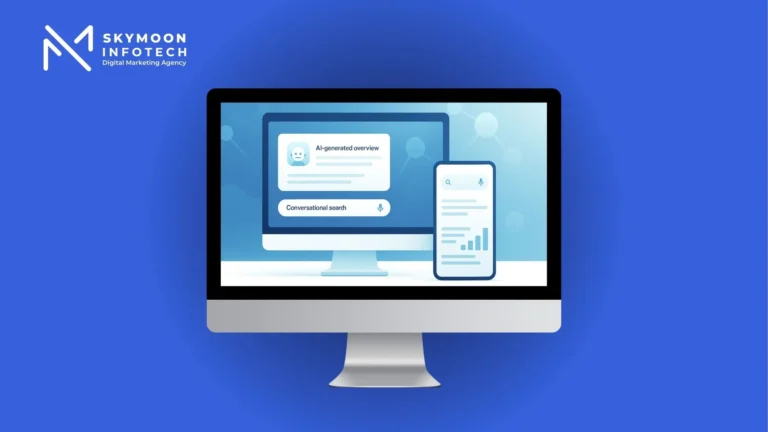
AI-powered search results SEO is transforming how websites gain visibility in 2025. With search engines rapidly shifting…
Read Article
AI web development is redefining how websites are designed, built, optimised, and maintained in 2025. With faster AI web…
Read ArticleAI-driven campaigns deliver an average 22% higher ROI with 32% more conversions and 29% lower acquisition costs than traditional methods. For businesses in India looking to grow online, understanding how AI applies to digital marketing is no longer optional. It is the foundation on which competitive campaigns are now built.
Artificial intelligence in digital marketing refers to the use of machine learning algorithms, predictive analytics, and automation to improve how businesses attract, engage, and convert customers online. Rather than replacing human marketers, AI handles the data-intensive, repetitive, and pattern-recognition tasks that would otherwise take teams hours or weeks to complete manually.
The practical definition is straightforward: AI marketing is smart software that learns from data and uses those learnings to make better decisions about content, targeting, bidding, personalisation, and campaign optimisation. It gets smarter over time by processing more data, making it one of the few marketing investments that compound in value rather than depreciate.
The global AI marketing market reached approximately $57.99 billion in 2026, growing at a compound annual growth rate of 37.2%, more than 2.5 times faster than the broader marketing technology industry. This growth reflects genuine business returns, not hype.
Traditional marketing technology follows rules you set. If a user visits a specific page, send them a follow-up email. If a campaign hits a certain CPC, pause it. AI marketing technology identifies the rules itself, based on patterns in data you would never discover by looking at reports manually. It moves from rule-based automation to intelligence-based optimisation, adapting in real time as user behaviour changes rather than waiting for a human to update the playbook.
AI is not a single tool you add to your stack. It is reshaping how every major marketing channel operates. Here is how it applies to the channels that matter most for businesses in India.
AI is changing SEO on two fronts simultaneously. First, it is changing how search engines evaluate and rank content. Google's algorithms now use AI to understand search intent at a level of nuance that keyword matching never could. Second, it is changing how marketers produce and optimise content, with AI tools processing competitive data in seconds to identify gaps, structure recommendations, and flag technical issues. According to Semrush research, 65% of businesses saw an improvement in SEO performance after adopting AI marketing tools. Our AI-powered SEO services apply these techniques directly to client campaigns.
AI is also reshaping where content needs to rank. Google AI Overviews, Perplexity, and ChatGPT now answer queries directly, pulling from authoritative web pages. Research from Ahrefs found that a site ranking first in traditional search results is 25% more likely to be cited in AI Overviews. This means traditional SEO and AI visibility are no longer separate disciplines. Strong SEO is now the entry point for both.
AI has fundamentally changed how paid campaigns are managed. Google's Performance Max campaigns, powered by AI, now drive 58% of paid search campaign optimisation. AI-driven PPC bid management reduces wasted ad spend by approximately 37% and increases ad ROI by roughly 50%, according to verified industry benchmarks. Smart Bidding strategies including Target CPA and Maximize Conversions use machine learning to adjust bids at every auction based on dozens of real-time signals, a task that no human team can replicate at scale. Our PPC management services use AI-powered bidding and audience strategies to improve performance for every client account we manage.
AI is also being applied to ad creative. Platforms now automatically test headline and image combinations, identify top performers, and allocate budget toward the variants converting best. Human marketers still write the strongest initial creative, but AI determines which creative reaches which audience and at what bid, compressing the testing cycle from months to days.
AI content tools are now used by 72% of global organisations for content creation. AI content drafting delivers 3.2 times ROI on average, according to the McKinsey Global AI Survey, with audience research coming in at 2.4 times and ad copy at 2.3 times. However, the organisations achieving these returns are not simply generating content with AI and publishing without review. They are using AI to accelerate research, identify content gaps, structure briefs, and draft first versions, while human editors refine for accuracy, voice, and depth.
Google's content quality guidelines reward content that demonstrates genuine expertise, first-hand experience, and authoritative sourcing. AI-generated content that lacks these qualities is increasingly filtered from top positions. The winning approach in 2026 uses AI for efficiency and humans for expertise, not one or the other.
AI-powered personalisation uses real-time behavioural signals including scroll depth, time on page, traffic source, and click patterns to dynamically adjust what a visitor sees. High-intent visitors can be shown a direct demo request form while a first-time visitor from a cold traffic source sees a lower-friction educational offer. This approach treats each visitor as an individual rather than a demographic segment. According to research, 71% of consumers expect personalised interactions from brands, and 80% show a higher likelihood to purchase when those expectations are met.
The most common mistake businesses make when adopting AI marketing is trying to implement everything at once. The businesses consistently achieving the strongest results in 2026 started with one or two high-impact applications, measured the results, then expanded systematically. Here is the sequence that works.
AI systems are only as accurate as the data they learn from. Before investing in any AI marketing tool, audit your tracking setup. Ensure Google Analytics 4 is configured correctly with conversion events mapped to real business outcomes, your ad platforms have Enhanced Conversions or server-side tracking enabled, and your CRM data is clean and consistent. Feeding an AI tool incomplete or inaccurate data produces confidently wrong recommendations, which is worse than no recommendation at all.
Paid advertising is where AI delivers the fastest and most measurable returns, because the feedback loop is tight and the data is immediate. Enable Smart Bidding in Google Ads if you have not already done so and ensure your conversion tracking is feeding the algorithm accurate signals. Move from manual CPC bidding to Target CPA or Maximize Conversions once you have at least 30 conversions per month in your account. This single change consistently reduces cost per acquisition while maintaining or improving volume.
AI tools are most effective as research and structuring assistants for content, not as replacements for subject matter expertise. Use AI to identify the questions your audience is asking, analyse what top-ranking content covers, find gaps your existing content misses, and structure initial outlines. Human writers and subject matter experts then produce content that adds genuine insight and experience that AI cannot replicate from training data alone.
As search behaviour shifts toward conversational AI tools like ChatGPT, Perplexity, and Google AI Overviews, businesses need to structure content so AI systems can extract and cite it accurately. This means using clear definitions at the start of major sections, implementing FAQ and Article schema markup, including original statistics with cited sources, and building topical authority across multiple related pages rather than isolated individual articles. This discipline, sometimes called Generative Engine Optimisation or GEO, is now a core part of a complete digital marketing strategy for any business that wants to maintain visibility as search continues to evolve.
At Skymoon Infotech, we integrate AI across every major channel we manage for clients in India. In paid advertising, we use AI bidding strategies, Performance Max campaigns, and Demand Gen formats to reduce wasted spend and improve conversion rates. In SEO, we use AI tools to identify content gaps, structure topical clusters, and optimise for both traditional rankings and AI search citation.
Our approach is not to hand campaigns to AI and step back. It is to use AI for the data-intensive tasks it does better than humans, and apply human expertise to strategy, creative direction, and quality control. This combination consistently outperforms either approach in isolation, which is why the strongest results in 2026 are coming from teams that have learned to work with AI rather than simply adopt tools and expect automatic gains.
Artificial intelligence in digital marketing is the use of machine learning, predictive analytics, and automation to improve how businesses attract, engage, and convert customers online. AI handles data-intensive tasks including keyword research, bid optimisation, content analysis, audience segmentation, and personalisation at a speed and scale that human teams cannot match manually. It learns from data over time and improves its recommendations as it processes more information from your campaigns and customers.
AI is changing SEO on two fronts. First, Google uses AI to understand search intent far beyond keyword matching, meaning content must address the complete context of a query rather than simply include target phrases. Second, AI search tools like ChatGPT, Perplexity, and Google AI Overviews now answer queries directly by pulling from authoritative ranked pages. Strong traditional SEO is now the prerequisite for both conventional rankings and AI citation, making the two disciplines inseparable.
AI improves PPC performance by adjusting bids at every auction based on dozens of real-time signals including device type, location, time of day, audience behaviour, and historical conversion patterns. AI bidding strategies like Target CPA and Maximize Conversions learn from your account data to identify which users are most likely to convert and bid higher for those opportunities while reducing bids for low-probability clicks. This consistently reduces wasted spend and lowers cost per acquisition compared to manual bidding approaches.
The most impactful AI tools for businesses in India depend on your primary marketing channel. For PPC, Google's Smart Bidding and Performance Max campaigns are the starting point, both built into Google Ads at no additional cost. For SEO, tools like Semrush and Ahrefs now include AI-powered content and keyword analysis features. For content creation, AI tools work best as research and structuring assistants rather than autonomous writers. For customer engagement, AI-powered chatbots and personalisation platforms can significantly improve response rates and conversion rates across your website.
AI will not replace skilled digital marketers, but it is reshaping which skills matter most. Routine tasks including manual bid adjustments, keyword list building, basic reporting, and first-draft content production are being automated. The demand for marketers who understand strategy, can interpret AI-generated insights, produce creative that resonates with human audiences, and make judgements that require genuine business context is growing. According to Gartner, 59% of marketers say AI is redefining their role rather than eliminating it.
Many of the most impactful AI marketing tools for small businesses are already included in platforms you likely use. Google Ads Smart Bidding costs nothing beyond your ad spend. Google Analytics 4 AI insights are free. Many email platforms include AI-powered send-time optimisation and subject line testing at standard subscription tiers. Dedicated AI marketing platforms range from Rs. 2,000 to Rs. 20,000 per month for small business tiers, with enterprise tools costing significantly more. The highest-return starting point is enabling AI features already available in your existing ad and analytics accounts.
Generative Engine Optimisation, or GEO, is the practice of structuring your content so that AI search tools including ChatGPT, Perplexity, and Google AI Overviews cite your pages in their generated answers. As more searches result in AI-generated summaries rather than traditional results pages, visibility in AI answers becomes as important as ranking in organic results. GEO requires clear content structure, FAQ and schema markup, original cited statistics, and topical authority built across multiple related pages. It is now a core component of any complete digital marketing strategy in 2026.