
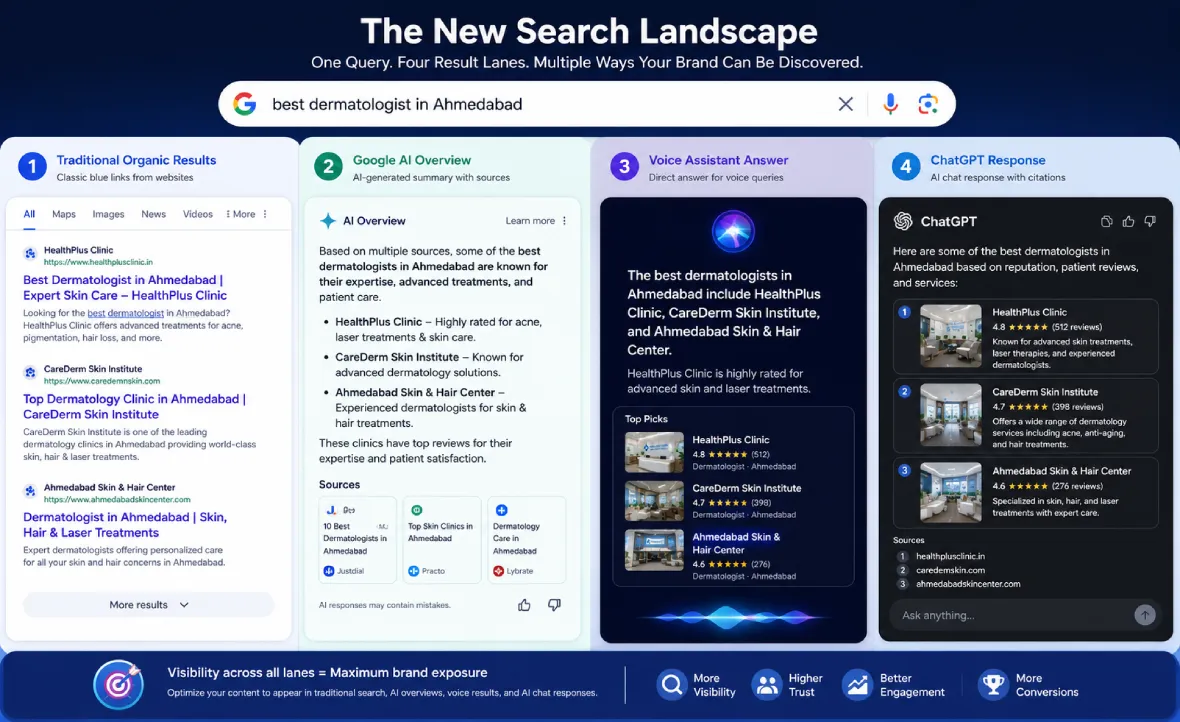
AI SEO trends 2026 are not a list of tactics to bolt onto an existing strategy. They represent a structural shift in how search works: the results page now contains AI-generated answers, direct citations, featured boxes, and organic links all competing for the same query. A site that only optimizes for the organic link position is competing in one lane of a four-lane road.
This guide covers the AI SEO trends that are producing measurable ranking and visibility changes in 2026: generative engine optimization, answer engine optimization, search everywhere optimization, and the direct-answer shift driven by AI Overviews. Each section focuses on what you actually do differently, not on why the landscape is changing.
Get found by ChatGPT, Gemini, and Google AI Overviews
Eighteen steps to prepare your business for how people are searching now. Our internal AI search readiness guide, free.
Quick navigation: Is SEO dead? Jump to the direct answer below. | Already know the trends? Jump to “How to optimize content for AI Overviews.” | For the full technical comparison of GEO vs AEO vs AIO as distinct disciplines, the GEO vs AEO vs AIO guide covers the definitions in depth.
Is SEO Dead in 2026? The Direct Answer
Is seo dead 2026 is one of the most-searched questions in the AI era of search, and the answer the data supports is: no. SEO is not dead in 2026. Google search volume is still growing year over year, and the majority of clicks on any given results page still go to organic listings. What has changed is that organic position alone no longer determines click volume, because an AI Overview may answer the query before anyone reads the blue links.
The more accurate framing: SEO is the foundation that everything else requires. Generative engine optimization, answer engine optimization, and AI Overview visibility all depend on Google first being able to crawl and index your page. An AI Overview does not cite a page that Google cannot find. The sites winning in 2026 are not the ones that abandoned SEO for AI optimization. They are the ones that strengthened their SEO and layered structured content, named authorship, and schema on top of it.
The stat that matters here: AI Overviews cut clicks on the top organic result by approximately 34.5% for queries where they appear. But organic listings still capture the majority of total clicks across all queries including the large share where AI Overviews do not appear. The response is not to abandon organic optimization. It is to also optimize for AI Overview citation.
The question “will ai replace seo” has a cleaner answer in 2026 than it did in 2024: AI search and SEO are reinforcing, not competing. Every AI search platform including ChatGPT, Perplexity, and Google AI Overviews cites from indexed, ranked web pages. Building stronger SEO improves AI citation probability rather than working against it.
The Numbers Behind AI SEO Trends 2026
Before covering the specific trends, the current numbers establish why these shifts require an updated strategy rather than minor tweaks:
| Metric | Figure | Source / Context | SEO Implication |
|---|---|---|---|
| AI Overviews reach | 2 billion+ monthly users | Google 2026 announcement | AI Overview citation is now mainstream-scale, not a niche SERP feature |
| Zero-click searches (US) | Approximately 6 in 10 searches | Industry tracking, 2026 | Click is no longer the default outcome of a successful ranking |
| CTR drop on top organic result (AI Overview queries) | Approximately 34.5% fewer clicks | Evergreen Media / Seoprofy analysis | Position 1 in organic does not mean position 1 in click volume on AI-Overview-triggered queries |
| LLM referral traffic growth | Up approximately 527% YoY | Industry aggregated tracking 2026 | Traffic from ChatGPT, Perplexity, and Gemini is the fastest-growing referral category for many content sites |
| Queries with AI Overviews | Approaching 30-40% of all informational queries globally | Multiple 2026 SEO research sources | The majority of informational queries now show an AI layer above organic results |
Generative Engine Optimization – What It Is and What You Actually Do
Generative engine optimization is the discipline of structuring content so AI systems like ChatGPT, Google AI Overviews, Perplexity, and Gemini cite or summarize it when generating answers, rather than only ranking it as a link. Where traditional SEO targets a position in the results list, generative engine optimization targets a citation inside the generated answer itself.
Cannibalization note: The full technical comparison of generative engine optimization vs AEO vs AIO as distinct frameworks is covered in the GEO vs AEO vs AIO guide. This section covers the specific 2026 tactics.
What Generative Engine Optimization Requires in Practice
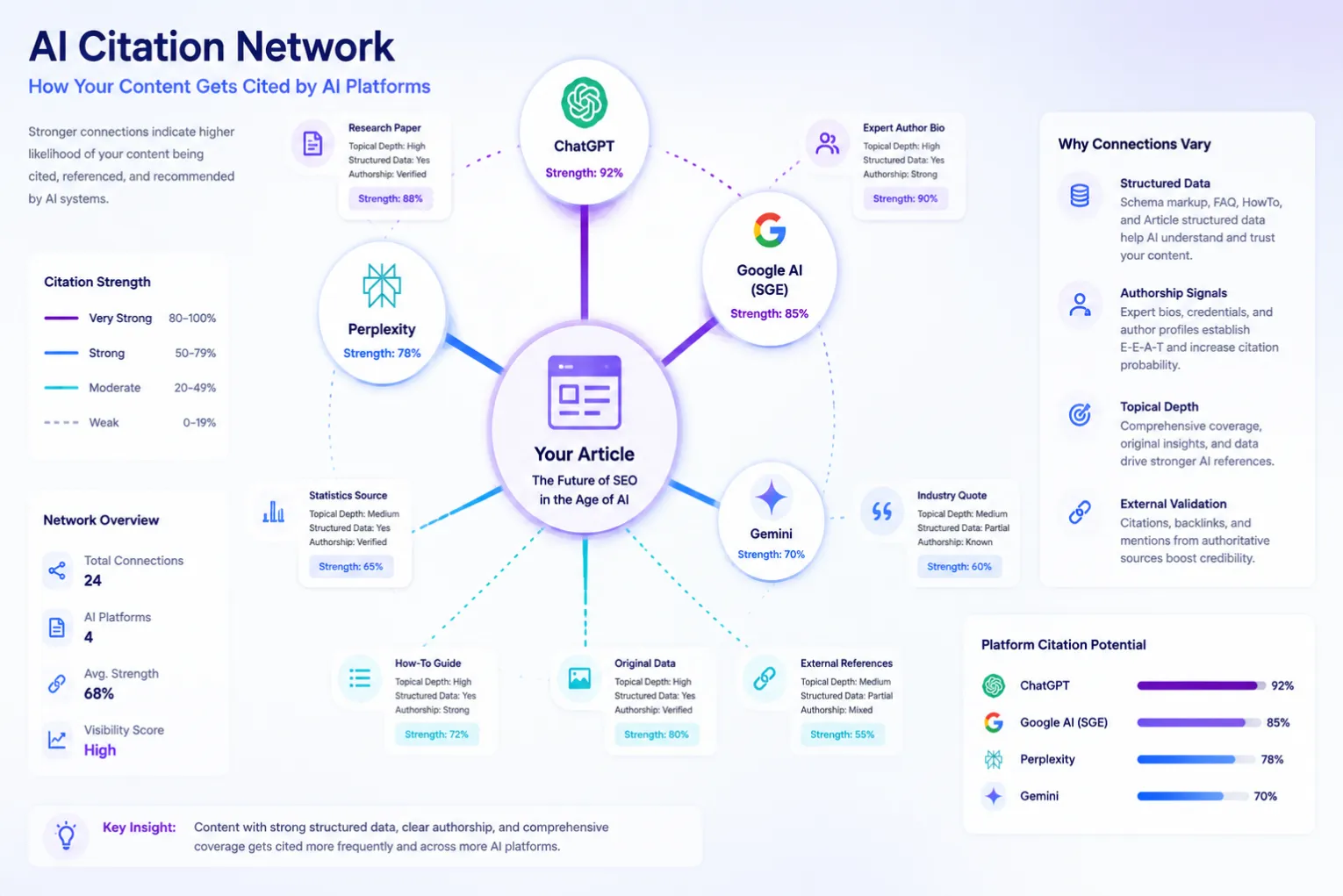
Generative engine optimization in 2026 operates on five signals that AI systems consistently favor when selecting content to cite:
- Named authorship with verifiable credentials. AI systems trained on E-E-A-T principles prefer content attributed to a named person whose expertise can be cross-referenced. A blog post bylined “Skymoon Infotech Team” converts less well as a citation candidate than the same post bylined with a named strategist whose work appears elsewhere.
- First-hand experience signals. Content that describes something the author has actually measured, tested, or implemented attracts AI citation at higher rates than generically assembled information. Specific numbers from your own client work, named case studies, and verifiable outcomes are the content format AI systems extract.
- Structured data and schema markup. AI systems parse structured data more efficiently than unstructured prose. FAQPage, Article, HowTo, and Organization schema all increase the probability that an AI system correctly identifies and cites the relevant section of a page. A page without schema is not excluded from citation, but schema reduces ambiguity.
- Google’s structured data documentation covers the schema types most relevant for AI visibility.
- Topical depth through internal linking. An AI system building an answer from web sources prefers sites where clicking through the internal link graph demonstrates genuine subject-matter depth. A site with one strong article about SEO is a weaker citation candidate than a site where that article internally links to fifteen related, substantive pieces across the same topic cluster.
- Mentions on external authoritative pages. Reddit discussions, Quora answers, industry publications, and forum threads are explicitly indexed and factored into AI training and retrieval. A brand that appears in genuine user-generated discussion across multiple platforms registers as more credible to AI systems than a brand that only appears on its own website.
Answer Engine Optimization – How Content Gets Selected as a Direct AI Answer
Answer engine optimization is the discipline of structuring content so that AI systems, voice assistants, and search engines select it as the direct answer to a query rather than simply ranking it as a link to click. Where traditional SEO earns the position in the results list, answer engine optimization earns the answer itself, appearing in featured snippets, People Also Ask boxes, voice responses, and the direct-answer panels inside AI Overviews.
The practical distinction from generative engine optimization matters. GEO optimizes for citation inside a longer AI-generated response drawn from multiple sources. AEO optimizes for selection as the single direct answer to a specific question. A page can succeed at both simultaneously, but the on-page requirements are slightly different. GEO rewards topical depth and authority breadth. AEO rewards precision: the right answer, in the right format, in the right position on the page.
What makes answer engine optimization a priority in 2026 is the scale of direct-answer demand. Roughly 6 in 10 searches in the US now end without a click. A significant share of those zero-click outcomes are answer engine selections: the user’s question was answered directly in the SERP without requiring a page visit. For informational queries, being the selected answer is often more valuable than ranking first, because the answer placement sits above the ranked results.
What Answer Engine Optimization Requires That Standard SEO Does Not
Standard SEO asks: does this page rank for the target keyword? Answer engine optimization asks a different question: does this page answer the specific question in a format an AI or search engine can extract and display without showing the surrounding page?
Would ChatGPT even recommend your business right now?
AI powered search is changing how people find companies like yours. Our free assessment shows exactly where you stand today.
No commitment, just a clear picture of where you stand.
That distinction drives five specific structural requirements:
The answer must appear within the first 100 words of the relevant section. Featured snippet and AI Overview selection systems extract from near the top of a section, not from a summary buried three paragraphs deep. A page that answers a question thoroughly but buries the direct answer inside a long preamble loses the AEO selection to a competitor whose answer is front-loaded, even if the overall content depth is lower.
The heading above the answer must match the question format. Questions work better than statement headings for AEO because the match between a user’s query and a heading framed as a question is explicit and machine-readable. “What is answer engine optimization?” above a concise definition outperforms “Answer engine optimization explained” for the same query.
The answer itself should land between 40 and 60 words. Featured snippet answers cluster in this range. Shorter responses may be supplemented by the algorithm; longer ones get truncated in ways that can distort meaning. Forty to sixty words is the target: one complete, standalone answer to the specific question.
FAQPage and HowTo schema must mark up the relevant content explicitly. These schema types tell AI systems and search engines that structured question-and-answer content exists on the page independent of how it reads as prose. Even after Google deprecated FAQPage rich results for most non-government sites in May 2026, the schema continues to signal answer-structured content to AI systems including ChatGPT and Perplexity, which do not follow Google’s deprecation decision.
Each page should answer one primary question with precision rather than touching multiple questions shallowly. The site that answers twenty distinct questions across twenty pages, each with a precise 40-60 word answer, generates more answer engine selections than a site with ten pages that each attempt to cover five questions in a single run of prose.
Applying these five requirements to existing content is often a faster AEO win than publishing new pages. Most underperforming articles already contain the right information. The issue is that the answer is embedded in paragraphs, behind statement headings, and without schema labeling – three structural edits away from being selection-ready.
AI Overviews SEO – How Google’s AI Layer Changes the Results Page
AI Overviews are the AI-generated summaries Google places above organic results for a growing share of search queries. They are not the same as featured snippets. A featured snippet extracts a single passage from one page and displays it with a clear attribution link. An AI Overview synthesizes content from multiple sources into a generated answer and lists citations below it.
For ai overviews seo, the distinction matters because the optimization requirements differ. Featured snippet optimization requires being the clearest single answer to a specific question on a single page. AI Overview citation optimization requires being a trustworthy, well-structured source across multiple pages on a topic cluster, because Google’s AI Overview system draws from multiple sources rather than selecting one winner.
What Determines AI Overview Citation in 2026
Based on observed citation patterns across 2026:
- Pages that Google already ranks in positions 1-10 organically are far more likely to be cited in AI Overviews than lower-ranking pages. Ranking well remains the primary prerequisite for AI citation.
- Content that directly answers the query in structured prose near the top of the page gets cited at higher rates than content that buries the answer after paragraphs of preamble.
- Pages with explicit author credentials and a visible last-reviewed or last-published date signal freshness and expertise, both factors in AI Overview source selection.
- Schema markup helps but does not guarantee citation. The relationship between schema presence and AI Overview citation is positive but not deterministic.
For the detailed mechanics of how Google’s AI Overviews select content, the AI-powered search results guide covers the SERP architecture changes in depth. This post focuses on the optimization response, not the mechanical explanation.
Search Everywhere Optimization – Why Google Is No Longer the Only Platform That Counts
Search everywhere optimization is the practice of building brand visibility across every platform where your target audience searches, not just Google. In 2026, this includes Reddit, Quora, YouTube, LinkedIn, TikTok, Amazon, app stores, and the growing number of AI-native search interfaces like Perplexity and ChatGPT Search.
The SEO relevance of search everywhere optimization goes beyond multi-channel marketing. Google’s AI systems and AI Overviews are trained partly on data from the broader web, including platforms like Reddit and Quora. A brand that appears consistently in genuine user-generated discussions on these platforms builds a type of authority signal that even strong on-page SEO cannot replicate. Reddit discussions, Quora answers, and niche forum threads where your brand or content appears as a credible reference directly feed the same AI systems you are trying to appear in.
Practical Search Everywhere Optimization Tactics
- Participate in Reddit and Quora discussions in your topic area with substantive, non-promotional answers. These platforms are heavily indexed by Google and their content appears in AI training data. A brand visible in these discussions with genuine expertise signals is a stronger AI citation candidate than one that only publishes on its own domain.
- Build YouTube content around the same keyword clusters as your written content. YouTube search is a large independent search engine, and transcripts from YouTube videos are crawled and indexed by Google. A topic cluster that has both a blog post and a YouTube video on the same subject has stronger topical authority than one with only written content.
- Monitor and respond to brand mentions across platforms. Brand sentiment aggregation is an emerging AI ranking input. AI systems making recommendations increasingly weight whether a brand has a pattern of positive, credible mentions across multiple independent platforms, not just a strong website.
- Create content specifically designed to be cited on Wikipedia and industry reference sites. These sources carry disproportionate weight in AI training data. A brand mentioned on Wikipedia in the context of a relevant topic is a significantly stronger AI citation candidate.
How to Optimize Content for AI Overviews – A Practical Checklist
Optimizing existing content for AI Overview citation is a structured process, not a guessing exercise. The following checklist applies to any page already ranking in organic results for a relevant query:
- Confirm the page is indexed and ranking. Open Google Search Console, enter the URL in the URL Inspection tool, and verify the page is indexed and appears for at least one relevant query. An unindexed page cannot be cited in an AI Overview regardless of content quality.
- Add or verify schema markup on all structured content. At minimum: Article or BlogPosting schema with named author and dateModified, FAQPage schema on any FAQ section, and BreadcrumbList for navigation context.
- Place a direct, complete answer to the page’s primary question within the first 100 words of the body content. AI Overview systems extract from multiple sources; your page’s contribution to the generated answer is more likely to be used if the relevant passage is easily identifiable near the top of the page rather than embedded in the middle of a long article.
- Add a named author with verifiable credentials. The author byline should link to an author profile page that lists the author’s professional background, relevant experience, and other published work. Anonymous or team-attributed content is a weaker AI citation candidate on E-E-A-T grounds.
- Build internal links to and from this page across your topic cluster. A page that sits in a well-connected internal link structure is a stronger topical authority signal than a page that exists in isolation. Each internal link should use descriptive anchor text that names the connected topic explicitly.
- Refresh the last-modified date when content is updated and reflect that date accurately in your Article schema’s dateModified field. Freshness is a documented factor in AI Overview source selection, particularly for topics where information changes over time.
For a foundation-level explanation of SEO before applying these AI-era tactics, the complete guide to what is SEO covers the crawling, indexing, and ranking mechanics that underpin everything above.
Reddit, Quora, and UGC as AI Citation Signals in 2026
Google’s preference for Reddit, Quora, and user-generated content in search results in 2026 is not a fleeting algorithm choice. It reflects a specific E-E-A-T signal: verified human experience. After years of AI-generated content flooding the web, Google’s quality systems increasingly weight content produced by identifiable people who have genuinely done, used, or experienced the thing they are describing.
This shift matters for AI SEO trends because Google’s guidelines on creating helpful, reliable, people-first content explicitly reward demonstrated experience over assembled information. A dermatologist writing about a treatment they have administered outranks an article summarizing published studies on the same treatment. A real user review of a product outranks a comparison article written without owning any of the compared products.
Ready to turn this into an actual growth plan?
Our team builds strategies across SEO, paid advertising, AI search visibility, and website performance, matched to your budget and your goals, not a generic package.
- A real thirty minute call, not a sales pitch
- Recommendations specific to your business
- A short list of what to fix first
For brands, the practical implication is that publishing genuine first-hand experience content, supporting community contributions about your topic area, and maintaining an active presence in relevant forums is not separate from SEO. It is a component of AI SEO in 2026.
AI SEO Trends 2026 – What Each Strategy Targets
| Strategy | What It Targets | Primary Ranking Signal | Timeframe for Results |
|---|---|---|---|
| Traditional SEO | Organic position in the standard results list | Page authority, relevance, technical health, backlinks | Months to years; compounds over time |
| Generative Engine Optimization (GEO) | Citation inside AI-generated answers (ChatGPT, Perplexity, AI Overviews) | Named authorship, E-E-A-T, topical depth, structured data, external mentions | 3-6 months for established domains; longer for new sites |
| Answer Engine Optimization (AEO) | Featured snippets, PAA boxes, voice results, direct AI answers | Clear question-answer structure, schema markup, answer brevity (40-60 words) | 4-8 weeks for structured content fixes on already-ranking pages |
| Search Everywhere Optimization | Visibility across Reddit, Quora, YouTube, Perplexity, ChatGPT Search | Brand mention consistency, UGC presence, multi-platform topical authority | Gradual; brand signals accumulate over 6-12 months |
| AI Overviews SEO | Citation inside Google AI Overviews specifically | Organic ranking (prerequisite), structured content, freshness, E-E-A-T | Dependent on existing ranking position; faster for pages already in top 10 |
Frequently Asked Questions – AI SEO Trends 2026
Is SEO dead in 2026?
No. Google search volume is still growing, and the majority of clicks on results pages go to organic listings. AI Overviews reduce CTR on the top organic result for queries where they appear, but they do not appear on every query. SEO remains the prerequisite for AI visibility because AI systems cite ranked, indexed pages. Abandoning SEO removes the foundation that GEO and AEO both depend on.
What is the difference between generative engine optimization and answer engine optimization?
Generative engine optimization targets citation inside AI-generated summaries from systems like ChatGPT, Google AI Overviews, and Perplexity. Answer engine optimization targets direct-answer formats including featured snippets, PAA boxes, and voice results. Both require structured content and clear authorship, but GEO prioritizes topical depth and external mentions while AEO prioritizes answer brevity and schema markup. For the full technical comparison, see the GEO vs AEO vs AIO guide.
Will AI replace SEO?
AI search platforms including ChatGPT, Perplexity, and Google AI Overviews all draw from indexed web pages when generating answers. A site with strong SEO is a stronger AI citation candidate than a site without. AI changes which result types appear on the page, not whether the underlying content infrastructure matters. SEO is the input AI search relies on, not the output AI search replaces.
How do I optimize content for AI Overviews?
The six steps that have the most consistent impact: verify the page is indexed and ranking, add Article and FAQPage schema markup, place a direct answer to the primary question within the first 100 words, add a named author with verifiable credentials, build internal links to and from the page across your topic cluster, and keep the dateModified field in schema synchronized with actual content update dates.
What is search everywhere optimization?
Search everywhere optimization is the practice of building brand and content visibility across every platform where your audience searches, not only Google. In 2026, this includes Reddit, Quora, YouTube, LinkedIn, Perplexity, ChatGPT Search, and app stores. It matters for SEO because Google’s AI systems index and draw from these platforms. A brand with genuine mentions across multiple independent platforms is a stronger AI citation candidate than one only visible on its own site.
Applying AI SEO Trends 2026 to Your Visibility Strategy
The ai seo trends 2026 covered in this guide are not a replacement for SEO fundamentals. They are an extension of them. Generative engine optimization, answer engine optimization, and search everywhere optimization all require a well-indexed, technically sound website as their starting point. If your site has crawlability problems, slow mobile performance, or unstructured content, those issues limit what every AI optimization tactic can achieve. Skymoon’s SEO services address the foundation before layering on the AI visibility work.
For the AI visibility layer specifically, the GEO service and AEO service cover implementation for brands ready to move beyond traditional rank tracking. To discuss which of the 2026 AI SEO trends are most relevant to your specific situation, book a free strategy consultation and we will map out a prioritized action sequence based on your current ranking baseline and content structure.
Let's turn this into results for your business.
SEO, paid advertising, AI search visibility, website design, and conversion optimization, all under one roof, all pointed at the same goal: revenue.