
What is SEO? Search engine optimization (SEO) is the process of improving a website so it appears higher in search results when people look for topics related to your business, services, or content. When done correctly, SEO brings you consistent, unpaid traffic from people actively searching for what you offer.
This guide is written for business owners, marketers, and anyone starting out with seo for beginners. It covers what SEO actually is, how search engines work, the three core types of SEO, what determines your rankings, and how SEO is changing as AI search engines enter the picture in 2026. By the end, you will have a complete working understanding of search engine optimization that applies whether you run a local business, an ecommerce store, or a content website.
The SEO checklist that finds what is actually holding you back
Twenty seven checks covering technical SEO, on page structure, and link strategy. The same list our team runs before quoting any new client.
Who this guide is for: Business owners wanting to understand why SEO matters, marketing teams building their first SEO strategy, and anyone who needs to explain what is seo in digital marketing to a non-technical stakeholder.
What Does SEO Mean in Digital Marketing and Business?
What is seo in digital marketing? SEO in digital marketing is one of the three primary channels for attracting website traffic. The other two are paid advertising (which stops when you stop paying) and direct or social traffic (which requires an existing audience). SEO is the channel that compounds over time: a well-optimized page can bring traffic for years after it was written.
In business terms, SEO means structuring your website so that when a potential customer types a question or query into Google, your page appears as a relevant answer. The practical effect is that you attract visitors who are already looking for what you sell, before spending anything on advertising. For small and medium businesses in India, this distinction matters because the organic traffic generated through SEO does not have a cost-per-click attached to it.
The benefits of seo for small businesses are especially clear in the comparison with paid ads. A Google Ads campaign for a competitive keyword in India can cost hundreds of rupees per click. The same keyword, ranked organically through a sustained SEO effort, delivers that click for free once the ranking is established. SEO takes longer to build than paid campaigns, but the return compounds instead of stopping the moment the budget runs out.
How Does SEO Work? The Three-Stage Search Engine Process
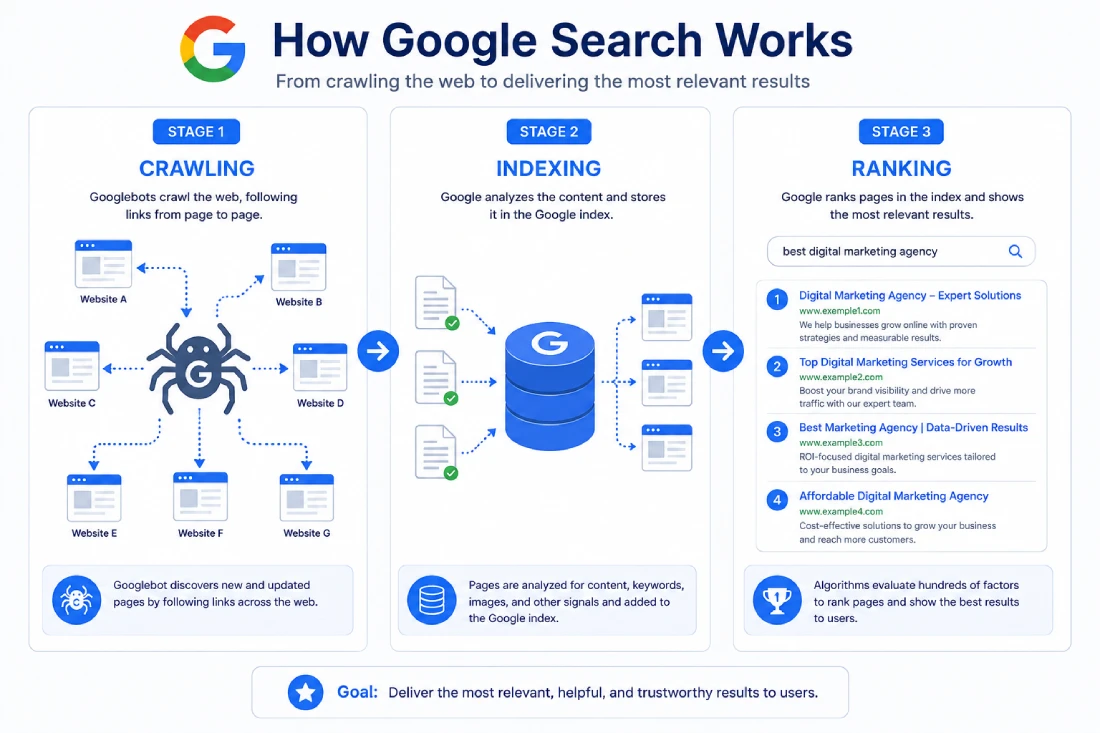
To understand how does seo works, you need to understand how search engines process the internet. Google’s official documentation on how search works describes three distinct stages that happen before any result appears on your screen.
Stage 1: Crawling
Search engines use automated programs called web crawlers (or spiders) to discover pages on the internet. Googlebot continuously follows links from page to page, finding new content and revisiting existing content to check for updates. If a search engine cannot crawl your page, it cannot rank it. Common crawling problems include pages blocked by robots.txt, broken internal links, and server errors that turn crawlers away before they can read the content.
Stage 2: Indexing
Once a page is crawled, the search engine analyzes its content, structure, and metadata, then stores it in a database called an index. Only indexed pages can appear in search results. During indexing, Google evaluates whether a page is unique, relevant, and trustworthy enough to include. Pages with thin content, duplicate text, or structural problems are often not indexed at all, which means they will never rank regardless of how much effort went into creating them.
Stage 3: Ranking
When someone performs a search, Google scans its index and returns results ranked by relevance, quality, and trustworthiness. The ranking order is determined by hundreds of signals processed by Google’s algorithms. These signals include the words on the page, which other sites link to it, how fast it loads, whether it is mobile-friendly, and how recent the content is. Understanding what these signals are, and how to strengthen them, is what SEO is practically about.
The 3 Types of SEO: On-Page SEO, Off-Page SEO, and Technical SEO
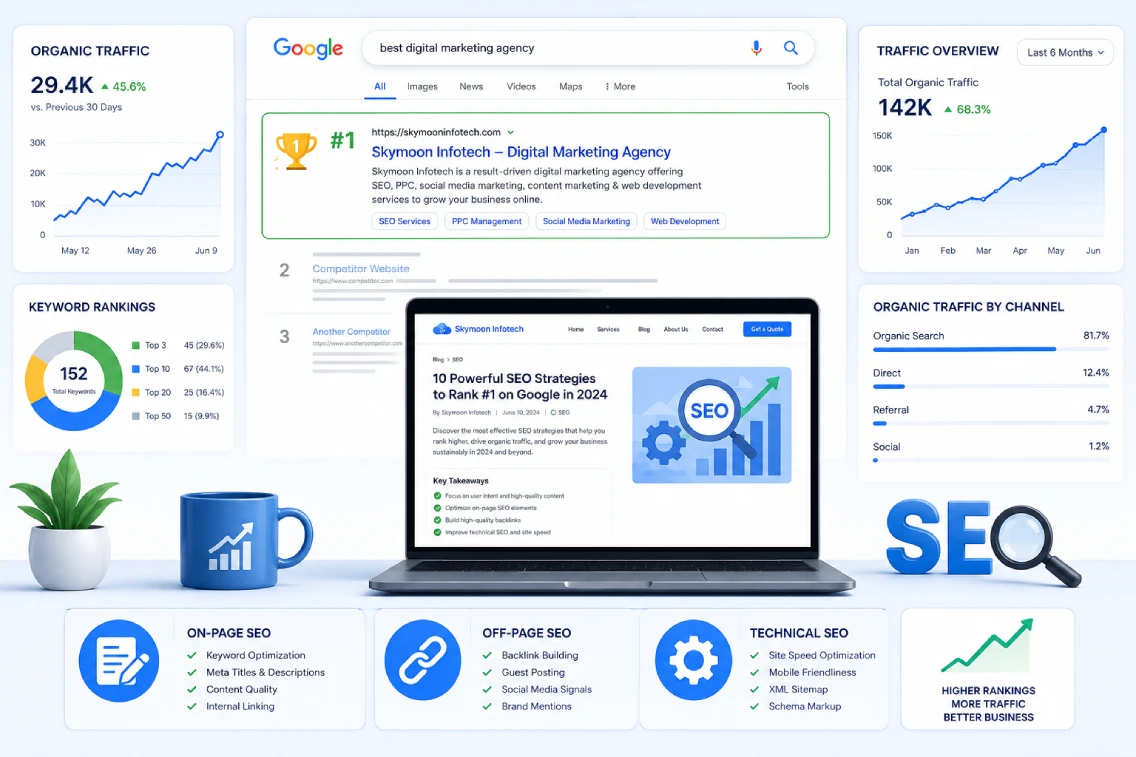
SEO splits into three interconnected disciplines. Each one addresses a different aspect of how search engines evaluate your site. Neglecting any one of them creates gaps that limit what the other two can achieve.
Technical SEO
Technical seo addresses the infrastructure of a website: how fast it loads, whether it is secure (HTTPS), how easy it is for search engines to crawl and index, and how it performs on mobile devices. Technical seo problems often act as multipliers on other issues. A slow site that is hard to crawl will rank poorly even if its on-page content and backlink profile are strong.
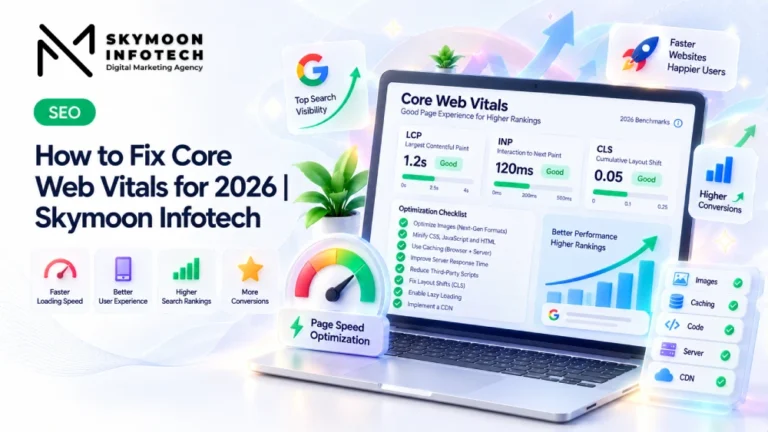
Core Web Vitals are Google’s measurable technical performance thresholds: Largest Contentful Paint (LCP) under 2.5 seconds, Interaction to Next Paint (INP) under 200 milliseconds, and Cumulative Layout Shift (CLS) under 0.1. Google’s Core Web Vitals documentation and web.dev guidance on performance are the authoritative sources for understanding these benchmarks. For a practical guide to meeting these thresholds, see Skymoon’s Core Web Vitals 2026 guide.
On-Page SEO
On page seo refers to everything you do on the page itself to make it more relevant for a specific search query. This includes the title tag, meta description, H1 and H2 headings, the body content, internal links, image alt text, and URL structure. On page seo is the most directly controllable part of search optimization because every element sits within your own website.
The most important on-page signal is relevance: does the page genuinely answer the query someone typed into Google? Google’s guidance on creating helpful, reliable content frames this as content that demonstrates first-hand experience, genuine expertise, and trustworthiness (E-E-A-T). For a full implementation checklist of on page seo elements, Skymoon’s on-page SEO checklist guide covers every technical element from meta tags to schema markup.
Off-Page SEO
Off page seo covers everything that happens outside your website that affects how search engines perceive your authority. The most significant off-page signal is backlinks: links from other websites to yours. When a reputable site links to your page, it signals to Google that your content is worth referencing. Off page seo also includes brand mentions, social signals, and your presence on external directories and review platforms.
The challenge with off page seo is that it cannot be directly controlled the way on-page elements can. Backlinks must be earned, not manufactured. Tactics like buying links or participating in link schemes carry the risk of Google penalties that can remove a site from search results entirely. The most sustainable off page seo strategy is publishing genuinely useful content that other sites naturally want to reference and link to.
| Type | What It Controls | Key Example Actions |
|---|---|---|
| Technical SEO | Site speed, crawlability, mobile experience | Pass Core Web Vitals; fix broken links; submit XML sitemap; enable HTTPS |
| On-Page SEO | Content, headings, metadata, internal links | Write keyword-relevant titles and H2s; optimize meta descriptions; add schema markup |
| Off-Page SEO | External authority and trust signals | Earn backlinks from reputable sites; build brand mentions; manage review profiles |
SEO Ranking Factors 2026: What Actually Determines Your Position
Google no longer publishes a simple numbered list of ranking factors. The old “200 ranking factors” figure that circulated across SEO articles for years has been superseded by a more complex picture revealed through algorithm documentation, research, and the 2024 Google API disclosures. What we know about seo ranking factors 2026 centers on five core areas:
1. Content Relevance and E-E-A-T
Content must genuinely match the search intent behind a query. Google evaluates content using E-E-A-T: Experience (evidence the author has done or used what they are writing about), Expertise (documented knowledge in the subject area), Authoritativeness (recognition from other credible sources), and Trustworthiness (accurate, verifiable information on a secure site). For YMYL-adjacent topics like finance, health, or legal matters, E-E-A-T requirements are applied with extra scrutiny.
Your competitors might be outranking you for a fixable reason
Most sites lose the majority of their potential traffic to issues that take days, not months, to fix. Our free audit tells you what those are.
No commitment, just a clear picture of where you stand.
2. Backlinks and Domain Authority
Links from authoritative external sites remain one of the strongest ranking signals. A page with zero backlinks will rarely rank for a competitive query regardless of how well-optimized its content is. Quality matters more than quantity: a single link from a high-authority news site or industry publication carries more weight than dozens of links from low-quality directories.
3. Technical Performance and Core Web Vitals
Page experience signals, including Core Web Vitals, mobile usability, and HTTPS security, act as a floor rather than a ceiling. Meeting these thresholds does not guarantee top rankings, but failing them can prevent rankings for competitive queries. For an in-depth walkthrough of what each metric means and how to fix common failures, see the
technical SEO section of how to build an SEO-friendly website and the website structure for SEO guide covering site architecture decisions that affect crawlability and link equity.
4. Search Intent Matching
A page optimized for the right keywords but wrong intent will underperform. If someone searches “what is seo”, they want a clear explanation, not a service page for an SEO agency. Google has become highly accurate at detecting intent and penalizing pages that technically contain the right keywords but were built to serve a different goal. Every page needs to be optimized for the intent of its target query, not just the keyword string.
5. User Signals and Engagement
Google uses anonymized data from Chrome and Search Console to understand how users interact with search results and pages. Pages where visitors quickly return to Google after landing (high pogo-sticking) signal that the page did not answer the query well. Pages that hold attention, generate scrolling, and earn return visits signal quality. These behavioral signals influence rankings over time, which is why pages with strong content engagement can outrank technically better-optimized pages with worse UX.
What is SEO in Digital Marketing: How It Fits with Other Channels
SEO does not operate in isolation. It sits within a broader digital marketing mix alongside paid advertising, social media, email marketing, and content strategy. Understanding how each channel relates to SEO helps set realistic expectations about what SEO can and cannot do on its own.
| Channel | Speed to Results | Cost Model | What SEO Adds |
|---|---|---|---|
| SEO (Organic) | 3-6 months for meaningful movement | Time and content investment; no per-click cost once ranking | Compounding, long-term traffic at zero marginal cost per visitor |
| Google Ads (PPC) | Immediate | Pay per click; stops when budget stops | SEO keyword data informs PPC targeting; landing pages benefit from on-page SEO |
| Social Media | Variable; algorithm-dependent | Time + paid promotion | Social shares can build brand mentions that support off-page SEO signals |
| Content Marketing | 4-8 months | Production cost; no per-visit cost | Content is the fuel of SEO — every optimized blog post or guide is an SEO asset |
For small and medium businesses, the most compelling case for SEO investment is the compounding return. The benefits of seo for small business become visible in the second and third year when pages published with proper SEO structure continue generating organic leads without requiring additional budget. This compound effect is what makes SEO the highest-ROI channel for most non-enterprise businesses over a 24-month horizon.
SEO Tools for Digital Marketing: What You Actually Need in 2026
The number of seo tools for digital marketing on the market has grown sharply in recent years, which makes it harder, not easier, to know where to start. For most businesses starting with SEO, four tools cover 90% of practical needs.
Google Search Console (Free)
Search Console shows you which queries bring people to your site, which pages are indexed, which have technical errors, and how your Core Web Vitals perform in the field. It is the most important SEO tool for anyone at any level because it uses Google’s actual data rather than estimates. If you set up only one tool, set up Search Console.
Google Keyword Planner (Free with Google Ads account)
Keyword Planner shows you monthly search volumes and competition levels for keyword ideas in specific countries. It is the source for the GKP-verified keyword data in this article. Its limitation is that it is designed for paid advertising, so it aggregates volume ranges rather than providing exact monthly counts.
A Crawling and Audit Tool (Screaming Frog / Sitebulb)
These tools simulate how a search engine crawls your website, flagging broken links, redirect chains, missing meta tags, duplicate content, and structural problems that are invisible to the naked eye. Screaming Frog’s free version crawls up to 500 URLs, which is sufficient for most small and medium business websites.
A Backlink Analysis Tool (Ahrefs / Semrush)
Paid tools in this category show you which sites link to you, which sites link to your competitors, and which keywords competitors are ranking for that you are not. While these tools require a subscription, they provide insight that is not available from free tools, particularly for competitive keyword research and link gap analysis.
For ecommerce SEO specifically: the tool requirements differ slightly from service or content businesses. See the ecommerce SEO tips guide for a breakdown of platform-specific tools for Shopify and WooCommerce sites.
What is SEO in the AI Search Era: Google AI Overviews, AEO, and GEO
The most significant change to what is seo in 2026 is that search results no longer only display ranked blue links. Google now generates AI-powered summaries at the top of the SERP for a growing share of queries. These summaries, called AI Overviews, appear before any organic result and pull content from sources across the web.
Two new disciplines have emerged alongside traditional SEO to address this shift. Answer Engine Optimization (AEO) focuses on structuring content so that search engines extract it as a direct answer in featured snippets, People Also Ask boxes, and AI Overviews. Generative Engine Optimization (GEO) focuses on getting a brand cited by external AI systems like ChatGPT and Perplexity when users ask them for recommendations or information.
For most businesses, the practical implication is that optimizing for traditional Google rankings is now necessary but no longer sufficient. A site that ranks second organically for a query where Google generates an AI Overview may receive less traffic than it did two years ago, even if its ranking did not change. Skymoon’s complete guide to GEO vs AEO vs AIO covers the technical differences between these three disciplines and how to implement each one. The short version: SEO builds the content foundation; AEO structures it for extraction; GEO builds the topical authority signals that make AI systems confident enough to cite your brand.
Key takeaway for 2026: SEO is not being replaced by AI search. The sources AI Overviews cite are ranked websites. The brands ChatGPT recommends are brands with authoritative published content. SEO remains the upstream investment that makes AI visibility possible.
Structured Data and Schema: The SEO Layer Most Sites Skip
Structured data is code added to a page to tell search engines explicitly what the content means, not just what it says. Google’s structured data documentation describes dozens of schema types that affect how pages appear in search results. For the “what is seo” page specifically, three schema types are directly applicable.
FAQPage Schema
Any page with a clearly structured FAQ section should implement FAQPage schema. While Google deprecated FAQPage rich results for most non-government sites in May 2026 (meaning the expanded FAQ accordion in the SERP is no longer reliably shown), the schema itself still signals to AI systems like ChatGPT and Perplexity that the page contains structured question-and-answer content. These AI systems do not follow Google’s deprecation decision.
Ready to turn this into an actual growth plan?
Our team builds strategies across SEO, paid advertising, AI search visibility, and website performance, matched to your budget and your goals, not a generic package.
- A real thirty minute call, not a sales pitch
- Recommendations specific to your business
- A short list of what to fix first
HowTo Schema
Step-by-step numbered lists are natural HowTo candidates. The “Starting Your SEO Journey” section in this guide, structured as five sequential steps, qualifies for HowTo schema markup. Unlike FAQPage, HowTo rich results are still actively served by Google in 2026 for queries with procedural intent.
Article / BlogPosting Schema
Every blog post should implement Article or BlogPosting schema with the headline field, author name, datePublished, dateModified, and publisher organization. Crucially, the headline field in BlogPosting schema must match the H1 exactly. The live version of this post had a three-way mismatch between the schema headline, the page H1, and the meta title tag, which is one of the diagnosed root causes of its zero-click record.
Starting Your SEO Journey: 5 Steps for Beginners
Seo for beginners can feel overwhelming because the discipline touches content, technology, and marketing simultaneously. The following five steps create a practical starting sequence that addresses the highest-impact areas first without requiring deep technical expertise from day one.
- Set up Google Search Console and verify your site. This gives you the data you need to understand what is already working before making any changes. Without Google Search Console, you are optimizing blind.
- Fix technical blockers. Use the Coverage report in Search Console to find pages with indexing errors. Check that your site loads over HTTPS. Run a Core Web Vitals assessment to identify speed problems. Technical issues prevent every other SEO effort from working properly.
- Map one keyword to each important page. Every page on your site should have a single primary keyword it is optimized for. This does not mean repeating the keyword constantly. It means structuring the page’s title, H1, and first paragraph around the most relevant query your target reader would type. For a step-by-step process, see the on-page SEO checklist.
- Build internal links between related pages. Internal links distribute authority across your site and help search engines understand which content is most important. Website structure and internal linking is a frequently skipped step that delivers measurable ranking improvements with no external dependency.
- Publish new content consistently. Rankings compound over time. A site that publishes one well-researched, properly optimized piece of content per month will outperform a site that published fifty posts three years ago and has added nothing since. Consistency signals to search engines that the site is actively maintained and updated.
Frequently Asked Questions About SEO
What is SEO and why does it matter for my business in 2026?
SEO (search engine optimization) is the process of improving your website so it ranks higher in Google and appears in AI-generated answers when people search for topics related to your business. In 2026, it matters because over 90% of online experiences start with a search, and the sites appearing at the top of those results capture the majority of clicks, leads, and revenue.
How long does SEO take to show results?
SEO typically shows early movement within 4 to 8 weeks for technical fixes like correcting indexing errors and improving page speed. Meaningful keyword ranking improvements on competitive terms take 3 to 6 months of consistent effort. For a new website with no existing authority, expect 6 to 12 months before organic traffic becomes a reliable acquisition channel.
What is the difference between on-page, off-page, and technical SEO?
On page seo covers content, headings, meta tags, and internal links: everything inside your own pages. Off page seo covers backlinks and external authority signals: things happening on other websites. Technical seo covers site speed, crawlability, mobile usability, and structured data: the infrastructure your content sits on. All three work together; weakness in any one limits what the other two can achieve.
How are AI Overviews and answer engine optimization changing SEO?
Google AI Overviews now appear above organic results for a growing share of queries, pulling content from ranked pages. This means ranking on page one is no longer sufficient if an AI summary answers the query before anyone sees your listing. AEO and GEO are the disciplines that help brands appear inside those summaries. Skymoon’s guide to GEO vs AEO vs AIO covers both in full.
Is SEO still worth it with AI answers and paid ads around?
Yes. AI Overviews cite ranked websites. ChatGPT and Perplexity recommend brands with published, authoritative content. Paid ads stop driving traffic the moment the budget runs out. SEO builds a compounding asset that generates organic visibility, feeds AI citation eligibility, and does not have a per-click cost once rankings are established. The investment case for SEO is stronger in 2026 than it was in 2022.
Ready to Build Your SEO Strategy?
What is seo is the starting question. The harder question is: what does your website need specifically to rank for the terms your customers are searching for? Skymoon Infotech’s SEO services cover the full implementation stack: keyword strategy, technical audits, on-page optimization, content production, and AI visibility optimization (AEO, GEO, and AIO). If you are ready to move from understanding SEO to executing it, book a free consultation and we will map out exactly where your site stands and what it needs to move.
Let's turn this into results for your business.
SEO, paid advertising, AI search visibility, website design, and conversion optimization, all under one roof, all pointed at the same goal: revenue.