
DOWNLOAD Get the on-page SEO checklist PDF and on-page SEO checklist Excel version below to work through every item on your own pages. Both are free. Both are linked again at the end of this post.
On-page SEO is work done directly on a published page to improve how search engines and what SEO is and how the pieces fit together; if you need the full picture, that post covers it. This checklist starts where that post ends: with the page already live and needing optimisation.
The SEO checklist that finds what is actually holding you back
Twenty seven checks covering technical SEO, on page structure, and link strategy. The same list our team runs before quoting any new client.
The on-page SEO checklist 2026 version of this post corrects factual errors, adds the AI Overview section, and implements the FAQ block the original told you to build. The original had 18,591 impressions and 1 click in 12 months. Position improved from 39 to 27 and zero additional clicks arrived. That is not a content problem; it is an authority and positioning problem.
The refresh adds the AI Overview section that this post was missing, implements the FAQ section item 16 that the original told you to build, removes the 2024 and 2025 references that were making the post look stale, and corrects the “1,200+ words minimum” guidance that was factually weak. Every other item has been reviewed for accuracy in 2026.
This post covers page-level on-page SEO only. For site-level architecture decisions, see the guide on building an SEO-friendly site. For the content brief that precedes this checklist, see the content brief format for AI search.
On-Page SEO Factors: Complete Reference Table
The table below covers every on-page SEO factor in this checklist. Each maps to a dedicated section below with the implementation detail.
| Factor | Priority | One-Line Summary |
|---|---|---|
| 1. Search Intent Alignment | P1; Critical | Match what the searcher actually wants, not just the keyword. |
| 2. Keyword Mapping | P1; Critical | One primary keyword per page, secondary cluster mapped to supporting H2s. |
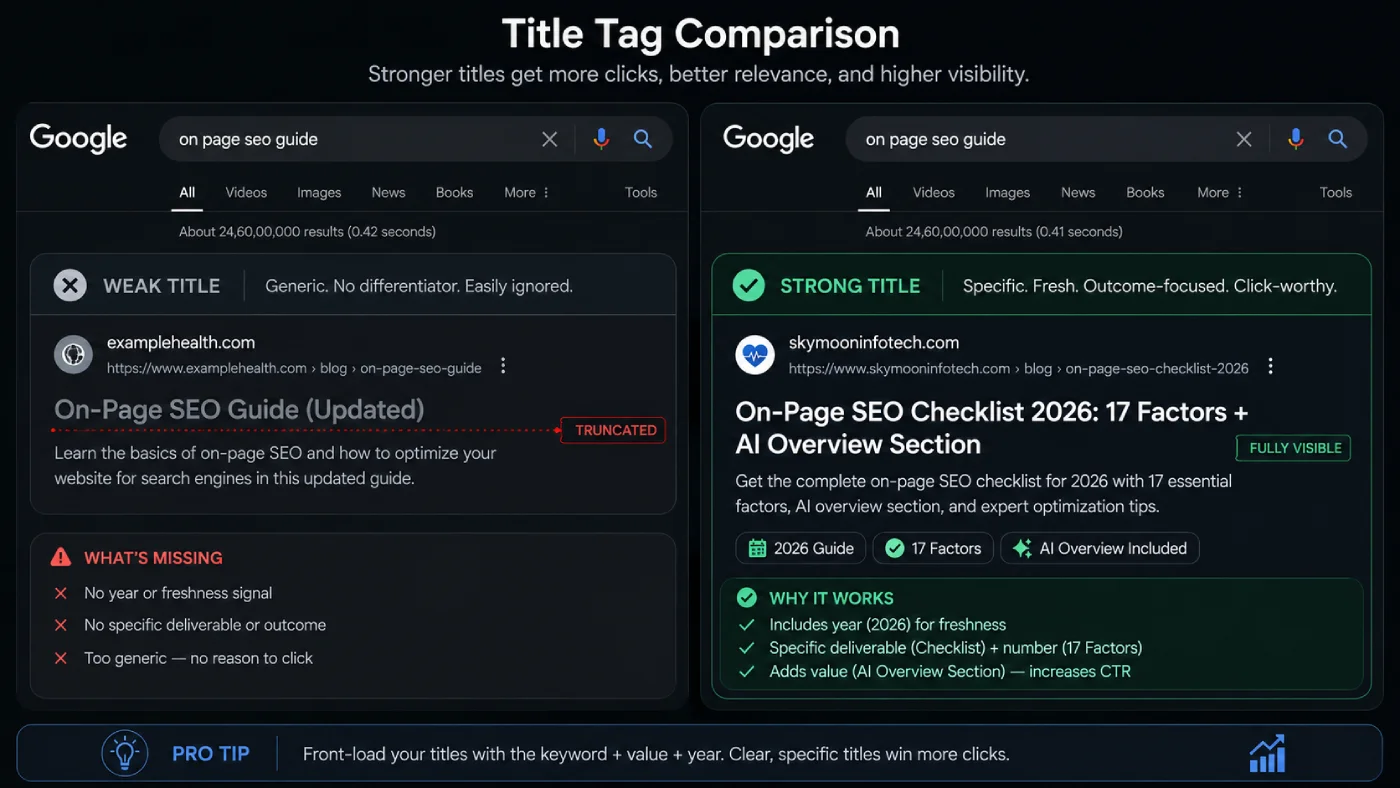
| 3. Title Tag | P1; Critical | Under 60 chars. Primary keyword at start. Differentiate from SERP competitors. |
| 4. Meta Description | P1; Important | Under 155 chars. Curiosity hook or benefit statement. Routes to dedicated post. |
| 5. H1 and Header Tags | P1; Important | One H1 containing primary keyword. H2s map to secondary keywords. Routes to dedicated post. |
| 6. Keyword Usage in Body | P1; Important | Topical coverage over density. Semantic breadth beats repetition. |
| 7. Content Depth and Quality | P1; Critical | Cover the topic completely for the intent. No word count minimum. |
| 8. Internal Links | P1; Important | Contextual, descriptive anchors. 3-7 per page is a workable range. |
| 9. Image Optimisation | P2; Standard | Descriptive file names, ALT text, compressed file size, modern format. |
| 10. URL Structure | P2; Standard | Short, descriptive, primary keyword in slug. No keyword stuffing. |
| 11. Schema Markup | P2; Standard | Article, FAQPage, HowTo where applicable. Does not directly boost rankings. |
| 12. E-E-A-T Signals | P1; Important | Author byline, credentials, visible date, cited sources, first-hand evidence. |
| 13. Page Speed (Core Web Vitals) | P1; Critical | LCP under 2.5s, INP under 200ms, CLS under 0.1. Technical but mandatory. |
| 14. Mobile Usability | P1; Critical | Google indexes mobile-first. Test on real device at real bandwidth. |
| 15. Outbound Links | P2; Standard | Link to authoritative sources that support your claims. |
| 16. FAQ Section with Schema | P2; Standard | Implement what you recommend. This post did not do this. Now it does. |
| 17. AI Overview Readiness | P2; New 2026 | Answer-first structure, question-forward headings, entity clarity, verifiable claims. |
How to Do On-Page SEO: The Core Checklist
On-page SEO is: align the page with search intent, place your primary keyword where Google looks first, write a title that earns clicks, structure headings around your secondary keyword cluster, and give users the most complete, trustworthy answer to their query. That is the complete on-page checklist in one sentence. The 17 items below expand each step.
Step 1: Align with Search Intent
On page optimization starts with intent. Intent alignment is the prerequisite for every other factor. A perfectly optimised page for the wrong intent will not rank. Identify whether the query expects informational content (how to, what is), commercial content (comparison, best list), transactional content (buy, download), or navigational content (brand name). Structure the page type; article, product page, landing page, tool; to match.
The fastest way to confirm intent: look at the top 5 results for your target keyword. If they are all how-to guides, your page should be a how-to guide. If they are all product category pages, your content format should match. Misaligned format is the most common reason a technically well-optimised page underperforms.
Step 2: Map Keywords Correctly
One primary keyword per page. A cluster of secondary and related keywords mapped to supporting H2s. This is page-level keyword mapping; planning site-wide structure and silos covers the broader architecture.
On the page: place the primary keyword in the title, H1, meta description, first 100 words, and URL slug. Secondary keywords appear naturally in H2s and body paragraphs.
The SEO on-page checklist variant of your primary keyword (the reworded or misspelt phrasing) is typically captured automatically when your primary term is used naturally throughout the page. No separate section is needed.
Step 3: Write a Title Tag That Earns Clicks
Title tags under 60 characters. Primary keyword at the start. Differentiate from what the top 5 results already say. For the full technical and copywriting depth on how to write meta titles and descriptions that earn clicks; the dedicated meta-tags post covers it completely. Keep your reading here for the checklist structure and go there for the implementation detail.
For H1, H2, and header tag hierarchy: structuring H1 to H6 for rankings covers every element. The summary for this checklist: one H1 per page, containing your primary keyword, written as a reader-facing headline not a keyword string. H2s map to secondary keywords.
On-Page SEO Techniques: Content and Keywords
Step 4: Keyword Usage in Body
Keyword density is not a ranking factor. There is no target percentage. Write for the reader using the full semantic breadth of your topic, and the keyword coverage takes care of itself.
What Google actually rewards is topical completeness: does this page cover all the aspects of the query that a person would want addressed?
Practical approach: write the page first. Then check whether your primary keyword appears naturally in the first 150 words, at least two H2s, and scattered throughout the body.
If it does not, the content is probably not about the topic you are targeting. If it appears 40 times in 600 words, you are stuffing, not writing.
Step 5: Content Depth Over Word Count
There is no minimum word count for on-page SEO. The existing version of this post said “1,200+ words per page” in its template. That is factually weak guidance and it is removed in this refresh. The correct framing: write enough to completely answer the intent of the query.
A local business address page needs 80 words. A technical guide comparing five database architectures may need 4,000 words. Neither is better than the other because of the word count.
Intent completeness is the measurable proxy: after reading your page, does the searcher have everything they came for, or do they need to go back to Google to find a missing piece? If they leave because they found the answer, that is a signal. If they leave to find the answer elsewhere, that is a gap.
Step 6: E-E-A-T Signals on the Page
E-E-A-T (Experience, Expertise, Authoritativeness, Trustworthiness) is evaluated at the site level and the page level. On the page specifically, the signals Google can verify are:
- Author byline with name and credentials, linked to an author page or credible external profile
- Visible publication date and dateModified; both must be accurate. A last-updated label on a page with stale content is a trust liability.
- Inline citations to primary sources: peer-reviewed papers, government data, original research; not just other blog posts
- First-hand evidence: screenshots, original data, test results, case studies with verified outcomes
- Specific verifiable claims over generic assertions. “Page speed matters” is generic. “Google/SOASTA Research (2017) found bounce rate increases 32% as load time goes from 1 to 3 seconds” is specific and verifiable.
[SKYMOON INFOTECH ANALYSIS] In the on-page SEO audits we have conducted for client sites, E-E-A-T failures are the most common cause of pages that rank at positions 20-40 for years without improving. The content is accurate and comprehensive.
The missing elements are the author byline, the visible dateModified, and the first-hand evidence that tells Google who is speaking. Adding those three elements without changing the content body has moved pages from position 30 to position 12 in a single 90-day cycle in our experience.
This is not guaranteed; it is an observation from our audit work, not a controlled study.
Step 7: Entity SEO On-Page
Entity SEO on the page means making your content machine-readable at the concept level, not just the keyword level. Google’s Knowledge Graph understands that “LCP” and “Largest Contentful Paint” are the same entity. A page that uses both terms is understood as more complete than one using only the abbreviation.
Practical application: name entities precisely and consistently. If your page is about Google Search Console, use that exact phrase rather than alternating between “GSC,” “Search Console,” and “Google’s analytics tool.”
Use schema markup (Article, Person, Organisation) to declare the entities on your page explicitly. Link to authoritative entity pages; Wikipedia, Wikidata, official product pages; where it adds reader value.
Your competitors might be outranking you for a fixable reason
Most sites lose the majority of their potential traffic to issues that take days, not months, to fix. Our free audit tells you what those are.
No commitment, just a clear picture of where you stand.
Step 8: Semantic Keywords SEO
Semantic keywords are the terms and phrases that naturally appear around your topic without being the primary keyword. A page about “on-page SEO” that never mentions “title tag,” “meta description,” “internal links,” or “Core Web Vitals” signals topical incompleteness. Tools like Google’s People Also Ask and “related searches” at the bottom of the SERP surface the semantic cluster for any topic.
Cover the semantic cluster naturally in your H2s and body prose. Do not create a section just to insert keywords. If you are writing substantively about your topic, semantic coverage arrives automatically.
On-Page SEO Activities: Technical and Structural Checks
Step 9: Internal Linking
Internal links distribute authority, help Google understand page relationships, and guide users through your site. Three to seven contextual internal links per page is a workable range; the constraint is relevance, not a number.
Use descriptive anchor text that tells the reader what they will find. “Click here” and “read more” are wasted signals. For building an SEO-friendly site architecture and site-wide internal link planning, that post covers the structural layer. This step is page-level only.
Step 10: Image Optimisation
Every image on the page: descriptive file name (not “IMG_3847.jpg”; use “on-page-seo-checklist.jpg”), ALT text describing the image content and including the keyword where genuinely appropriate, compressed file size using a modern format (WebP or AVIF rather than JPEG for web), and explicit width and height dimensions in the HTML to prevent Cumulative Layout Shift.
Step 11: URL Structure
Short, descriptive, lowercase slug containing the primary keyword. No stop words unless they are genuinely needed for readability. No dates in the URL unless the content is time-specific and will be updated. Once a URL is indexed and has backlinks, changing it requires a 301 redirect and loses some equity; get it right before publishing.
Step 12: Schema Markup for On-Page SEO
Schema markup does not directly boost rankings. It helps Google understand your content and makes rich results (FAQ dropdowns, HowTo steps, review stars) possible. Google does not guarantee rich results even with correct markup.
For this post, the applicable schema types are Article, FAQPage, and HowTo. For healthcare-specific schema implementation with copy-paste JSON-LD, that will be covered in a dedicated post; the content brief format we use for AI search covers the pre-publication side of this workflow.
On-Page SEO Checks: Performance and Mobile
On-page SEO checks that most guides treat as technical SEO; page speed and mobile usability; are listed here because they directly affect ranking and user experience on the page itself. The distinction between on-page and technical SEO is blurry here. Apply these at the page level.
Step 13: Page Speed and Core Web Vitals
Google’s Core Web Vitals are the page speed standards that directly affect ranking: Largest Contentful Paint (LCP) under 2.5 seconds, Interaction to Next Paint (INP) under 200 milliseconds, Cumulative Layout Shift (CLS) under 0.1. Google/SOASTA Research (Think with Google, 2017) found that bounce rate increases 32% as page load time goes from 1 second to 3 seconds.
That research is from 2017; the expectation bar has risen since. For the full technical implementation guide, see core web vitals in detail.
Step 14: Mobile Usability
Google indexes the mobile version of your page first. If the mobile experience is broken; text too small to read, tap targets too close together, content wider than the viewport; the ranking consequence applies to all versions of the page.
Test on a real device at realistic bandwidth. Use Google’s Mobile-Friendly Test, but also load the page on a mid-range Android handset on 4G. The tool and the device often give different results.
Step 15: Outbound Links
Linking to authoritative external sources adds credibility to your claims and helps Google understand the topic context of your page. Each outbound link should support a specific claim.
Sourcing statistics to the original study, not to another blog post citing the study, is the distinction between a credible citation and a laundered one.
On-Page SEO Audit Checklist: Step 16; FAQ Section
The previous version of this post listed “Add FAQ Sections with Schema Markup” as item 16. The post had no FAQ section and no FAQPage schema. That is a credibility gap: the post told you to do something it had not done. The FAQ section below is now implemented with FAQPage schema (see schema reference section).
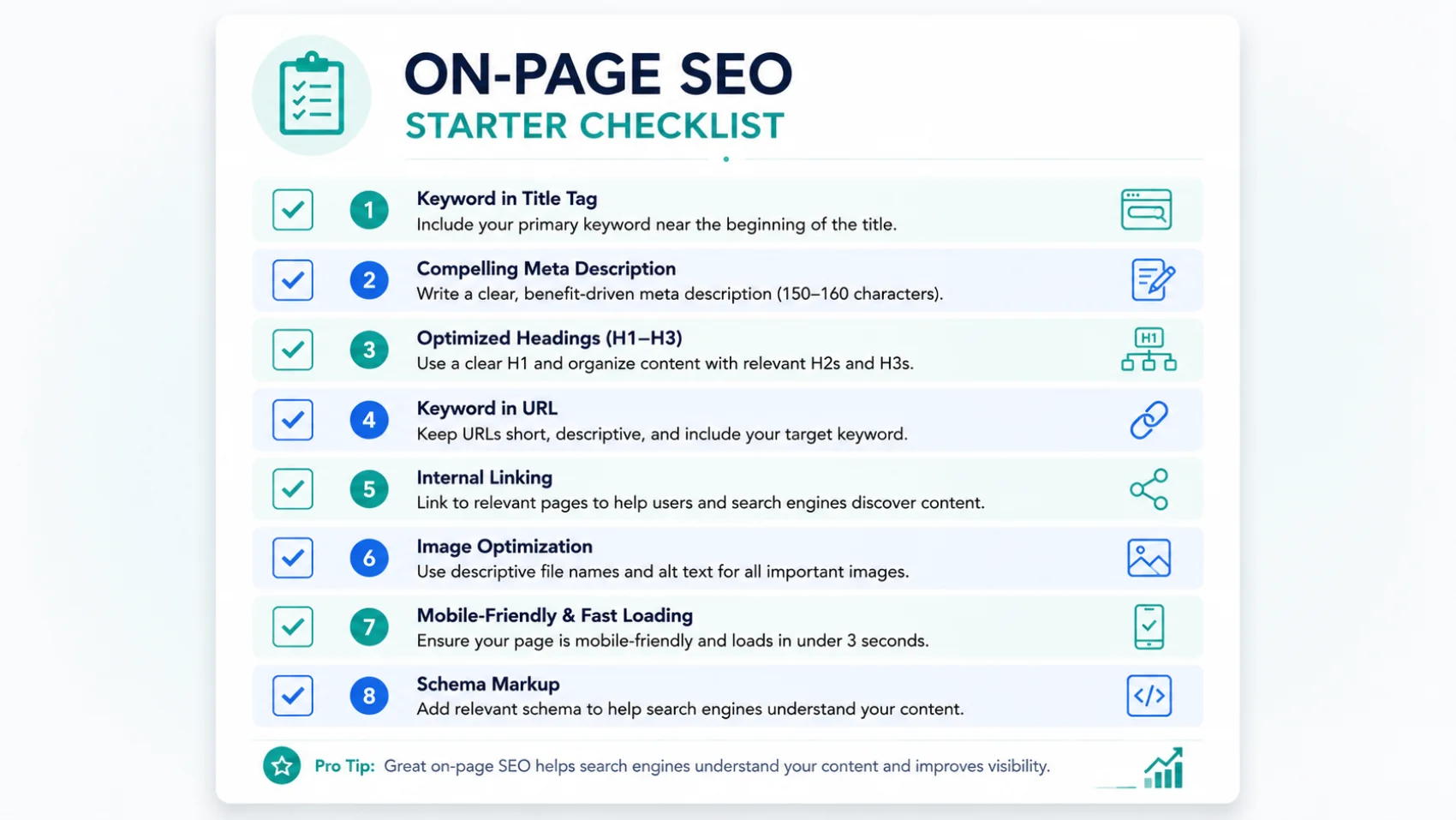
On-Page SEO for Beginners: The 8-Item Starter List
For on-page SEO for beginners, start with these eight items rather than the full 17-factor list. They cover the highest-impact factors and take less than 30 minutes to audit on any page:
- Does the page title include your target keyword and fit under 60 characters?
- Does the H1 match (or closely align with) the page title?
- Is the primary keyword in the first 100 words of the body?
- Does the URL slug contain the primary keyword and nothing else?
- Are all images compressed and do they have descriptive ALT text?
- Does the page link to at least two related internal pages with descriptive anchors?
- Does the page load in under 3 seconds on mobile? Test in Chrome DevTools throttled to “Fast 3G.”
- Does the page have a visible author name and publication date?
Once these eight are in place, work through the full 17-factor checklist. The schema section of this post documents how to do on-page SEO step by step using HowTo schema for the search result display.
Does On-Page SEO Still Matter with AI Search?
Does on-page SEO still matter now that AI Overviews appear on nearly half of all Google queries? The short answer is yes, and the evidence is direct.
Yes. In May 2026, Google published its first official guide to optimising for AI features in Search and stated directly: “AI Overviews and AI Mode are rooted in our core Search ranking and quality systems.” On-page SEO is not a competing discipline. It is the prerequisite.
For how AI-powered search results actually work; definitions, platform behaviour, and citation dynamics belong there. This section covers the on-page mechanics only.
How to Structure Content for AI Overviews
How to structure content for AI Overviews is the practical question here. Google states there are no special requirements for AI Overview citation. The on-page adjustments that improve extractability; and work for featured snippets too; are:
- Question-forward headings: phrase H2s and H3s as the questions your readers actually ask. AI systems prefer headings they can match to a user query.
- Answer-first structure: put a direct answer under 50 words immediately after each question-form heading, before any expansion or caveat.
- Named entities and verifiable claims: precise entity names (full product names, official organisation names) and claims tied to named sources with years. Vague claims are harder to extract and cite.
- Tables and numbered lists: structured content that a language model can parse as a unit rather than extract sentence by sentence.
- Visible author and dateModified: AI systems use freshness and authority signals, even if they do not always surface them in citations.
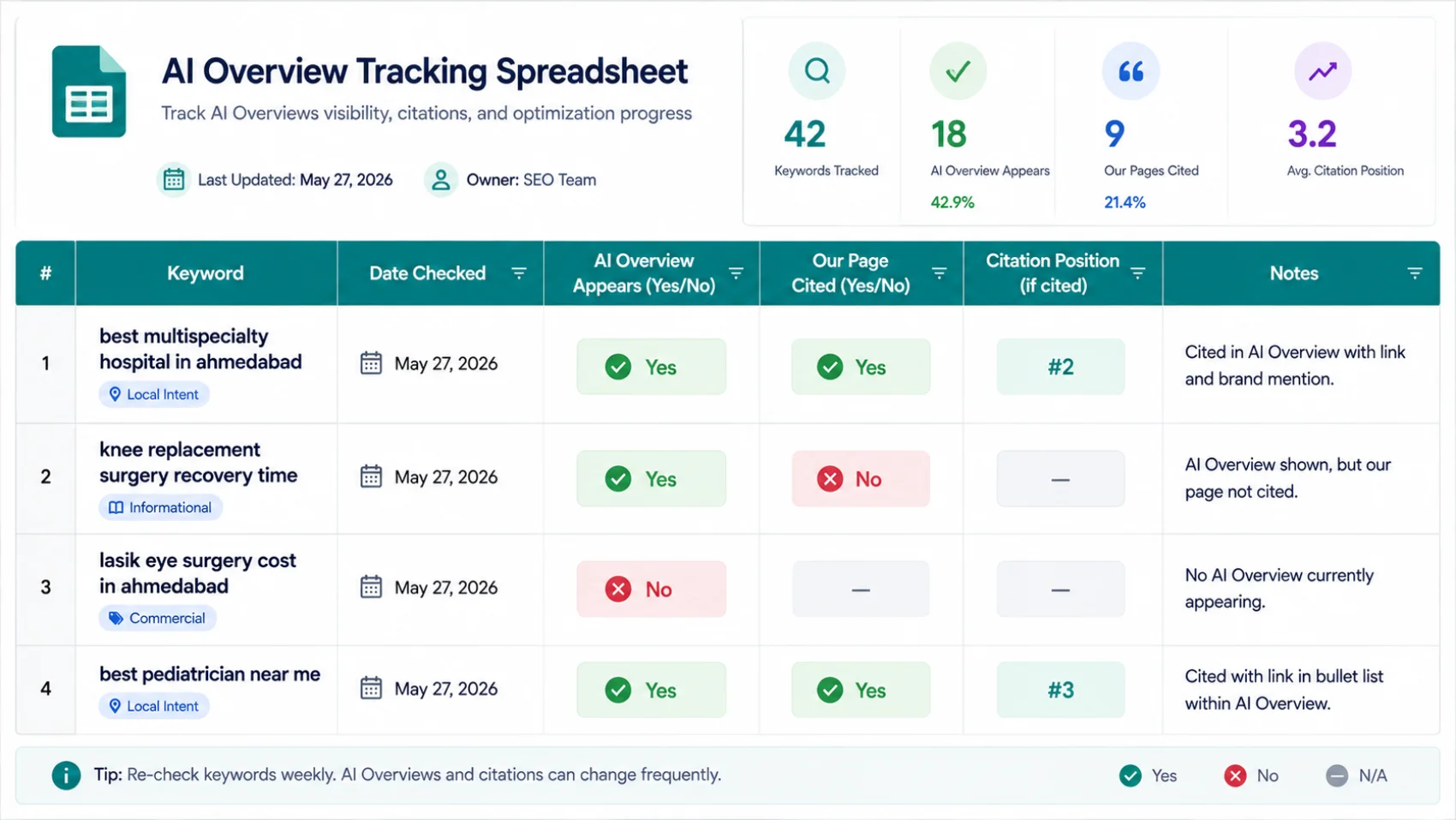
A practical measurement method, free and repeatable: search your target keyword in an incognito window. Record whether an AI Overview appears. If it does, check whether your page is cited.
Do this for your 10 highest-value pages once a month. Track changes after publishing. That is the entire measurement workflow for most small and mid-size sites; no paid tool required.
[NOTE] llms.txt is an emerging convention for helping AI crawlers understand site structure. Google has clarified it is not processed in any special way for Search or AI Overviews (Google, 2026).
Its value for non-Google AI systems (ChatGPT, Perplexity) is still being evaluated. If you want to explore LLM citation strategy beyond Google, see the post on getting cited by ChatGPT and other LLMs.
On-Page Checklist: Download and Use
Use the on page checklist below in PDF or Excel to work through every factor. The on-page SEO checklist PDF and the Excel version cover every item in this post in a format you can print, share with a team, or work through page by page. Both are free.
If you want a scored audit against all 17 factors for your most important pages, on-page SEO services describes how Skymoon approaches that process.
Ready to turn this into an actual growth plan?
Our team builds strategies across SEO, paid advertising, AI search visibility, and website performance, matched to your budget and your goals, not a generic package.
- A real thirty minute call, not a sales pitch
- Recommendations specific to your business
- A short list of what to fix first
Frequently Asked Questions
What is the difference between on-page SEO and technical SEO?
| Dimension | On-Page SEO | Technical SEO |
|---|---|---|
| Where it lives | The page itself; content and structure | The site infrastructure; crawling and indexing |
| Examples | Title tag, H1, keyword usage, internal links | Robots.txt, sitemaps, page speed, structured data |
| Overlap | Page speed and schema markup apply to both | Page speed and schema markup apply to both |
| Who typically owns it | Content team or SEO generalist | Developer or technical SEO specialist |
Does on-page SEO still matter with AI Overviews?
Yes. Google’s May 2026 official AI Search guide states its generative AI features are “rooted in our core Search ranking and quality systems.” On-page SEO earns the organic ranking that makes AI citation possible.
Ahrefs March 2026 data (863K SERPs) shows 38% of AI Overview citations come from top-10 pages; top-10 ranking is still the strongest signal for citation probability, even as the pool has widened.
How do I optimise a page for Google AI Overviews?
Use question-forward headings with a direct answer under 50 words immediately after each. Expand with tables, lists, and numbered steps. Name entities precisely and tie claims to verifiable sources with years.
Add a visible author byline and dateModified. Google states there is no special AI Overview optimisation beyond good SEO fundamentals; these are answer-extractability improvements, not a separate discipline.
How many on-page SEO factors are there?
There is no official count from Google. This post lists 17 prioritised factors. Other credible checklists list between 12 and 30. A longer list is not more accurate; it is just more granular.
Prioritisation matters more than exhaustiveness: factors 1 through 8 in this checklist produce the most ranking impact. Start there and work outward.
How often should I update my on-page SEO?
Review high-value pages quarterly. Refresh a page when: search intent for the target keyword shifts (check the live SERP; if the top results change format, yours should too), when a competitor adds substantive coverage you do not have, or when a search feature changes (AI Overviews were triggered on this topic in 2026; that is a signal to refresh).
This post is a worked example: refreshed because position improved and clicks did not, and because AI Overviews arrived on the topic.
Is keyword density still a ranking factor?
No. Keyword density has not been a meaningful ranking signal for years. Topical completeness – covering all relevant aspects of a query – is what Google rewards. Write for the reader.
If you are covering the topic thoroughly, keyword coverage follows naturally. Checking that your primary keyword appears in the title, H1, and first 100 words is sufficient verification. Counting percentage density is wasted time.
What is the ideal word count for on-page SEO?
There is no ideal word count. This post previously stated “1,200+ words per page”; that guidance is removed in this refresh because it is factually weak. Write until you have completely answered the search intent.
A local business page needs 80 words. A technical comparison guide may need 4,000. Google does not count words; it evaluates whether the page fully serves the query.
Do I need schema markup for on-page SEO?
Schema markup does not directly boost rankings. It helps Google understand your content structure and makes rich results (FAQ dropdowns, HowTo steps, breadcrumbs) possible. Google does not guarantee rich results even with correct markup.
For a standard blog post, implement Article, FAQPage if you have a real FAQ section, and BreadcrumbList. HowTo applies when the content is genuinely step-by-step. Do not add schema that does not reflect real page content.
Let's turn this into results for your business.
SEO, paid advertising, AI search visibility, website design, and conversion optimization, all under one roof, all pointed at the same goal: revenue.