
GEO vs AEO vs AIO are three terms describing how content must be structured to appear in AI-generated search results. If you have been hearing all three and are not sure what each means or which one to focus on first, this guide gives you clear definitions and a practical starting point.
AI search is no longer a future trend. Google AI Overviews now appear in an estimated 45% of searches. ChatGPT processes over 2.5 billion prompts every day. Perplexity is growing at a rate that is reshaping how researchers and B2B buyers find information. The practices that understand AI search optimization in 2026 will capture significant organic visibility that their competitors are actively losing.
Get found by ChatGPT, Gemini, and Google AI Overviews
Eighteen steps to prepare your business for how people are searching now. Our internal AI search readiness guide, free.
Critical stat: Only 11% of domains cited by both ChatGPT and Perplexity also rank on page one of Google for the same query. Traditional rankings and AI search citations are two separate visibility channels that require separate optimization strategies.
What Is Generative Engine Optimization?
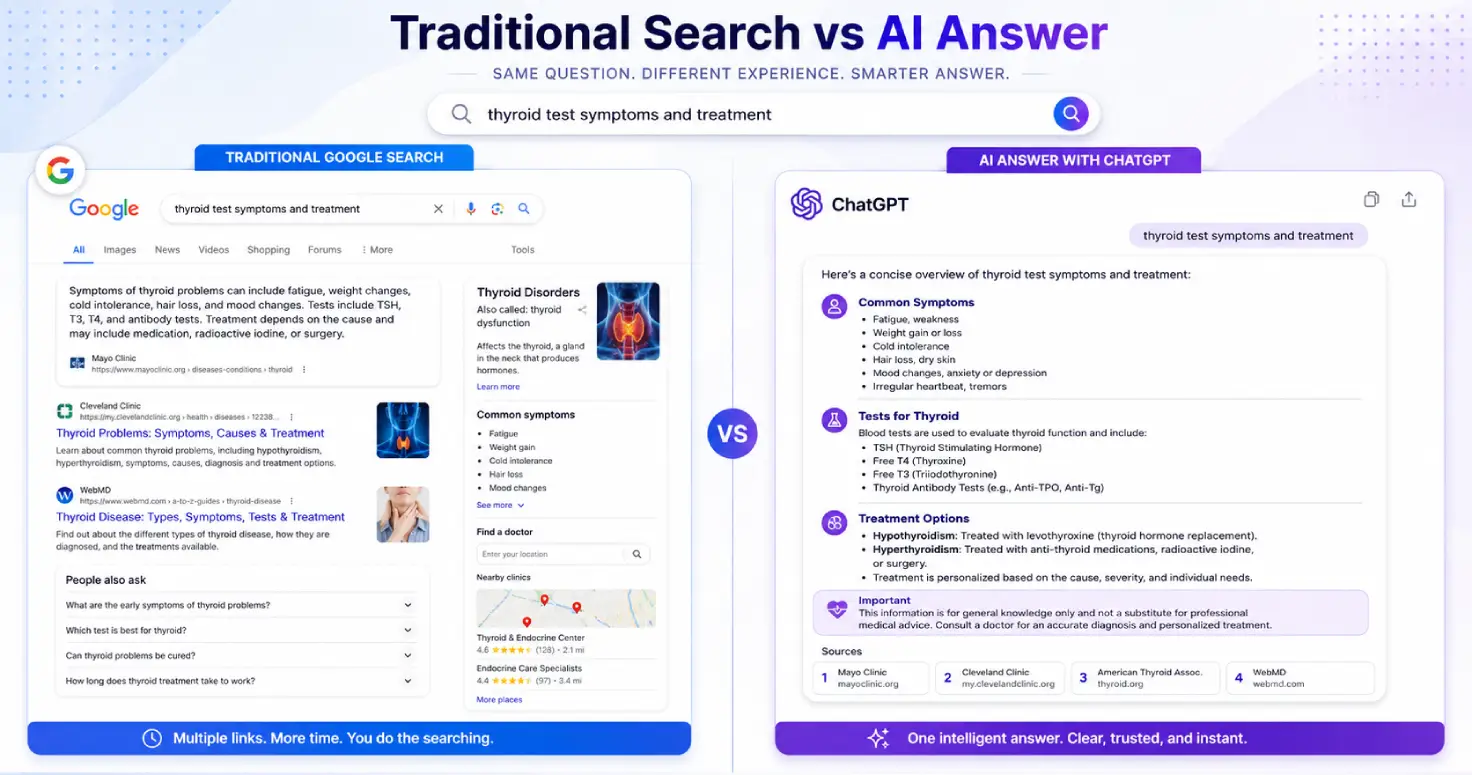
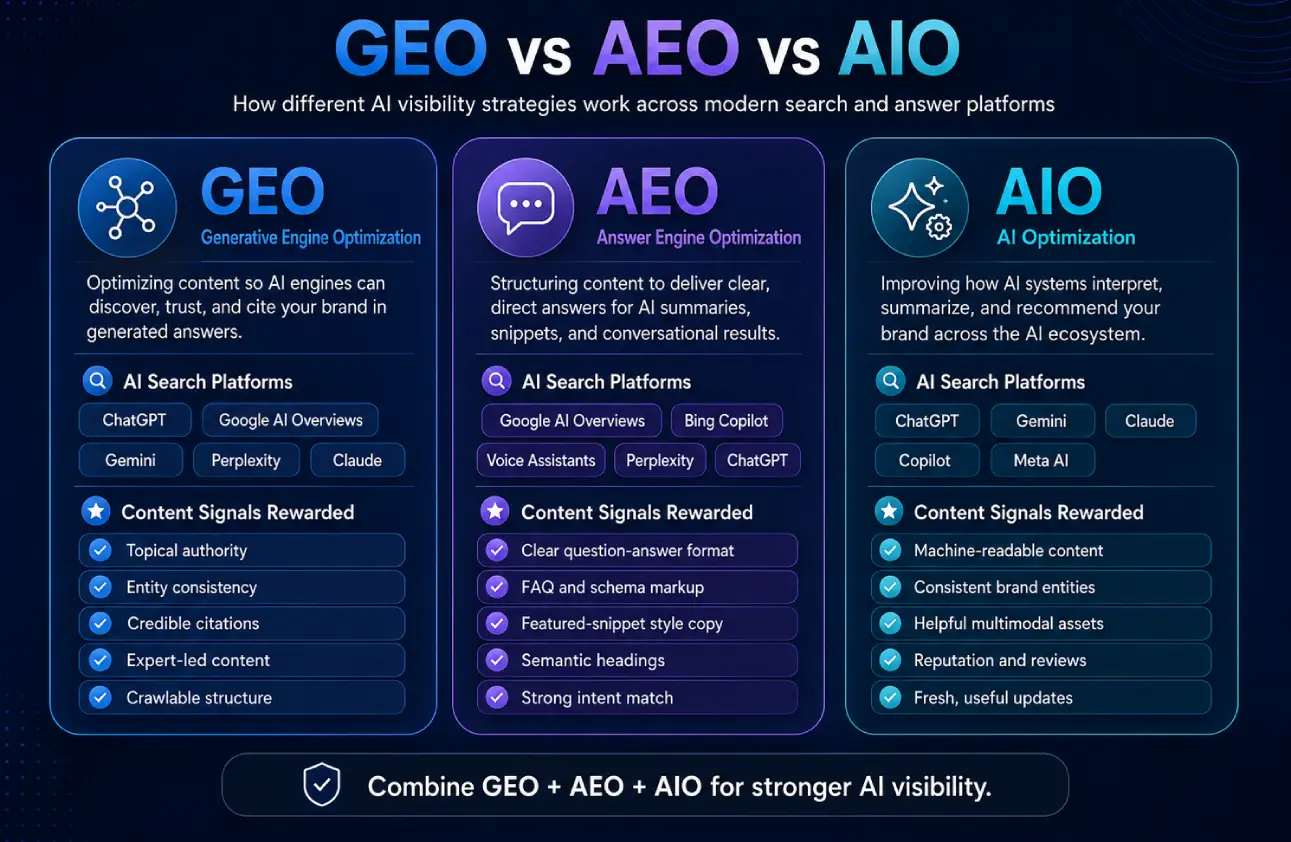
Generative engine optimization (GEO) is the practice of structuring and presenting content so that AI language models cite it in their generated answers. Unlike traditional SEO, which targets search engine rankings, GEO targets the AI systems that summarize, answer, and recommend, including ChatGPT, Perplexity, Claude, Gemini, and Google AI Overviews.
The term was formalized in a 2024 paper from Princeton University researchers who studied how different content characteristics affected citation rates across AI search platforms. Their findings changed how content strategists think about optimization: adding cited sources to content boosted AI visibility by 40%. Adding statistics boosted it by 37%. Comparison tables lifted it by 33%.
GEO is not a replacement for SEO. It is a layer on top. A page that ranks well on Google is more likely to be cited by AI systems because training data and search index data overlap. But a well-ranked page with poor structure, no statistics, and no schema markup will be systematically passed over in favor of a slightly lower-ranked page that is well-organized and data-rich.
What Is Answer Engine Optimization?
Answer engine optimization (AEO) is the practice of structuring content to appear in direct answer positions in search: featured snippets, PAA (People Also Ask) boxes, voice search responses, and AI-generated answer summaries. AEO predates the current wave of AI search tools. It developed as Google began returning direct answers rather than just links.
The practical difference between GEO and AEO is this: AEO was built around Google’s structured answer features. GEO extended those principles to third-party AI systems. In 2026, AEO and GEO overlap heavily because the content signals that earn featured snippets (clear definitions, 40-60 word answers, FAQ structure, direct question-heading match) are also the signals that earn AI citations.
| Factor | Answer Engine Optimization (AEO) | Generative Engine Optimization (GEO) |
|---|---|---|
| Primary target | Google featured snippets and PAA boxes | ChatGPT, Perplexity, Claude, Gemini citations |
| Content format | 40-60 word direct answers under question headings | 40-60 word answers + statistics + cited sources |
| Schema priority | FAQPage, HowTo, Speakable | FAQPage + Article + Speakable + all above |
| Year developed | 2015-2018 as featured snippets grew | 2023-2024 as LLM search tools emerged |
| Relationship to SEO | Extends traditional on-page SEO | Extends AEO and traditional SEO combined |
| Bot access requirement | Standard Googlebot | GPTBot, ClaudeBot, PerplexityBot also needed |
What Is AIO? Understanding Google AI Overviews
AIO stands for AI Overviews, which is Google’s term for the AI-generated summary boxes that appear at the top of search results for many queries. AI Overviews pull from pages that Google already trusts based on traditional ranking signals and then restructures that content into a direct answer with cited sources listed below.
Optimizing for Google AI Overviews is a specific subset of GEO. Because AI Overviews pull from Google’s own index, strong traditional SEO rankings are the most reliable predictor of AI Overview citation. However, structural signals still matter. Pages with clear definition blocks, updated dates, author credentials, and FAQPage schema are cited in AI Overviews at higher rates than pages that rank well but are poorly structured.
India-specific note: Google AI Overviews have expanded to Indian English search results in 2025-2026. Healthcare, finance, education, and technology queries now frequently trigger AI Overviews in India. Businesses optimizing for the Indian market need to include AIO optimization in their 2026 SEO strategy.
GEO vs AEO vs SEO: Which Should You Prioritize?
The answer depends on your current organic presence and where your audience searches.
Would ChatGPT even recommend your business right now?
AI powered search is changing how people find companies like yours. Our free assessment shows exactly where you stand today.
No commitment, just a clear picture of where you stand.
If you have strong Google rankings but low AI search visibility, prioritize GEO: add statistics with sources, restructure key sections into 40-60 word answer blocks, and implement schema on all content pages. This is the fastest path to increasing your AI citations without rebuilding your content strategy.
If you have weak Google rankings overall, fix your SEO foundation first. AI search is not a shortcut past low domain authority or thin content. ChatGPT, Perplexity, and Google AI Overviews all rely partly on traditional ranking signals as a quality proxy. A site that ranks on page three for its core terms is unlikely to get cited in AI Overviews for those same terms until its traditional ranking improves.
If you are starting from scratch, build with all three in mind from the beginning. Write every article with a definition block, at least three cited statistics, and a FAQ section with 40-60 word answers. This approach optimizes for traditional featured snippets (AEO), AI language model citations (GEO), and Google AI Overviews (AIO) simultaneously.
How to Optimize for ChatGPT and Perplexity
Optimizing content to get cited by ChatGPT and Perplexity follows a consistent pattern based on how these platforms select sources.
Step 1: Allow AI Bot Access
The most common reason Indian websites are not cited by ChatGPT or Perplexity is that their robots.txt blocks AI crawlers. Check your robots.txt file immediately. You need to allow GPTBot (OpenAI), PerplexityBot, ClaudeBot (Anthropic), and Google-Extended. Blocking these bots means these platforms cannot index your content, making citation technically impossible.
Step 2: Structure Content for Extraction
AI systems extract passages, not full pages. Every important claim in your content should work as a standalone statement without needing surrounding context. Use the following patterns:
- Definition blocks: “GEO is [definition]. It works by [mechanism].” – 40-60 words
- Step-by-step blocks with numbered lists for how-to content
- Comparison tables for GEO vs AEO vs SEO type queries
- FAQ blocks with direct question headings and 40-60 word answers
- Statistic blocks: “[Stat]% of [population] [behavior] according to [source with link]”
Step 3: Add Citations and Statistics
AI systems strongly prefer content that cites primary sources. A claim like “over 77% of patients search online before booking” with a link to the research source is cited at 40% higher rates than the same claim made without attribution. Add cited sources to every significant factual claim in your content.
Step 4: Implement Schema Markup
FAQPage, Article, and HowTo schema give AI systems explicit structural context. Perplexity’s citation algorithm gives additional weight to pages with structured data because it can parse the content more accurately. Implement schema on every page you want cited, not just your homepage or most visited pages.
Step 5: Get Third-Party Mentions
Brands are 6.5 times more likely to be cited by AI systems via third-party sources than via their own domain. Your brand being mentioned in an authoritative trade publication, Wikipedia article, or Reddit thread with significant engagement dramatically increases the probability of an AI system including your brand in a response.
How to Get Cited by AI Search: A Checklist
Use this checklist to audit any page you want to appear in AI-generated answers.
| Check | Status | Notes |
|---|---|---|
| AI bots allowed in robots.txt (GPTBot, ClaudeBot, PerplexityBot, Google-Extended) | Verify | Check before any other optimization – blocking = zero chance of citation |
| Definition block: 40-60 word self-contained answer in first section | Verify | Works without needing surrounding context |
| Minimum 3 cited statistics with linked sources | Verify | +40% AI visibility per Princeton GEO study |
| Comparison table for any comparison-intent query | Verify | +33% AI visibility per Princeton GEO study |
| FAQ section with 40-60 word answers under question headings | Verify | FAQPage schema required alongside the FAQ copy |
| FAQPage schema implemented on page | Verify | Use Rank Math Pro or JSON-LD in wp_head |
| Article schema with author name and dateModified | Verify | AI systems weight recency and author attribution heavily |
| Last-updated date visible on page | Verify | Perplexity favors recently updated content significantly |
| Third-party citations: brand mentioned on external authoritative sites | Verify | Reddit, Wikipedia, trade publications all count |
| /llms.txt file on domain root | Verify | Gives AI systems structured context about your brand and key pages |
LLM Optimization: What It Means and Why It Is Growing
LLM optimization is an emerging term for the broader practice of making content legible, accurate, and useful for large language models. It overlaps heavily with GEO but extends to developer-focused practices like creating /llms.txt files, maintaining llms-full.txt documentation, and ensuring that machine-readable versions of your content are indexed and current.
The practical upside for marketing teams: LLM optimization is low-competition in most verticals in India. Most competitors have not yet created llms.txt files, allowed AI bot access, or implemented AI-specific schema. The window to establish an early citation advantage in AI search is still open in 2026, but it is narrowing as more brands become aware of the channel.
Ready to turn this into an actual growth plan?
Our team builds strategies across SEO, paid advertising, AI search visibility, and website performance, matched to your budget and your goals, not a generic package.
- A real thirty minute call, not a sales pitch
- Recommendations specific to your business
- A short list of what to fix first
Frequently Asked Questions About GEO, AEO, and AI Search Optimization
What is the difference between GEO, AEO, AIO, and traditional SEO?
Traditional SEO gets your content ranked on Google. AEO (answer engine optimization) gets your content into featured snippets and PAA boxes within Google. GEO (generative engine optimization) gets your content cited by AI systems like ChatGPT and Perplexity. AIO (AI Overviews) is Google’s specific AI-generated answer format. In 2026, all four overlap and should be optimized together.
Does GEO replace SEO or do they work together?
GEO and SEO work together. Strong traditional SEO rankings significantly increase the probability of AI search citation because AI systems use ranking signals as a quality proxy. A page that does not rank on page one for its target term is unlikely to get cited by AI Overviews for that term. Build your SEO foundation first, then add GEO-specific structure on top.
How do I get my content cited by ChatGPT or Perplexity?
Allow AI bot access in your robots.txt (GPTBot, PerplexityBot, ClaudeBot), add at least three cited statistics to each page, write a 40-60 word definition block for your primary topic, implement FAQPage schema, and get your brand mentioned on at least one authoritative third-party source. These five steps cover the highest-impact citation signals identified in the Princeton GEO study (KDD 2024).
What is llms.txt and does every website need one?
An llms.txt file is a plain text document at your domain root that gives AI systems a structured overview of what your brand does, who it serves, and which pages are most important. It is not yet required but gives early adopters a citation advantage. Think of it as a robots.txt for AI systems, helping them understand your content hierarchy without parsing your full site.
Does ranking on Google automatically mean you will appear in AI search results?
No. Only 11% of domains cited by both ChatGPT and Perplexity also rank on page one of Google for the same query. Strong Google rankings improve your probability of AI Overview citation specifically, but Perplexity and ChatGPT draw from a broader source pool. A page that ranks on page two or three with strong structure and cited statistics can outrank a page-one result in AI search citation.
What type of content do AI engines prefer to cite?
Comparison articles receive the highest share of AI citations (roughly 33% of total citations). Definitive guides and original research follow. Content with cited statistics, expert quotations, FAQPage schema, and clear definition blocks is systematically preferred over content with the same word count but no structured signals. AI systems favor pages that give them extractable, verifiable, standalone answer blocks.
Let's turn this into results for your business.
SEO, paid advertising, AI search visibility, website design, and conversion optimization, all under one roof, all pointed at the same goal: revenue.