
AI SEO tools cover a broad category. This post narrows to one specific problem: ecommerce catalogues with hundreds or thousands of product pages, where generic content optimization tools run out of runway fast.
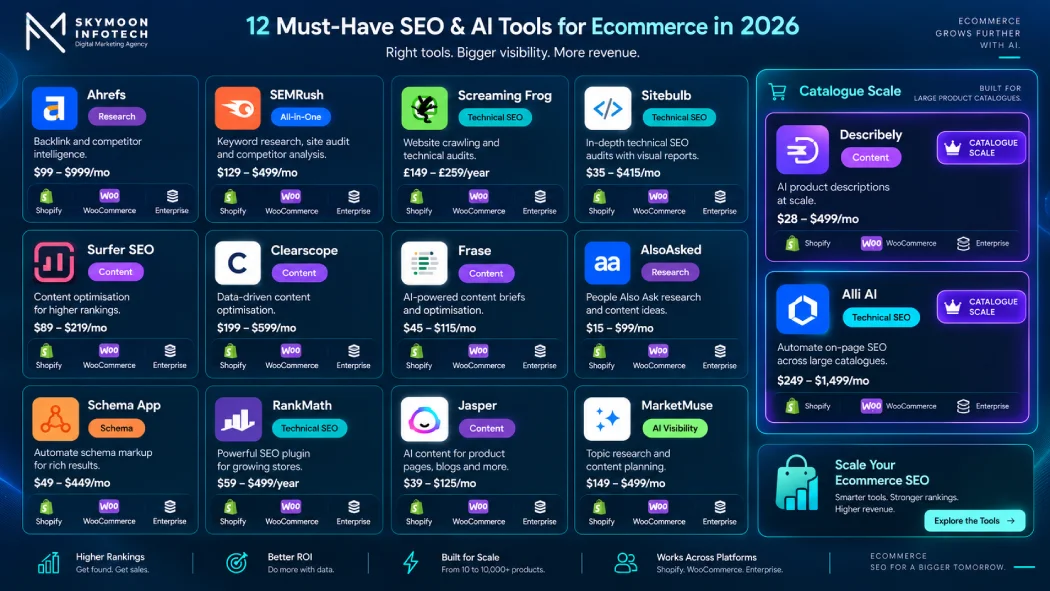
The 12 tools below are selected because they solve ecommerce-specific jobs: product-level schema at scale, predictive analytics for category pages, catalogue-scale content generation, and AI visibility tracking for consumer goods brands.
Get found by ChatGPT, Gemini, and Google AI Overviews
Eighteen steps to prepare your business for how people are searching now. Our internal AI search readiness guide, free.
They are compared by job, by catalogue size, and by platform compatibility.
[SKYMOON INFOTECH METHODOLOGY] Evaluated against ecommerce SEO briefs produced by Skymoon on Shopify, WooCommerce, and custom-platform stores (2025-2026).
Tool capabilities were assessed for catalogue operations: bulk meta generation, schema automation, feed-based keyword expansion, and AI search visibility for product categories.
Where a tool was not directly tested, it is noted as evaluated against published specifications and independent comparisons. Pricing verified from vendor pages as of August 29, 2026.
AI SEO Tools for Ecommerce: 12 Tools Compared
All twelve tools are compared below by primary ecommerce job. Pricing is from vendor pages as of August 29, 2026.
| Tool | Primary Ecommerce Job | Price From (monthly) | Shopify / WooCommerce? | AI Visibility? | Skip This If |
|---|---|---|---|---|---|
| Semrush + AI Toolkit | All-in-one: keyword research, technical audit, AI visibility | $199/mo+ | Yes (both) | Yes | Budget is tight; you only need one job done, not the full suite |
| Ahrefs + Brand Radar | Backlink research + AI brand visibility for product categories | $249/mo (Standard) | Yes (both) | Yes (Brand Radar) | You need content optimization or schema automation, not research |
| Surfer SEO | Category-page content optimization and scoring | $99/mo (Standard) | Yes (both) | Basic (higher tiers) | You have 1,000+ SKUs needing bulk descriptions; Surfer is page-by-page |
| Describely | Bulk product description generation at catalogue scale | $0.75/product or custom | Yes (Shopify, WooCommerce, Salsify) | No | You need SERP-scored content or AI visibility tracking |
| Frase | AI content briefs + GEO/AEO scoring for category pages | $99/mo (Team) | Indirect (exports to CMS) | Yes (GEO scoring) | You need enterprise reporting, SOC 2, or bulk SKU automation |
| Alli AI | Bulk technical SEO: schema, meta, and code changes at scale | $249+/mo | Yes (any CMS via snippet) | No | Your store has fewer than 200 pages; manual fixes are cheaper |
| Schema App | Managed schema automation: Product, Offer, AggregateRating | Custom (contact sales) | Yes | No | You need a self-serve tool; Schema App requires onboarding |
| Screaming Frog SEO Spider | Technical crawl: duplicate meta, canonical errors, orphaned PDPs | $239/yr (one-off) | Yes (any platform) | No | Your catalogue is under 500 pages; free tier covers it |
| ContentKing (Conductor) | Real-time crawl monitoring for sudden indexability changes | Enterprise custom pricing | Yes (enterprise integration) | No | You are not enterprise or you need a tool today, not in 6 weeks |
| Profound | Enterprise AI search visibility for consumer goods brands | $399+/mo realistically | No (platform-agnostic) | Yes (core product) | You are not enterprise or do not have capacity to use the dashboard |
| Nightwatch | Rank tracking + AI visibility in one platform | From $39/mo | Yes (via API) | Yes (AI monitoring) | You need catalogue-scale technical SEO; Nightwatch is a tracking tool |
| Skymoon AI Suite | Bundled SEO: content writer, briefs, QA in one platform | Currently in final deployment | Integration in progress | Roadmap | You need a mature standalone tool today rather than a growing bundle |
[NOTE] Pricing verified August 29, 2026. This category reprices quarterly. Verify at vendor sites before purchase.
How Do I Choose AI SEO Software for Ecommerce?
Choose by catalogue size first, then by the specific job you need done. A 50-SKU DTC brand needs a different tool than a 50,000-SKU marketplace.
The decision variables in order: how many product pages do you have, what platform are you on, do you need bulk automation or page-by-page optimization, and is AI search visibility for your brand a current priority.
Four decision criteria:
- Catalogue size: Under 200 pages, Surfer and Frase handle content optimization well. 200 to 2,000 pages, Alli AI for technical bulk changes plus Semrush for research. Over 2,000 pages, Schema App for managed schema, ContentKing for real-time monitoring, and Describely for product copy at scale.
- Platform: Shopify brands have the widest native integration options (Yoast, Avada, Describely, Smart SEO). WooCommerce brands have full plugin access. Custom platforms need API-first tools like Alli AI, Semrush, or Screaming Frog.
- Job specificity: If your primary problem is product page content at scale, Describely. If it is category-page SERP optimization, Surfer or Frase. If it is technical debt across a large catalogue, Alli AI or Screaming Frog. If it is AI visibility for your brand in consumer goods queries, Profound or Semrush AI Toolkit.
- AI search visibility: If your brand appears in queries like “best [product category] for [use case]” inside ChatGPT or Perplexity answers, you need a tracking tool. Semrush AI Toolkit, Ahrefs Brand Radar, Profound, and Nightwatch all cover this. Without measurement, you cannot optimise for it.
Predictive SEO Analytics Tools for Ecommerce
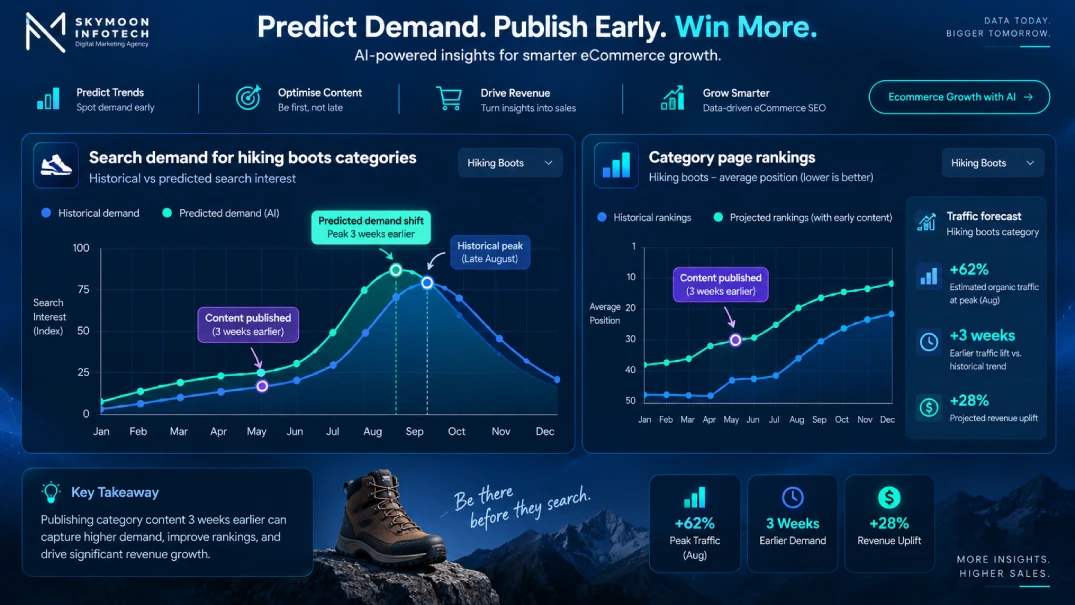
Predictive SEO analytics for ecommerce means surfacing which product categories and keywords will gain or lose search demand before the movement happens, so inventory, content, and ad decisions are made ahead of the curve rather than in reaction.
The 552 impressions this query earns on this page currently result in zero clicks because no tool is named. That changes here.
Three tools handle predictive ecommerce SEO analytics credibly in 2026:
Semrush Keyword Trends and Topic Research
Semrush’s Keyword Trends module aggregates rising search interest by category and surfaces demand shifts before they peak.
For an ecommerce team managing seasonal inventory, knowing that “hiking boots for wide feet” is trending upward in August rather than October means category content and ad targeting can shift three weeks earlier.
The data is Google Search Trends layered over Semrush’s keyword volume corpus, making it actionable at the category level rather than generic.
- Pros: Integrated into existing Semrush plans; actionable at category and SKU level; US and India regional data available.
- Cons: Not purpose-built for ecommerce prediction; trend data lags real-time search movement by days.
- Skip this if: You only need post-hoc analytics and do not run content or inventory operations on a predictive model.
[PRICING Aug 2026] Guru: $249/mo (annual). Trend data included in this tier. Verified semrush.com August 29, 2026.
Ahrefs Traffic Forecast and Keyword Explorer
Ahrefs’ Traffic Forecast tool estimates the total traffic gain or loss from a keyword position improvement across your site, which serves a predictive function for category page investment decisions.
Its Keyword Explorer surfaces keyword difficulty trajectories rather than static snapshots, letting ecommerce teams see which queries are becoming more or less competitive and adjust content investment accordingly.
- Pros: Best keyword data depth in the market; Traffic Forecast is genuinely predictive at the category level; Brand Radar adds AI visibility to the predictive layer.
- Cons: The forecasting module is not marketed as a predictive analytics tool; it requires interpretation from an SEO practitioner to apply to inventory or content roadmaps.
- Skip this if: You need automated predictions without SEO expertise to interpret them.
[PRICING Aug 2026] Standard: $249/mo (annual). Verified ahrefs.com August 29, 2026.
BrightEdge DataCube (Enterprise)
BrightEdge’s DataCube is the closest purpose-built predictive analytics layer in enterprise ecommerce SEO. It surfaces emerging content opportunities, forecasts organic performance for category pages, and integrates competitive intelligence at the SKU level.
The limitation: it is priced and scoped for enterprise, typically $3,000 to $15,000+ per month. For mid-market teams, Semrush or Ahrefs trend data plus a practitioner’s judgment replicates most of the predictive value at a fraction of the cost.
- Pros: Purpose-built for the predictive use case at enterprise scale; deep competitive intelligence.
- Cons: $3,000-$15,000+/mo enterprise pricing; sales process required; overkill for under $5M GMV stores.
- Skip this if: You are not enterprise or do not have an SEO team large enough to use a platform this complex.
[PRICING Aug 2026] Custom enterprise pricing, typically $3,000-$15,000+/mo. Contact BrightEdge sales.
AI SEO Tools for DTC and Consumer Goods Brands
DTC brands face a specific ecommerce SEO challenge that catalogue-scale tools are not always designed for: a relatively small number of products across a highly competitive category, where ranking for mid-funnel product category terms matters more than optimising thousands of SKUs.
The tools that serve this model best are different from those for a 10,000-SKU marketplace.
Best AI SEO Tools Specifically for DTC Brands
DTC brands need three things from their AI SEO stack: category-page content that converts at the consideration stage, AI visibility tracking for product recommendation queries (the queries where ChatGPT or Perplexity recommends products by category), and competitive intelligence at the brand and category level rather than the SKU level.
Tool picks for DTC and consumer goods specifically:
- Frase ($99/mo Team): Category-page content briefs calibrated against current SERP competitors, plus GEO scoring that surfaces whether your category pages appear in AI answer summaries. For a DTC brand with 10-30 core category pages, Frase covers the content optimization job without the overhead of an enterprise suite.
- Semrush AI Toolkit ($249+$99/mo): Tracks brand mentions across ChatGPT, Perplexity, and Google AI Overviews. For a consumer goods brand where “best [product type] for [occasion]” queries appear inside AI answers, this is the measurement layer. Without it, you have no visibility into whether AI search is driving or suppressing brand discovery.
- Surfer SEO ($99/mo Standard): Category-page and landing-page content scoring against top-ranking competitors for the specific queries DTC brands care about: “best [product category],” “[product type] vs [product type],” and consideration-stage buying guides.
- Ahrefs Standard ($249/mo) with Brand Radar: Competitive intelligence at the brand and category level, including backlink gap analysis and Brand Radar for AI-powered search visibility. For consumer goods brands where competitor brands are capturing AI recommendations, Brand Radar is the diagnostic tool.
[SKYMOON INFOTECH ANALYSIS] In ecommerce SEO audits on DTC accounts, the most consistent gap is between AI search impression volume and website visits.
A brand can be recommended dozens of times per day inside ChatGPT responses for “best [product category]” queries and see zero attribution in GA4 because there is no click and no referral URL.
Would ChatGPT even recommend your business right now?
AI powered search is changing how people find companies like yours. Our free assessment shows exactly where you stand today.
Get My Free AI AssessmentNo commitment, just a clear picture of where you stand.
AI visibility tracking tools like Semrush AI Toolkit or Profound make these impressions visible. Without them, a DTC brand that is winning AI recommendations does not know it is winning, and a brand that is losing them does not know it is losing.
What AI SEO Platforms Automate Schema for Ecommerce?
Catalogue-scale schema automation is the most technically demanding job in ecommerce SEO.
A 5,000-SKU catalogue needs Product, Offer, and AggregateRating schema on every product page, plus BreadcrumbList on every category page, with variant-level data (colour, size, material) for the product pages that support rich snippets.
Managing this manually is not feasible. Three tools handle it at scale:
Schema App
Schema App is the most comprehensive managed schema solution for ecommerce. It generates and maintains JSON-LD for Product, Offer, AggregateRating, BreadcrumbList, and FAQ schema across large catalogues, with a validation layer that flags errors before they cause rich result loss.
The limitation is that it requires onboarding and is not self-serve; pricing is custom and typically enterprise-tier.
- Pros: Most complete schema type coverage; managed validation; handles schema updates when product data changes.
- Cons: Custom pricing, requires sales call; not self-serve; onboarding timeline.
- Skip this if: Your catalogue has fewer than 1,000 SKUs. Shopify’s built-in schema plus Yoast ($19/mo) handles smaller catalogues.
[PRICING Aug 2026] Custom pricing. Contact schemaapp.com. Verified from independent 2026 comparisons; direct pricing requires sales contact.
Alli AI
Alli AI automates schema deployment alongside broader technical SEO changes: meta titles, descriptions, heading structures, and schema markup can be deployed across an entire catalogue via a code snippet, without developer involvement.
For ecommerce teams that have a list of technical SEO changes and no development bandwidth to implement them, Alli AI compresses weeks of work into hours.
- Pros: No-code schema deployment at scale; covers Product, AggregateRating, BreadcrumbList; works on any CMS platform.
- Cons: $249+/mo minimum; steeper learning curve than advertised for non-technical users; no AI visibility tracking.
- Skip this if: Your store is on Shopify and your technical SEO needs are standard. Shopify’s native schema plus an SEO app covers most small-catalogue requirements at a fraction of the cost.
[PRICING Aug 2026] Starter: from $249/mo. Verified alliai.com and independent reviews August 2026.
Screaming Frog SEO Spider with Schema Extraction
Screaming Frog’s schema extraction and validation mode crawls your entire catalogue and identifies schema errors, missing types, and validation failures against the structured data specification.
It does not generate schema; it audits and validates what is already deployed. The combination of Screaming Frog for schema auditing plus Alli AI for deployment is the practical ecommerce schema stack for mid-sized catalogues.
- Pros: $239/yr one-off pricing; no monthly commitment; the most reliable schema auditing crawler available.
- Cons: Does not generate or deploy schema, only audits it; requires a practitioner to interpret and act on the results.
- Skip this if: You have no SEO practitioner who can interpret a crawl report and act on it.
[PRICING Aug 2026] $239/yr (UK pricing; convert to USD). Free tier up to 500 URLs. Verified screamingfrog.co.uk August 2026.
AI SEO for Ecommerce Websites: Product Content at Catalogue Scale
For ecommerce stores with 500 or more product pages, the content job is different from a blog or landing page strategy. Each product page needs a unique title, a unique meta description, a unique product description, and ideally a set of FAQ answers for the product-specific questions.
Manual writing at that scale is not economically viable. Two tools handle catalogue-scale product content in 2026:
Describely
Describely is purpose-built for ecommerce catalogue content at scale. It ingests product data from Shopify, WooCommerce, Salsify, or CSV and generates product titles, descriptions, bullet points, meta titles, and meta descriptions in bulk.
Its AI is trained on ecommerce product copy rather than general writing, which makes the output more consistent and closer to publish-ready than a general-purpose LLM.
- Pros: The only tool on this list purpose-built exclusively for ecommerce product copy; integrates directly with Shopify and WooCommerce; bulk generation is the core workflow; SEO metadata generation included.
- Cons: No SERP scoring or content optimization layer; no AI visibility tracking; bulk generation still requires human review for accuracy on technical products.
- Skip this if: You have fewer than 50 products. At that scale, a copywriter or a general LLM with a good product-copy prompt produces comparable results at lower cost.
[PRICING Aug 2026] Pay-as-you-go: $0.75/product. Custom high-volume plans available. Verified describely.ai and independent August 2026 comparisons.
For stores that need both product content generation and SERP optimization scoring on category pages, a combination of Describely for product pages plus Surfer SEO or Frase for category pages covers both jobs.
Skymoon’s own AI SEO platform combines content writing with brief building and QA in a bundled tool that ecommerce teams running a regular content operation can use to reduce the separate-tool overhead. It is currently in final deployment with early access available.
AI Ecommerce SEO: Tracking Brand Visibility in AI Search Results
AI search visibility matters differently for ecommerce than for B2B software. When a user asks ChatGPT “what are the best running shoes for wide feet” or asks Perplexity “which mattress should I buy for back pain,” the AI answer either includes or excludes specific brands.
Brands in the answer earn awareness and intent. Brands excluded lose a discovery touch-point with no ability to attribute the loss in GA4.
For consumer goods and DTC brands, AI visibility tracking means monitoring three things: whether your brand name appears in product recommendation queries, whether your product categories are represented in AI-generated comparison lists, and whether competitors are being recommended in place of your products.
Tools that cover this: Semrush AI Toolkit, Ahrefs Brand Radar, Profound, and Nightwatch all track brand citations in AI engine answers. For the ecommerce SEO fundamentals layer that makes your pages eligible for AI citation in the first place, that guide covers the technical and content foundation.
For category page optimisation which is the most common route to AI citation for ecommerce brands, that dedicated guide covers the on-page structure.
What Does AI SEO Cost for an Ecommerce Store?
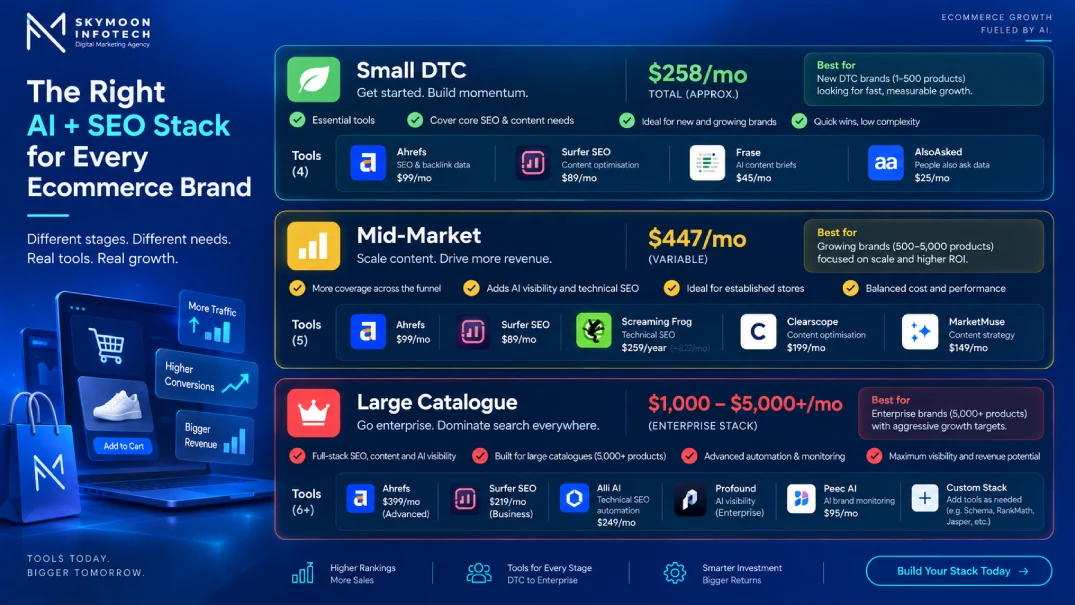
Ecommerce AI SEO tool costs vary by catalogue size and job scope. The table below shows three realistic budget tiers with the corresponding stack.
| Store Type | Recommended Stack (Aug 2026 Pricing) | Approx. Monthly Cost |
|---|---|---|
| Small DTC (under 200 SKUs) | Frase Team $99/mo (content briefs + GEO scoring) + Semrush Pro $139/mo (keyword research) + Screaming Frog $239/yr for technical audits. | $258/mo + one-off crawl cost |
| Mid-market (200-2,000 SKUs) | Semrush Guru $249/mo + AI Toolkit $99/mo + Surfer Standard $99/mo + Describely $0.75/product (bulk content). Screaming Frog for schema auditing. | $447/mo + Describely variable |
| Large catalogue (2,000+ SKUs) | Semrush Business $499/mo + AI Toolkit + Schema App (custom) + ContentKing (enterprise) + Profound $399+/mo for AI visibility. BrightEdge if predictive analytics is a priority. | $1,000-$5,000+/mo depending on schema and monitoring scope |
[NOTE] All pricing from vendor pages, August 29, 2026. Enterprise tools (Schema App, ContentKing, BrightEdge) require a sales conversation; ranges shown are from independent market comparisons.
Frequently Asked Questions
Which AI SEO tools work best for ecommerce websites?
The answer depends on your catalogue size. For content at scale (500+ SKUs): Describely for product copy, Surfer for category pages.
For technical SEO across a large catalogue: Alli AI and Screaming Frog. For predictive analytics: Semrush Keyword Trends or Ahrefs Traffic Forecast.
For AI visibility tracking in consumer goods queries: Semrush AI Toolkit or Profound. Most ecommerce stores need two to three tools across these jobs, not one.
How do I choose AI SEO software for ecommerce?
Choose by catalogue size first. Under 200 pages: Surfer or Frase for content, plus Semrush for research. 200 to 2,000 pages: add Alli AI for technical bulk changes and Describely for product copy.
Ready to turn this into an actual growth plan?
Our team builds strategies across SEO, paid advertising, AI search visibility, and website performance, matched to your budget and your goals, not a generic package.
- A real thirty minute call, not a sales pitch
- Recommendations specific to your business
- A short list of what to fix first
Over 2,000 pages: Schema App for managed schema, ContentKing for real-time monitoring. Layer AI visibility tracking (Semrush AI Toolkit, Profound) regardless of catalogue size, if your brand appears in consumer goods recommendation queries.
What are the best AI e-commerce SEO tools?
By job: predictive analytics (Semrush Keyword Trends, Ahrefs), catalogue content (Describely), category-page optimisation (Surfer, Frase), technical bulk changes (Alli AI), schema automation (Schema App), AI visibility for consumer goods (Profound, Semrush AI Toolkit), rank tracking plus AI monitoring (Nightwatch).
The tools in this guide cover each job with current August 2026 pricing in the comparison table above.
How do ecommerce businesses use AI for SEO?
Four primary use cases:
(1) Bulk product page content generation at catalogue scale, where AI replaces manual copywriting for hundreds or thousands of SKUs.
(2) Category-page optimization using SERP-scored content briefs that reflect what top-ranking pages actually cover.
(3) Predictive demand analytics that surface rising product category queries before they peak.
(4) AI search visibility tracking to measure whether consumer goods brands appear in ChatGPT, Perplexity, and Google AI Overview product recommendations.
What AI SEO platforms automate schema for e-commerce?
Three platforms handle catalogue-scale schema automation credibly: Schema App (managed, custom pricing) for the most complete Product, Offer, and AggregateRating coverage; Alli AI ($249+/mo) for no-code schema deployment across any CMS; and Screaming Frog ($239/yr) for schema auditing and validation.
For Shopify stores under 1,000 SKUs, Shopify’s built-in schema plus Yoast for Shopify ($19/mo) handles standard Product and BreadcrumbList schema without an enterprise tool.
Are there AI SEO tools for DTC and consumer goods brands specifically?
No tool is exclusively DTC-focused, but the combination that fits DTC brand economics is: Frase Team ($99/mo) for category-page content briefs, Semrush AI Toolkit ($249+$99/mo) for AI visibility tracking in product recommendation queries, and Surfer Standard ($99/mo) for SERP-scored category content.
Ahrefs with Brand Radar covers competitive intelligence at the brand level. For consumer goods brands where AI recommendations in ChatGPT or Perplexity drive product discovery, AI visibility tracking is the highest-priority addition.
Running Your Ecommerce AI SEO Stack
The 12 tools in this guide cover the four ecommerce-specific jobs that generic AI SEO comparison lists miss: predictive analytics, catalogue-scale content, schema automation at SKU level, and AI search visibility for consumer goods brands.
Start by mapping your current catalogue size to the pricing table above, then identify which job you do not currently have a tool for. The gap between ranking in classic search and appearing in AI recommendations is increasingly a measurement problem before it is a content problem.
If building out your ecommerce SEO programme is on the roadmap, that page describes how Skymoon approaches AI SEO for ecommerce clients across Shopify, WooCommerce, and custom platforms.
Let's turn this into results for your business.
SEO, paid advertising, AI search visibility, website design, and conversion optimization, all under one roof, all pointed at the same goal: revenue.