
WordPress vs Shopify in 2026 is a more complicated comparison than it was three years ago. Both platforms have moved: Shopify has added native AI tools, rebuilt its pricing structure, and aggressively expanded into agentic commerce. WordPress has introduced AI through its plugin ecosystem, doubled down on content SEO flexibility, and remains the dominant CMS globally. The choice between them is now less about which is better in absolute terms and more about which fits your specific situation.
This guide covers the decision from three angles where the comparison has changed most in 2026: total real cost (not the sticker price), SEO capability head-to-head, and the AI tooling landscape that did not exist in most previous comparisons. Whether you are choosing a platform for the first time or re-evaluating an existing site, these are the three areas where the 2026 decision diverges most from older guidance.
Is your website actually built to convert?
Twenty two checks covering Core Web Vitals, user experience, and conversion paths. The exact list we run before every website audit.
Quick verdict for people in a hurry: Choose Shopify if you want faster setup, predictable costs, native AI tools, and less technical overhead. Choose WordPress with WooCommerce if you need deeper SEO control, complex content architecture, or a lower total cost at scale with a capable developer. Neither is universally better.
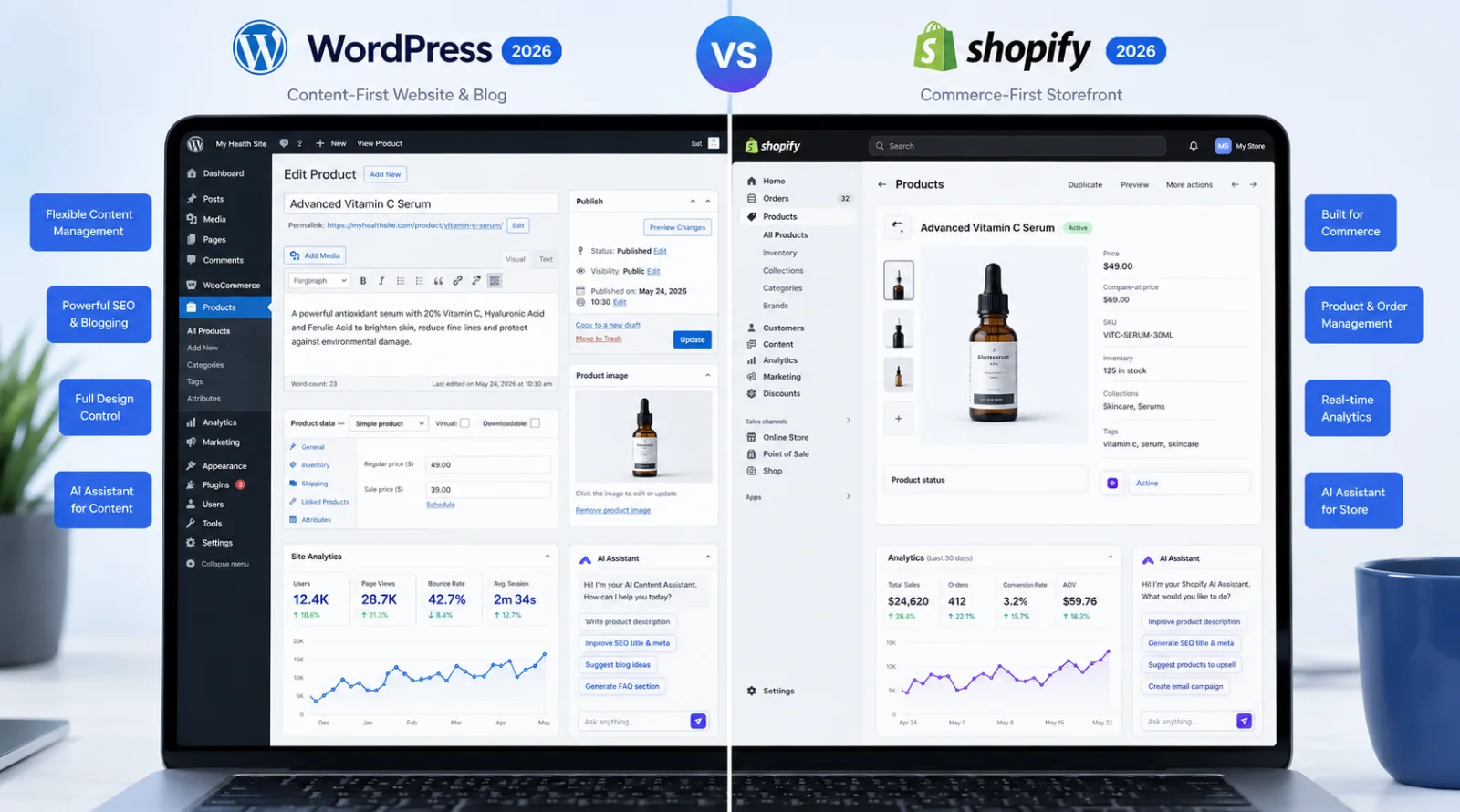
WordPress vs Shopify in 2026: Where Both Platforms Stand
The market position of each platform in 2026 matters as a baseline for the comparison because scale determines plugin availability, community support, theme quality, and the pace of AI feature development.
| Metric | WordPress | Shopify | What It Means |
|---|---|---|---|
| CMS market share | 41.9% of all websites (W3Techs, 2026) | 5.6M+ live stores | WordPress is the dominant general-purpose CMS; Shopify leads among dedicated hosted ecommerce platforms |
| Primary audience | Content sites, blogs, agencies, ecommerce via WooCommerce | Ecommerce stores, D2C brands, dropshippers | If ecommerce is your only goal, Shopify has a narrower and tighter feature set. WordPress handles more use cases. |
| AI in 2026 | Plugin-based: Elementor AI (Angie), Divi AI, Jetpack AI | Native: Shopify Magic, Sidekick, AI theme generation, Agentic Storefronts | Shopify ships AI by default. WordPress requires choosing and managing AI plugins separately. |
| Hosting model | Self-hosted (you choose, configure, maintain) | Fully hosted (Shopify manages infrastructure) | WordPress gives control. Shopify eliminates infrastructure work. |
| Developer requirement | Strongly recommended for ecommerce; optional for basic sites | Not required for standard store setup | Solo founders launch Shopify stores without code. WooCommerce stores often need developer input. |
Real Cost Comparison: WordPress vs Shopify in 2026
The most misleading claim in the wordpress vs shopify debate is that WordPress is free and Shopify is expensive. Both statements are partially true and completely incomplete. WordPress.org software costs nothing. Running an ecommerce store on it does. Shopify’s sticker price is predictable. The real cost with apps and transaction fees is not always what the plan page shows.
Shopify Pricing 2026: What Each Plan Actually Costs
| Plan | Monthly (billed monthly) | Monthly (billed annually) | Transaction Fee (Shopify Payments) | 3rd-Party Gateway Surcharge |
|---|---|---|---|---|
| Basic | $39/month | $29/month | 2.9% + $0.30 per transaction | 2% per transaction |
| Grow | $105/month | $79/month | 2.7% + $0.30 per transaction | 1% per transaction |
| Advanced | $399/month | $299/month | 2.5% + $0.30 per transaction | 0.6% per transaction |
| Plus | From $2,300/month | From $2,300/month | Negotiated, typically ~2.45% | Waived on qualifying plans |
Annual billing saves a flat 25% on Basic, Grow, and Advanced plans. New stores get a $1/month promotional rate for the first three months. If you use Shopify Payments as your payment processor, the 3rd-party gateway surcharge is completely eliminated. Confirm current live pricing at shopify.com/pricing before committing, since Shopify adjusts plan pricing and promotional offers periodically.
Total Price of a WordPress.org Blog Site vs Shopify: The Real Year-One Numbers
The total price of a wordpress.org blog site vs shopify in year one is not what either platform’s marketing page suggests. Here is an honest breakdown based on what a competitive small business ecommerce store actually requires on each platform:
| Cost Component | WordPress + WooCommerce (Year 1) | Shopify Basic (Year 1) |
|---|---|---|
| Platform / software | $0 (open-source) | $468/year ($39/mo) or $348/year ($29/mo annual) |
| Hosting | $120-360/year (managed: SiteGround, Kinsta, WP Engine) | Included in plan |
| Domain name | $15-20/year | $15-20/year (not included in plan) |
| SSL certificate | Included with most hosts (free) | Included in plan |
| Theme | $60-100 one-time (premium) | $150-500 one-time (premium) OR free Shopify themes |
| Essential plugins / apps | $200-700/year (WooCommerce extensions, security, SEO, caching) | $120-600/year (3-8 apps at $10-50/month typical) |
| Payment processing | 2.9% + 30c per transaction (Stripe/PayPal typical) | 2.9% + 30c per transaction (Shopify Payments on Basic) |
| Developer setup cost | $0 (if self-managed) to $500-2,000+ (if outsourced) | $0 for basic stores; $0-1,000 for custom work |
| Estimated Year-1 Total | $1,200-1,600 (competitive store, self-managed) | $468-900 (Basic annual, minimal apps, own domain) |
| Year-2 note | Hosting renews at full rate (often $200-300 higher than promo rate) | Predictable renewal at same plan price |
The shopify versus wordpress cost gap depends heavily on transaction volume and technical overhead. The wordpress vs shopify cost comparison shifts significantly at scale. A high-volume WordPress store that has already paid for its technical stack and is running efficiently costs less per additional transaction than Shopify, because WooCommerce does not charge transaction fees on top of payment processor fees. Shopify’s per-transaction surcharges (2% on Basic if using a 3rd-party gateway) become material at higher revenue volumes.
Is WordPress or Shopify Better for SEO? The 2026 Verdict
The is wordpress or shopify better for seo debate has a nuanced answer in 2026. Shopify’s baseline technical SEO is strong out of the box. WordPress gives deeper control over every SEO lever if you are willing to manage that control actively. Which is better for seo depends on what you are optimizing for.
Your website might be losing customers before they even scroll
Slow load times, confusing navigation, and weak calls to action quietly cost businesses real revenue every month. See exactly what yours is missing.
No commitment, just a clear picture of where you stand.
Where Shopify Wins on SEO
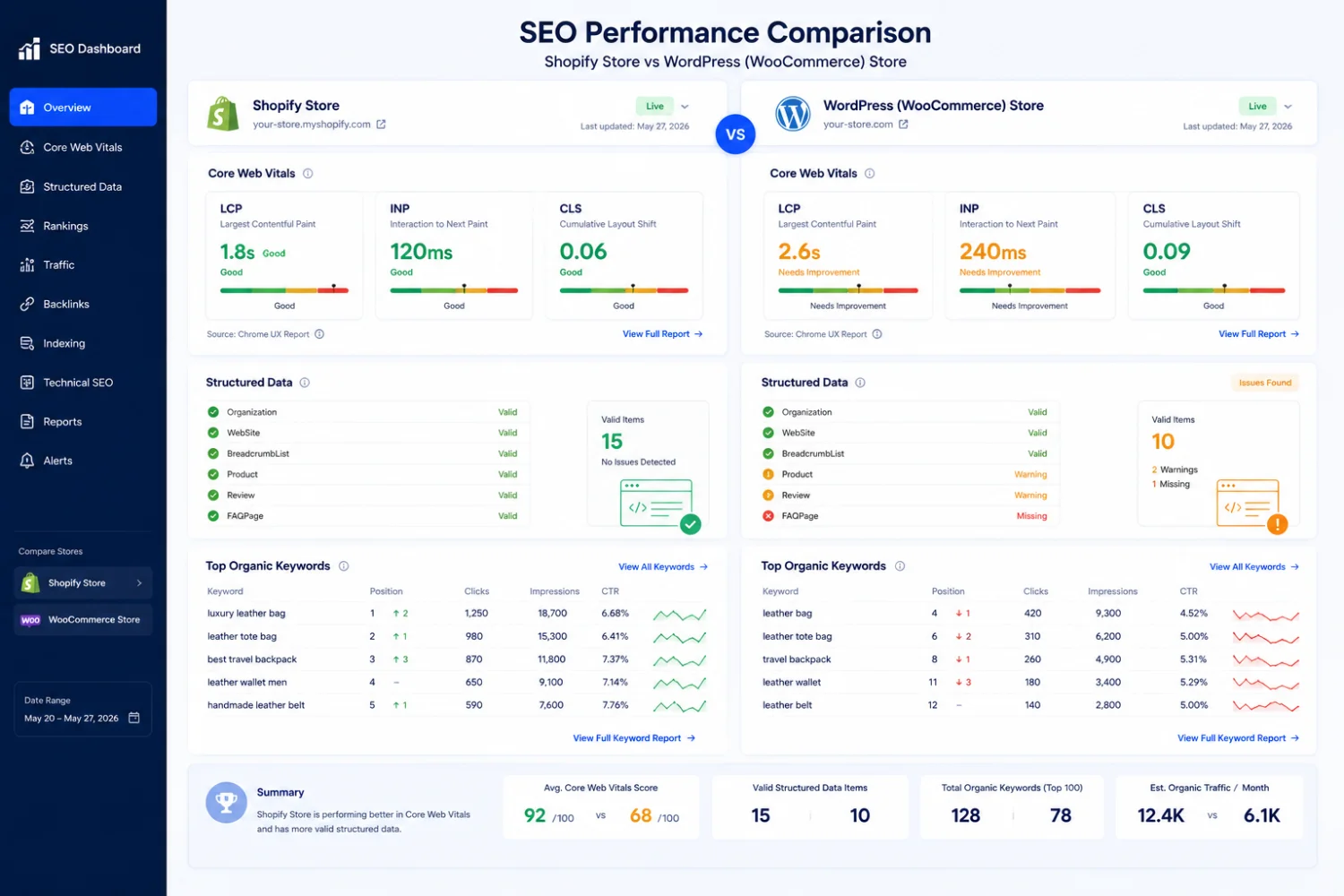
- Core Web Vitals performance out of the box. Shopify’s themes are built on a fast, clean codebase with image optimization, lazy loading, and CDN delivery handled automatically. Most Shopify stores pass Core Web Vitals without developer intervention. Most WooCommerce stores require active optimization work to reach the same baseline.
- SSL, mobile responsiveness, and site speed handled at platform level. These are not optional extras on Shopify: they are infrastructure. Every store on every plan gets the same fast, secure infrastructure regardless of technical skill.
- Structured data for products included by default. Shopify generates Product and BreadcrumbList schema for product pages without plugin configuration. This is a direct SEO advantage for ecommerce stores where product schema affects how listings appear in Google Search and AI Overviews.
- Agentic Storefronts for AI search visibility. Shopify’s 2026 launch of Agentic Storefronts syndicates product data to ChatGPT and other AI search interfaces natively, making products discoverable in AI-generated shopping responses without separate optimization work.
Where WordPress Wins on SEO
- Complete URL structure control. WordPress allows fully custom permalink structures, clean category URLs, and canonical tag configuration at a granular level that Shopify’s fixed URL patterns do not match. For content-heavy ecommerce sites where URL architecture affects crawl efficiency, this matters.
- Advanced content SEO through Rank Math or Yoast. The breadth of on-page SEO control available through Rank Math Pro on WordPress exceeds what Shopify’s native tools and most SEO apps provide. Detailed schema configuration, redirect management, schema type customization, and breadcrumb control are areas where WordPress has a practical advantage.
- Long-form content and blogging architecture. WordPress’s native blogging and content management capabilities are structurally stronger than Shopify’s built-in blog. For stores where organic content is a primary acquisition channel, WordPress’s content SEO infrastructure is more capable. Ecommerce SEO tactics that depend on content cluster architecture are more easily implemented on WordPress.
- Plugin-level control over technical SEO elements. Crawl budget management, robot.txt control, hreflang implementation, and structured data customization are all more granular on WordPress. Large stores with complex international or multi-language requirements typically find WordPress gives them the control Shopify does not.
The SEO Verdict – wordpress vs shopify seo
For a new ecommerce store without complex content requirements: Shopify’s technical SEO baseline is stronger and requires less active management. For a content-heavy brand where organic traffic from editorial content is a primary growth lever: WordPress’s content and structural SEO capabilities justify the technical overhead. In the wordpress vs shopify seo comparison, neither platform is universally better. The question is whether your SEO strategy is primarily technical and product-focused (Shopify advantage) or content-architecture-intensive (WordPress advantage).
Core Web Vitals note: Both platforms can pass Core Web Vitals. Shopify reaches passing scores faster with less configuration. WordPress requires active optimization particularly for LCP and INP on plugin-heavy stores. The Core Web Vitals 2026 guide covers the specific fixes that apply to each platform.
AI Tools Compared – Shopify vs WordPress in 2026
The AI tooling landscape is the section where the shopify versus wordpress comparison has changed most since 2024. This is the biggest content gap identified versus competitors, and the actual point of this refresh for readers already familiar with the basic platform comparison.
Shopify AI Tools in 2026
Shopify ships AI natively in 2026 rather than through third-party app integrations. The core AI tools included with standard plans are:
- Shopify Magic: generates product descriptions, email content, FAQ answers, and ad copy from a product URL or brief text prompt. Available on all paid plans. Produces drafts that merchants edit rather than finished copy that publishes automatically.
- Shopify Sidekick: a conversational AI assistant integrated into the Shopify admin. Answers questions about store performance, suggests actions based on analytics, and can execute some store changes (creating discount codes, updating inventory settings) through natural language commands.
- AI theme generation: generates a starting theme layout from a description of the business and product type. Reduces initial setup time for stores without a design background.
- Agentic Storefronts: syndicates product catalogue data to AI shopping interfaces including ChatGPT and Perplexity, making products discoverable in AI-generated shopping recommendations without separate integration work. This is a 2026 launch and the most significant AI-commerce feature Shopify has shipped.
WordPress AI Tools in 2026
WordPress’s AI capabilities come through its plugin ecosystem rather than platform-native features. The most widely used AI integrations for WordPress stores in 2026 are:
- Elementor AI (Angie): the AI assistant built into Elementor Pro, which handles AI-driven page building, content generation inside the editor, and MCP-based agentic tasks. Angie is positioned as an agentic assistant rather than a content generation tool, capable of multi-step actions within the Elementor environment.
- Divi AI: integrated into the Divi builder, generates page layouts, sections, and written content from prompts. Tight integration with the Divi ecosystem makes it most useful for stores already built on Divi.
- Jetpack AI: adds AI writing assistance, content summarization, and form generation to WordPress without a page builder dependency. Works across any theme and is usable on WordPress.com and self-hosted installations.
- WooCommerce + third-party AI apps: WooCommerce does not ship native AI. Product description generation, chatbots, and recommendation engines require separate plugins or integrations such as Tidio, LiveChat, or Yoast AI features.
| AI Capability | Shopify (2026) | WordPress + WooCommerce (2026) |
|---|---|---|
| Product description AI | Shopify Magic (built-in, all plans) | Elementor AI, Divi AI, Jetpack AI (plugin-dependent) |
| Admin assistant | Shopify Sidekick (conversational, action-capable) | Elementor Angie (builder-specific); no universal WP admin AI |
| AI shopping / agentic commerce | Agentic Storefronts (native, syndicates to ChatGPT/Perplexity) | Not available natively; requires custom integrations |
| Theme / design AI | AI theme generator (built-in) | Elementor AI, Divi AI (within their respective builders) |
| Content / writing AI | Shopify Magic for copy; email marketing AI | Jetpack AI, Elementor AI, Divi AI (choose per builder) |
| Integration requirement | None: all ship with standard plans | Plugin selection required; compatibility varies per stack |
| Cost of AI features | Included in existing plan pricing | Varies by plugin: some free tier, most premium |
The AI tooling verdict: Shopify has a meaningful advantage in native AI integration in 2026. The features ship without configuration and without compatibility risk. WordPress’s AI ecosystem is more flexible because it allows choosing tools that match your workflow, but that flexibility requires active management and plugin compatibility work that Shopify’s native stack eliminates.
WordPress or Shopify – Head-to-Head Comparison Across Key Decision Factors
| Factor | WordPress Wins | Shopify Wins | Context |
|---|---|---|---|
| Setup speed | Yes | Shopify stores launch in hours. WordPress+WooCommerce setup takes days to weeks for a production-ready store. | |
| Year-1 cost (basic store) | Often | WP+WooCommerce can run $348-600 on lean shared hosting. Shopify Basic annual is $348 + domain + apps. | |
| Year-1 cost (competitive store) | Often | Competitive WP stores cost $1,200-1,600/year. Competitive Shopify Basic stores can land $500-900/year with minimal apps. | |
| SEO control (technical) | Yes | URL structure, crawl control, redirect management, schema customization are all more granular on WordPress. | |
| SEO baseline (no configuration) | Yes | Shopify’s default technical SEO (speed, mobile, schema) is better than a default WooCommerce install. | |
| Content blogging architecture | Yes | WordPress’s content infrastructure is built for publishing; Shopify’s blog is functional but not its core strength. | |
| Native AI tools | Yes | Shopify Magic and Sidekick ship by default. WordPress AI requires choosing and managing plugins. | |
| Agentic / AI commerce | Yes | Agentic Storefronts (ChatGPT/Perplexity product syndication) is Shopify-native with no WordPress equivalent. | |
| Customization ceiling | Yes | WordPress + WooCommerce has no architectural ceiling. Shopify imposes platform-level constraints on checkout and data structure. | |
| Plugin / app ecosystem | Yes (60,000+ plugins) | WordPress’s plugin library is vastly larger. Shopify’s app store is more curated but smaller. | |
| Technical overhead | Yes | Shopify eliminates hosting, security, updates, and backups. WordPress requires managing all of these. | |
| Transaction fees | Yes (at scale) | WooCommerce does not add per-transaction fees on top of payment processor fees. Shopify does (unless using Shopify Payments). |
Who Should Choose Shopify vs WordPress in 2026?
Choose Shopify If:
- You are launching a new store and want to be selling within days rather than weeks
- Your team does not include a developer or technical resource willing to manage hosting, updates, and plugin compatibility
- You want native AI tools for product description, admin assistance, and AI shopping visibility without integrating third-party plugins
- You process high order volumes where Shopify Payments transaction fee savings outweigh the plan cost
- You need a fully managed platform where security, backups, and infrastructure are handled without your involvement
Choose WordPress (with WooCommerce) If:
- Content marketing and organic SEO are central to your growth strategy and you need the full flexibility of WordPress’s editorial and technical SEO architecture
- You have a developer resource willing to manage hosting, plugin updates, and technical maintenance
- You need deep customization of the checkout flow, customer data ownership, or backend integrations that Shopify’s platform constraints do not accommodate
- You are building a site that is more content-plus-ecommerce than pure-ecommerce, where WordPress’s content strengths outweigh Shopify’s ecommerce-first design
- You want to avoid per-transaction fees at high revenue volumes and are using a preferred payment gateway
On WooCommerce vs Shopify specifically: The WooCommerce vs Shopify comparison is a distinct topic with its own keyword cluster and decision factors. It is not fully covered in this post. A dedicated comparison covering WooCommerce vs Shopify on plugin ecosystem, extension costs, and developer tooling is planned as a separate guide.
Frequently Asked Questions – WordPress vs Shopify 2026
Is Shopify or WordPress cheaper in 2026?
For a minimal launch, both can start around $350-400 in year one. For a competitive small business ecommerce store, WordPress with WooCommerce typically costs $1,200-1,600 in year one including hosting, theme, and essential plugins. Shopify Basic on annual billing with minimal apps lands at $500-900. Year two costs on WordPress often increase when hosting promotional rates expire.
Ready to turn this into an actual growth plan?
Our team builds strategies across SEO, paid advertising, AI search visibility, and website performance, matched to your budget and your goals, not a generic package.
- A real thirty minute call, not a sales pitch
- Recommendations specific to your business
- A short list of what to fix first
What is the real cost of a WordPress store vs a Shopify store?
The total price of a wordpress.org blog site vs shopify includes costs that neither platform prominently advertises. For WordPress: domain ($15-20), managed hosting ($120-360), premium theme ($60-100), and essential plugins ($200-700) sum to $395-1,180 before developer work. For Shopify Basic: $348 annually plus a domain ($15-20) and apps ($120-600) brings the realistic total to $483-968. Transaction fees add to both depending on payment setup.
Is WordPress or Shopify better for SEO?
Shopify’s SEO baseline is stronger out of the box with automatic Core Web Vitals compliance, product schema, and fast infrastructure. WordPress gives more granular control over URL structure, crawl management, redirects, and schema configuration through plugins like Rank Math. For product SEO, Shopify requires less effort. For content-driven and technical SEO at scale, WordPress offers more control.
Does Shopify or WordPress have better AI tools in 2026?
Shopify has a clear advantage in native AI tools in 2026. Shopify Magic, Sidekick, and Agentic Storefronts ship with all paid plans and require no configuration. WordPress gets AI through plugins including Elementor AI (Angie), Divi AI, and Jetpack AI, which are capable but require choosing, installing, and maintaining separately from the core platform.
Can I switch from Shopify to WordPress without losing my SEO rankings?
Platform migration is possible but requires a disciplined 301 redirect plan, structured data recreation, URL structure matching where possible, and speed validation on the new host before cutover. Migrations that skip redirect mapping or allow canonical conflicts typically see a temporary ranking drop lasting 3-6 months. Migrations done correctly with proper redirect coverage preserve most authority within 60-90 days of the switch.
Need Help Deciding Between WordPress vs Shopify?
The wordpress vs shopify decision is not one-size-fits-all in 2026. Both platforms have genuine advantages depending on your technical resource, content strategy, and AI commerce requirements. If your primary concern is getting ecommerce SEO right on whichever platform you choose, Skymoon’s ecommerce SEO services cover platform-specific SEO optimization for both Shopify and WooCommerce. For a direct platform assessment against your specific store requirements and current GSC data, book a free strategy consultation and we will give you a recommendation based on your actual situation, not a generic answer.
Let's turn this into results for your business.
SEO, paid advertising, AI search visibility, website design, and conversion optimization, all under one roof, all pointed at the same goal: revenue.