
Landing page design best practices are the foundation of effective conversion rate optimization because even the best marketing campaign fails if the page does not convert. Many businesses focus heavily on traffic generation but overlook the structure, clarity, and psychology of their landing pages. The result is high bounce rates, low engagement, and wasted ad spend.
The landing page design importance goes far beyond colors and layout. A well-designed landing page guides attention, reduces friction, builds trust, and drives a single, focused action. Whether the goal is lead generation, product sales, demo bookings, or webinar registrations, design directly influences user behavior.
Turn more of your existing traffic into customers
Twenty checks across landing pages, calls to action, forms, and trust signals. No extra traffic needed, just a better funnel.
Today’s users decide within seconds whether to stay or leave. Visual hierarchy, CTA placement, copy clarity, and trust signals all determine whether visitors convert or exit. That is why landing page conversion rate optimization starts with intentional design decisions rather than surface-level styling.
In this guide, you will learn how to design a landing page that converts, discover proven landing page design tips, explore real landing page design examples, avoid costly landing page design mistakes, and implement a structured landing page design checklist to increase landing page conversion rate consistently.
This article combines data-backed insights, CRO frameworks, and practical implementation strategies to help you turn landing pages into measurable growth assets.
Why Landing Page Design Matters in CRO
Landing page design importance becomes clear when you connect design directly to behavior. Conversion rate optimization is not just about testing button colors or rewriting headlines. It is about understanding how users process information and making design decisions that guide them toward action.
A landing page is a decision environment. Every element either reduces doubt or increases friction. The structure, spacing, typography, imagery, and call to action placement all influence whether a visitor converts.
The Psychology Behind Conversion-Focused Design
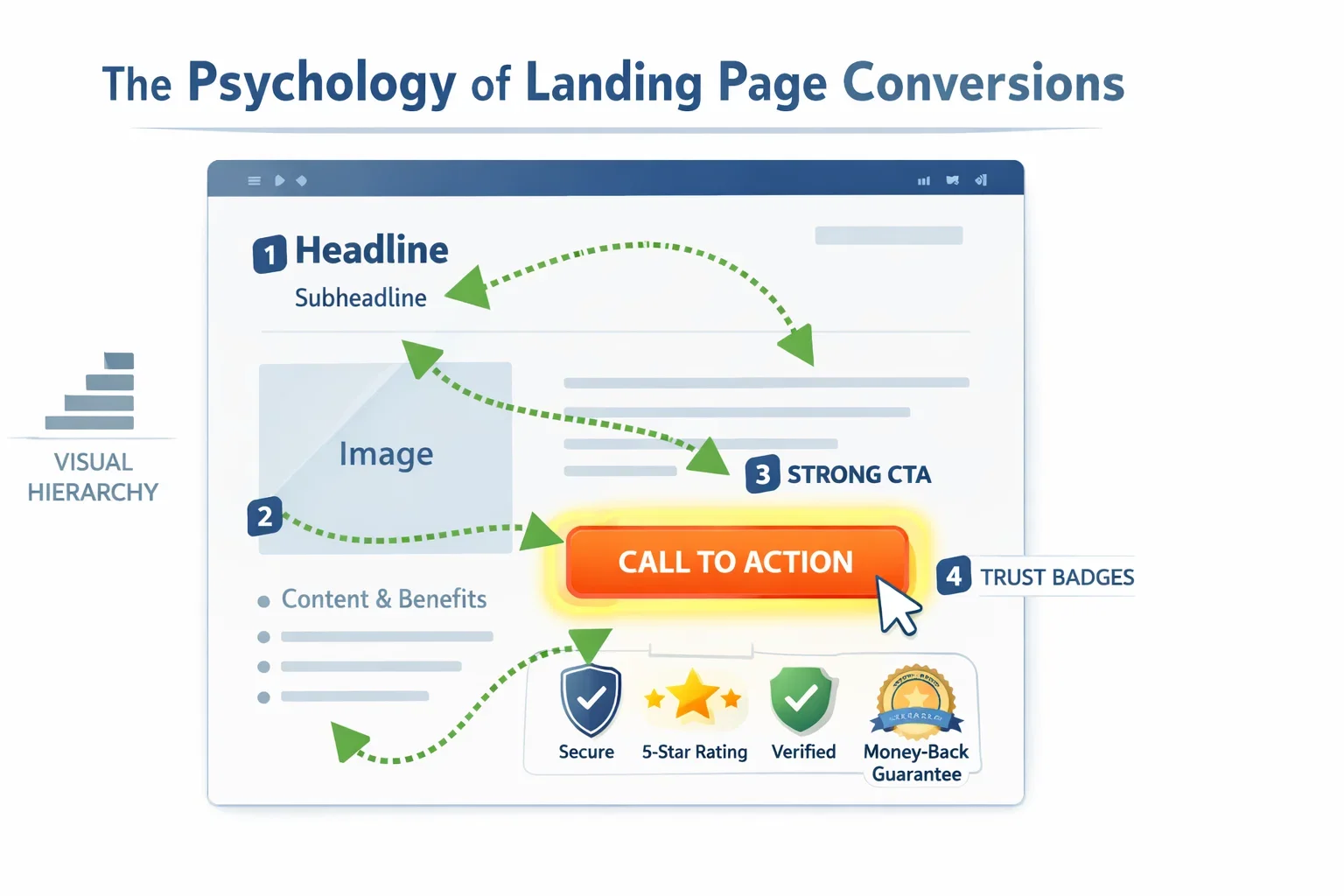
Human attention is limited. When visitors arrive on a landing page, they scan rather than read. Research from institutions like the Nielsen Norman Group shows that users follow predictable visual patterns such as the F-pattern or Z-pattern. This means your layout must guide the eye intentionally.
Effective landing page optimization leverages:
- Visual hierarchy to direct focus
- Contrast to highlight calls to action
- White space to reduce cognitive overload
- Directional cues that subtly point toward conversion
When a landing page lacks structure, users feel overwhelmed. When it has clear hierarchy, they feel confident. Confidence increases action.
Trust is another psychological trigger. Testimonials, reviews, certifications, and recognizable brand logos reduce uncertainty. Without these trust signals, even a well-written page struggles to convert.
How Design Impacts Trust, Attention, and Action
Trust is built visually before it is built verbally. Clean layouts, consistent branding, readable typography, and fast-loading pages create credibility instantly.
Design affects:
- Perceived professionalism
- Emotional response
- Clarity of value proposition
- Ease of interaction
For example, cluttered layouts with multiple competing CTAs confuse visitors. A focused layout with one primary action increases clarity and improves landing page conversion rate optimization outcomes.
Attention leads to interest. Interest leads to action. Design controls this flow.
The Link Between UX and Landing Page Optimization
User experience and landing page optimization are inseparable. If users cannot find information easily or struggle with forms, conversion drops.
Key UX-driven factors that increase landing page conversion rate include:
- Mobile-first design
- Short, frictionless forms
- Fast page load speed
- Clear headline messaging
- Consistent CTA placement
Small usability improvements often create large conversion lifts. Even reducing form fields from six to three can significantly increase submissions.
Landing page design best practices focus on eliminating friction at every step. When design supports the user’s intent instead of distracting from it, conversion naturally improves.
How to Design a Landing Page That Converts
Understanding landing page design best practices is important, but implementation is where results happen. Many businesses collect landing page design tips yet struggle to apply them in a structured way.
If you want to know how to design a landing page that converts, you need a repeatable process. Conversion-focused design is not random creativity. It follows a strategic framework rooted in clarity, psychology, and measurable goals.
Below is a step-by-step structure used in high-performing landing page optimization strategies.
Step 1: Define One Clear Conversion Goal
Every high-converting landing page starts with one specific objective. That objective could be:
- Book a demo
- Download a guide
- Start a free trial
- Purchase a product
- Register for a webinar
Multiple goals dilute focus. When visitors see competing actions, they hesitate. Hesitation reduces conversions.
Landing page conversion rate optimization begins by eliminating distractions. Remove unnecessary navigation. Remove secondary CTAs. Focus the entire design around one measurable outcome.
Clarity drives action.
Step 2: Craft a Strong Value Proposition Above the Fold
The first screen visitors see must answer three questions instantly:
- What is this?
- Who is it for?
- Why should I care?
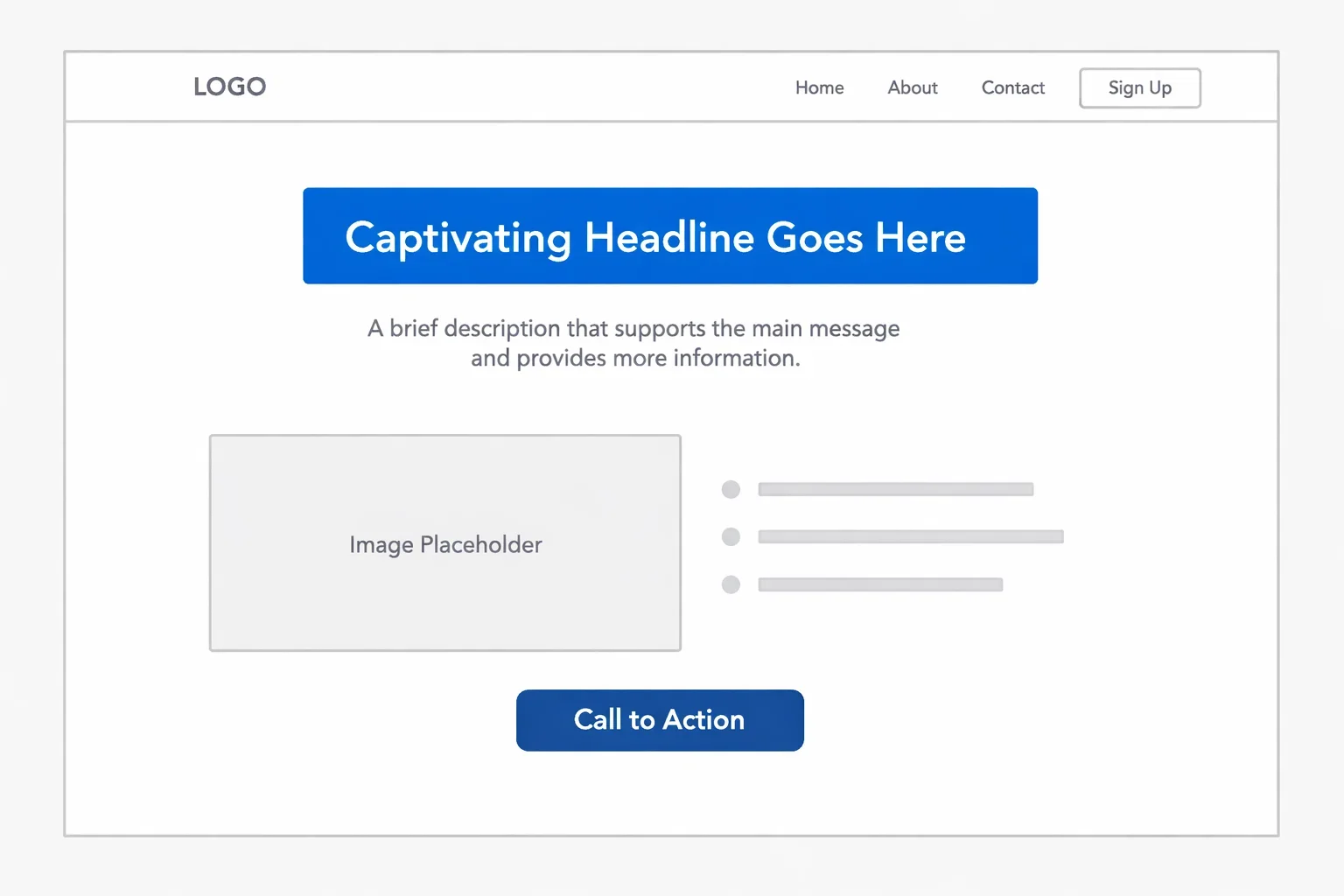
Your headline should communicate benefit, not features. Your subheading should reinforce differentiation. Supporting elements such as short bullet points or micro-copy can clarify value.
A strong above-the-fold section improves engagement and reduces bounce rates. When users understand value within seconds, they are more likely to continue scrolling.
This is one of the most critical landing page design tips for increasing conversion performance.
Step 3: Design Visual Hierarchy That Guides Attention
Visual hierarchy determines what users notice first, second, and third.
You can control hierarchy through:
- Font size and weight
- Color contrast
- Placement
- White space
- Imagery positioning
The primary CTA should be visually dominant. Supporting information should reinforce the decision rather than compete with it.
Landing page design best practices prioritize simplicity. A clean structure keeps attention where it belongs.
Step 4: Reduce Friction in Forms and Interactions
Forms are common conversion barriers. Long forms increase abandonment rates.
To improve landing page optimization:
- Ask only essential information
- Use inline validation
- Break long forms into steps
- Clearly explain privacy and data usage
Each additional field adds cognitive load. Simplifying forms is one of the fastest ways to increase landing page conversion rate.
If the offer is low commitment, the form should match that commitment level.
Step 5: Strengthen CTAs With Context and Contrast
Your CTA should be action-oriented and benefit-focused.
Weak CTA example:
“Submit”
Stronger CTA example:
“Get My Free Strategy Guide”
Effective CTAs:
- Use strong contrast colors
- Appear multiple times strategically
- Include supporting micro-copy if needed
- Align directly with the conversion goal
CTA placement should feel natural within the design flow. Users should never have to search for the next step.
Step 6: Add Trust Signals at Decision Points
Trust reduces hesitation.
High-converting landing pages include:
- Testimonials
- Case studies
- Ratings and reviews
- Security badges
- Client logos
Trust elements should appear near CTAs or forms. Placement matters as much as presence.
Landing page conversion rate optimization improves significantly when social proof supports the decision moment.
Step 7: Optimize for Mobile First
More than half of traffic now comes from mobile devices. If your design works only on desktop, conversions suffer.
Mobile-focused design requires:
- Thumb-friendly buttons
- Short scroll sections
- Simplified layouts
- Fast loading speed
Mobile optimization is no longer optional. It is foundational.
Summary of the Conversion Framework
When you apply these structured steps, landing page design best practices move from theory to execution. Clear goal setting, strong value communication, visual hierarchy, friction reduction, persuasive CTAs, trust signals, and mobile responsiveness create a cohesive experience that converts.
15 Landing Page Design Best Practices (Data-Backed)
Now that you understand the framework behind how to design a landing page that converts, let’s break down the most effective landing page design best practices used by high-performing brands.
These principles are grounded in CRO research, usability testing, and real-world optimization case studies. When applied consistently, they help increase landing page conversion rate across industries.
1. Prioritize Clarity Above the Fold
Your headline must communicate value instantly. Avoid clever wording that sacrifices clarity.
A strong above-the-fold section includes:
- Clear headline
- Supporting subheading
- Primary CTA
- Visual reinforcement
Visitors should understand the offer without scrolling.
2. Remove Unnecessary Navigation
Landing pages are not homepages. Extra navigation links distract users and reduce focus.
For effective landing page conversion rate optimization:
- Remove full navigation menus
- Keep only essential links (privacy, terms if needed)
- Direct attention to one action
Focus increases conversions.
3. Use High-Contrast CTA Buttons
CTAs should stand out visually. If your button blends into the design, users overlook it.
Best practice:
- Use contrasting colors
- Ensure strong readability
- Make buttons large enough for mobile taps
Contrast drives action.
4. Keep Copy Benefit-Focused
Visitors care about outcomes, not features.
Instead of listing product capabilities, highlight:
- Problems solved
- Results achieved
- Time or cost saved
Benefit-driven messaging supports landing page optimization efforts.
5. Use Directional Cues
Arrows, eye direction in images, or layout flow can subtly guide attention toward CTAs.
Directional design reduces friction and improves decision flow.
6. Incorporate Social Proof Strategically
Social proof works best when placed near conversion triggers.
Examples:
- Testimonials under pricing
- Case studies near form sections
- Star ratings near purchase buttons
Strategic placement improves landing page conversion rate optimization impact.
7. Simplify Forms
Long forms reduce submissions.
Best practice:
- Ask for minimum required information
- Use smart autofill
- Consider multi-step forms for longer inputs
Reducing effort increases completion rates.
8. Optimize Page Speed
Slow load times directly affect conversions. Even a one-second delay can reduce engagement significantly.
Improve speed by:
- Compressing images
- Minimizing scripts
- Using optimized hosting
Speed is a silent conversion factor.
9. Design for Scannability
Most users skim.
Improve readability by:
- Using short paragraphs
- Adding bullet points
- Including subheadings
- Keeping sentences concise
Scannable structure supports user engagement.
10. Maintain Visual Consistency
Consistent fonts, spacing, colors, and layout improve perceived professionalism.
Inconsistent design creates doubt and reduces trust.
Professional consistency strengthens landing page design importance.
11. Use White Space Intentionally
White space reduces cognitive overload.
Instead of filling every area, allow breathing room between elements. Clean layouts feel more trustworthy and easier to process.
12. Highlight Key Benefits With Icons
Icons help break up text and increase comprehension.
Use simple, meaningful visuals to reinforce value points.
13. Repeat CTAs Strategically
Users may not convert immediately.
Place CTAs:
You already have the traffic. Are you converting enough of it?
Most websites convert a small fraction of the visitors they get. A free review shows you exactly what is stopping the rest from becoming customers.
No commitment, just a clear picture of where you stand.
- Above the fold
- Mid-page
- After testimonials
- At the bottom
Strategic repetition increases landing page conversion rate.
14. Align Design With Traffic Source
Landing pages must match user expectations.
If traffic comes from a specific ad, the headline and visuals should reflect that promise. Message match improves landing page optimization performance.
15. Test Continuously
No landing page is perfect on the first version.
Test:
- Headlines
- Button copy
- Layout structure
- Form length
- Visual elements
A/B testing is essential for long-term landing page conversion rate optimization success.
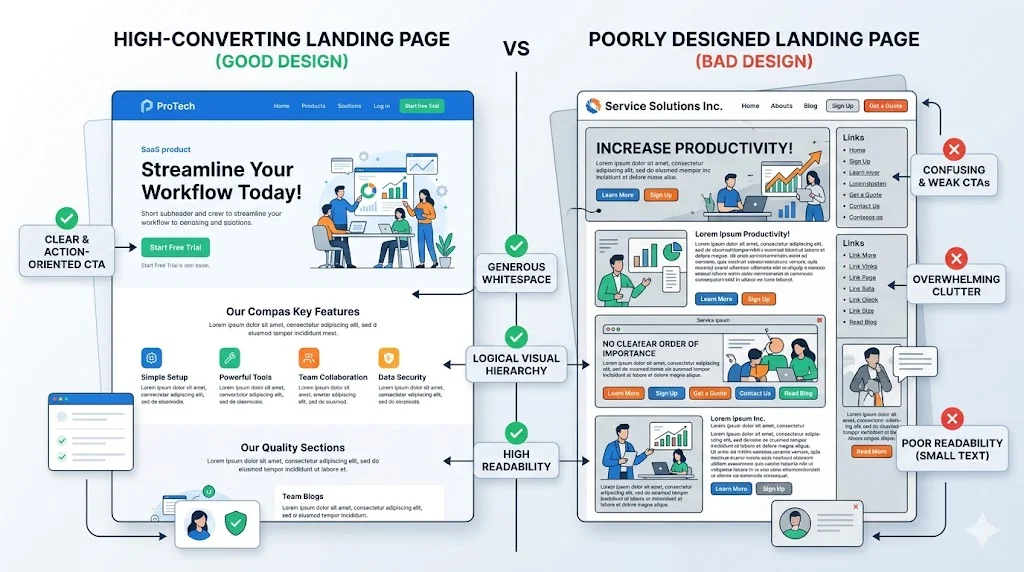
Why These Best Practices Work Together
Landing page design best practices are most powerful when combined. Clarity without trust signals may not convert. Good CTAs without strong messaging may not persuade.
Conversion performance improves when design, messaging, and psychology align as a cohesive system.
Landing Page Design Examples (What Works & Why)
Understanding theory is helpful, but real clarity comes from observing landing page design examples that convert successfully. High-performing landing pages follow patterns that align with user intent, traffic source, and offer type.
Below are structured breakdowns of common landing page types and why they perform well in landing page conversion rate optimization.
SaaS Landing Page Example
A SaaS landing page typically promotes a demo, free trial, or product signup.
What works:
- Clear value proposition in one sentence
- Product screenshot or interface preview
- Trust logos from known clients
- Bullet points explaining benefits
- Free trial CTA placed prominently
Why it converts:
SaaS buyers look for clarity and credibility. Showing the product visually reduces uncertainty. Adding testimonials near CTAs builds confidence at decision points. Removing unnecessary navigation keeps focus on starting the trial.
This structure aligns perfectly with landing page optimization goals.
E-commerce Landing Page Example
E-commerce landing pages focus on a specific product or collection rather than an entire store.
What works:
- High-quality product images
- Clear pricing and offers
- Scarcity indicators such as limited stock
- Reviews near the purchase button
- Sticky “Add to Cart” CTA
Why it converts:
Visual proof matters in e-commerce. Strong imagery reduces doubt. Social proof reinforces buying decisions. Clear pricing removes hesitation.
When product pages follow landing page design best practices, they create urgency while maintaining trust.
Lead Generation Landing Page Example
This type of page aims to collect contact details for services, consultations, or downloadable resources.
What works:
- Strong problem-focused headline
- Short supporting copy
- Simple form with minimal fields
- Privacy reassurance
- Testimonials or case results
Why it converts:
Lead generation pages succeed when friction is minimized. The design reduces cognitive load and keeps attention on the form. Short copy paired with proof increases completion rates.
Reducing form complexity is one of the most effective ways to increase landing page conversion rate in lead campaigns.
Webinar or Info Product Landing Page Example
Webinar pages are designed around time-sensitive registration.
What works:
- Date and time highlighted clearly
- Speaker credentials for authority
- Bullet list of learning outcomes
- Countdown timers
- Clear registration CTA
Why it converts:
Urgency and authority drive action. When the layout clearly communicates benefits and limited availability, users are more likely to register.
Landing page conversion rate optimization in webinar funnels often depends on reinforcing urgency while maintaining credibility.
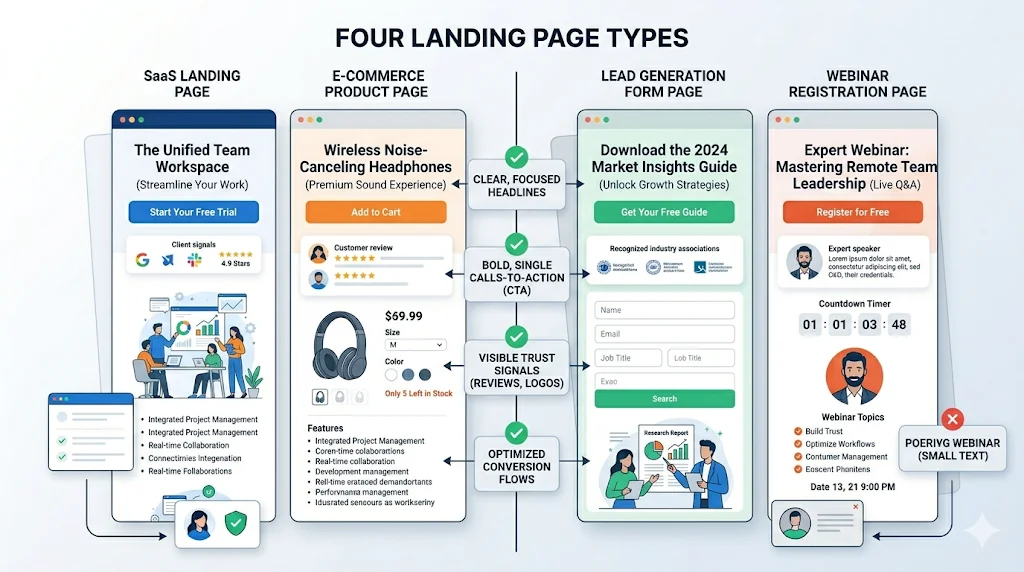
Common Pattern Across All High-Converting Examples
Despite differences in industry, all effective landing page design examples share the same characteristics:
- Clear single objective
- Strong above-the-fold value communication
- Visual hierarchy guiding attention
- Strategic CTA placement
- Trust-building elements
- Mobile responsiveness
The difference between an average page and a high-converting page is rarely dramatic redesign. It is strategic alignment between message, structure, and user psychology.
When landing page design best practices are applied consistently across different campaign types, measurable growth follows.
Common Landing Page Design Mistakes That Kill Conversions
Even well-designed landing pages can fail if critical mistakes undermine clarity and trust. Understanding landing page design mistakes is just as important as learning best practices. In many CRO audits, small structural issues create major conversion losses.
Improving website performance optimization helps reduce load times, which is a critical factor in conversion success.
Below are the most common errors that negatively impact landing page conversion rate optimization.
1. Too Many CTAs Competing for Attention
One of the most frequent landing page design mistakes is offering multiple primary actions.
Examples:
- “Buy Now”
- “Download Guide”
- “Subscribe”
- “Contact Us”
When users see too many choices, decision fatigue increases. Instead of acting, they hesitate or leave.
Landing page design best practices recommend one primary CTA and optional secondary links placed subtly if necessary.
2. Weak or Confusing Headlines
Your headline determines whether users continue reading.
Common issues:
- Generic messaging
- Feature-heavy language
- Lack of clear benefit
- Clever wording without clarity
If visitors cannot immediately understand value, they bounce. Strong headlines must communicate outcomes clearly and directly.
3. Cluttered Layouts
Visual overload reduces comprehension.
Common clutter mistakes:
- Excessive text blocks
- Too many colors
- Inconsistent fonts
- Overuse of animations
Clean design improves perceived professionalism and strengthens landing page design importance in the user’s mind.
Whitespace is not empty space. It is a clarity tool.
4. Ignoring Mobile Experience
A desktop-focused layout often breaks on smaller screens.
Mobile mistakes include:
- Tiny CTA buttons
- Hard-to-read fonts
- Long scroll sections without breaks
- Forms that are difficult to complete
Since mobile traffic dominates many campaigns, poor mobile design significantly reduces conversion rates.
5. Long and Complicated Forms
Asking for too much information creates friction.
Common errors:
- Mandatory unnecessary fields
- No progress indicators
- Confusing validation messages
Simplifying forms is one of the fastest methods to increase landing page conversion rate in lead funnels.
6. Lack of Social Proof
Visitors hesitate when there is no evidence of credibility.
Missing elements may include:
- Testimonials
- Reviews
- Case studies
- Security badges
Trust signals placed near CTAs reinforce confidence at decision moments.
7. Slow Loading Speed
Page speed is often overlooked during design discussions. However, even minor delays can increase bounce rates.
Heavy images, unnecessary scripts, and poor hosting environments slow performance and hurt landing page optimization efforts.
Speed is a conversion factor, not just a technical metric.
8. Poor Message Match With Ads
If a user clicks on an ad promising a specific benefit and lands on a generic page, trust declines instantly.
Headline, visuals, and offer must align with traffic source messaging. Message mismatch weakens landing page conversion rate optimization results.
Before vs After Mindset Shift
Low-converting pages often look visually attractive but lack strategic structure. High-converting pages prioritize clarity over decoration.
Instead of asking:
“How can we make this look better?”
Ask:
“How can we make this easier to understand and act on?”
This shift transforms landing page optimization outcomes.
Landing Page Optimization Framework for Higher Conversions
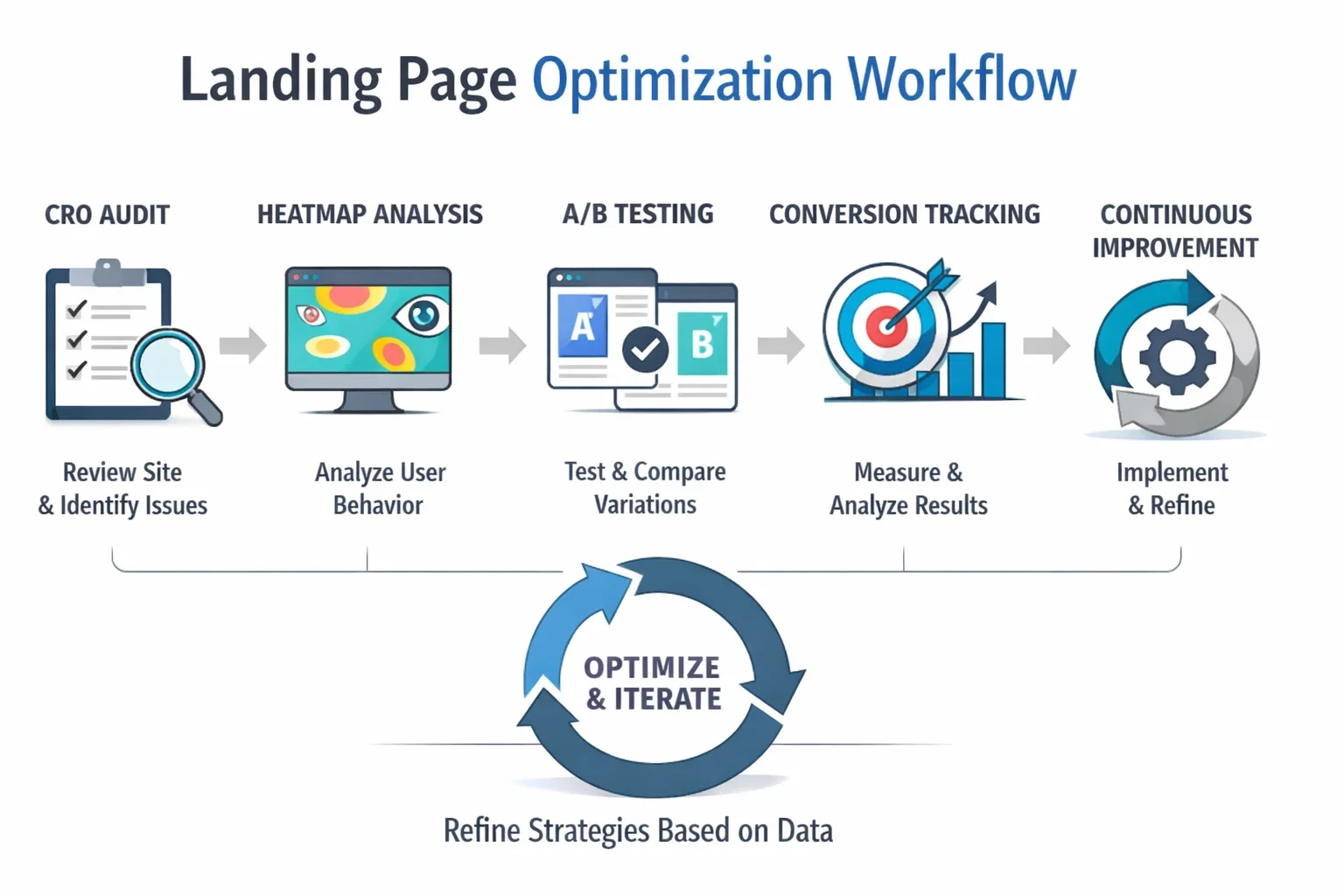
Design is the foundation, but ongoing improvement drives sustainable growth. Landing page optimization is a continuous process that refines structure, messaging, and user experience based on real data.
Many teams redesign pages repeatedly without a framework. Effective landing page conversion rate optimization requires systematic analysis rather than guesswork.
Below is a structured approach to improve performance consistently.
Step 1: Conduct a Structured CRO Audit
Before making changes, identify friction points.
A CRO audit evaluates:
- Headline clarity
- Value proposition strength
- CTA visibility and placement
- Form friction
- Trust signals
- Mobile usability
- Page speed
Instead of redesigning everything at once, isolate weak elements. Small improvements often produce measurable lifts.
Landing page design best practices emphasize testing and iteration rather than assumptions.
Step 2: Analyze User Behavior With Heatmaps and Scroll Data
User behavior tools reveal how visitors actually interact with your page.
Behavior analysis helps answer:
- Are users reaching the CTA?
- Where do they drop off?
- Which sections receive the most attention?
- Are forms abandoned at specific fields?
Scroll depth analysis shows whether critical content is placed too low. Click heatmaps identify distractions or missed opportunities.
Tools like heatmap analysis help identify where users click, scroll, and drop off, making landing page optimization more data-driven.
Step 3: Implement A/B Testing Strategically
A/B testing allows you to compare two versions of a landing page element.
Common elements to test:
- Headlines
- CTA copy
- Button color
- Layout variations
- Form length
- Social proof placement
Test one variable at a time for clear results. Random multi-change testing makes it difficult to identify impact.
Landing page conversion rate optimization becomes predictable when structured experimentation replaces guesswork.
Step 4: Benchmark and Measure Conversion Metrics
To increase landing page conversion rate, you must define what success looks like.
Track metrics such as:
- Conversion rate percentage
- Cost per lead
- Bounce rate
- Time on page
- Scroll depth
- Form completion rate
Benchmark current performance before changes. Measure after implementation. Continuous tracking ensures improvement is measurable and scalable.
Step 5: Iterate Based on Performance Data
Optimization is not a one-time project. Markets evolve, user expectations shift, and campaign strategies change.
High-performing brands:
- Review performance monthly
- Test new value propositions
- Update testimonials regularly
- Refresh visuals based on trends
- Align landing pages with updated ad messaging
Landing page design best practices are not static. They adapt to audience behavior and business goals.
The Core Optimization Principle
Traffic brings opportunity. Design converts opportunity into action. Optimization turns action into predictable growth.
Without structured landing page optimization, even strong campaigns plateau. With consistent testing and iteration, conversion rates compound over time.
Ultimate Landing Page Design Checklist
After understanding landing page design best practices, reviewing examples, and identifying mistakes, the next step is structured execution. A landing page design checklist ensures that every critical element supports conversion.
Use this checklist before launching any campaign or redesigning an existing page.
Goal & Strategy Alignment
- One clear primary conversion goal defined
- No competing CTAs above the fold
- Message aligned with ad or traffic source
- Defined target audience and intent
Clarity at this stage prevents structural confusion later.
Above-the-Fold Optimization
- Strong, benefit-focused headline
- Supporting subheadline reinforcing value
- Primary CTA visible immediately
- Clean layout with no distractions
- Relevant visual supporting the offer
The first screen determines engagement. Strong above-the-fold design is central to landing page conversion rate optimization.
Visual Hierarchy & Layout
- Clear font hierarchy
- Strategic white space
- Logical section flow
- Directional cues guiding attention
- Consistent brand design
Visual structure should guide the user naturally from problem to solution to action.
CTA Optimization
- Action-oriented CTA copy
- High contrast button color
- Multiple CTA placements throughout page
- Sticky CTA if relevant
- Mobile-friendly button sizing
Strong CTAs significantly increase landing page conversion rate when supported by clear messaging.
Form Optimization
- Minimal required fields
- Clear privacy reassurance
- Inline error validation
- Multi-step form if needed
- Thank-you confirmation page
Reducing friction in forms is one of the fastest improvements in landing page optimization.
Trust & Credibility Elements
- Testimonials or case studies
- Star ratings or reviews
- Client or partner logos
- Security badges
- Guarantees or risk-reversal statements
Trust signals placed near decision points reinforce credibility.
Mobile & Speed Optimization
- Responsive design tested across devices
- Fast loading time
- Compressed images
- Clean code structure
- Touch-friendly layout
Speed and mobile usability directly influence conversions.
Tracking & Measurement
- Conversion tracking installed
- Analytics properly configured
- Scroll depth tracking enabled
- Event tracking for CTA clicks
- A/B testing plan defined
Measurement ensures landing page conversion rate optimization is continuous rather than static.
Why a Checklist Matters
Many landing page design mistakes occur because teams skip structured review. A checklist reduces oversight and aligns execution with strategy.
Landing page design best practices are most effective when implemented systematically, not selectively.
Using a checklist before launch can prevent conversion losses that might otherwise take months to diagnose.
When to Invest in Professional Landing Page Design Services
While many businesses attempt to implement landing page design best practices internally, there are specific situations where professional landing page design services deliver significantly better results.
Designing for aesthetics is different from designing for conversion. CRO-focused landing pages require research, psychology, analytics, testing frameworks, and technical implementation expertise.
Below are scenarios where expert involvement makes a measurable impact.
1. When Paid Ad Spend Is Increasing
If you are scaling paid advertising campaigns, every percentage increase in conversion rate directly reduces cost per acquisition.
For example:
- Increasing conversion rate from 3 percent to 4 percent represents a 33 percent lift in leads without increasing ad spend.
In such cases, landing page conversion rate optimization becomes a revenue multiplier. Professional landing page design services help ensure ad traffic converts efficiently.
2. When Conversions Plateau
If traffic grows but conversions remain flat, the issue is rarely traffic quality alone.
Common hidden issues:
- Weak value proposition
- Poor message match
- UX friction
- Ineffective CTA placement
An external CRO-focused review often identifies overlooked friction points that internal teams miss.
3. When You Lack Structured Testing Frameworks
A/B testing requires:
- Hypothesis development
- Traffic segmentation
- Statistical significance evaluation
- Implementation tracking
Without a framework, changes become guesswork. Professional landing page optimization teams operate with structured experimentation models that deliver consistent improvements.
4. When Brand Positioning Needs Strengthening
Landing pages are often the first impression of your brand. Inconsistent design, outdated visuals, or unclear messaging reduce credibility.
Professional services align:
- Brand identity
- Conversion strategy
- UX design
- Technical performance
This alignment reinforces landing page design importance at every stage of the funnel.
5. When You Need Faster Growth Cycles
In competitive industries, speed matters.
Professional landing page design services accelerate:
- Research
- Wireframing
- Copy development
- Implementation
- Testing
Instead of spending months experimenting internally, businesses can deploy optimized pages quickly and refine them through data.
ROI Perspective on Conversion Optimization
Investing in landing page optimization is not an expense. It is a performance lever.
Even small lifts compound:
- 2 percent improvement across multiple campaigns
- Lower acquisition costs
- Higher lead quality
- Increased revenue per visitor
Landing page design best practices create a foundation. Professional expertise amplifies results.
If your campaigns are driving traffic but conversions are underperforming, it may be time to evaluate your current landing page strategy. A structured CRO audit can identify friction, strengthen messaging, and unlock measurable growth opportunities.
Frequently Asked Questions
What are landing page design best practices?
Landing page design best practices focus on clarity, single-goal structure, strong value propositions, visual hierarchy, high-contrast CTAs, minimal friction, and trust signals. These elements work together to support landing page conversion rate optimization and improve user decision flow.
How can I increase landing page conversion rate?
To increase landing page conversion rate, focus on simplifying forms, strengthening headlines, improving message match with ads, optimizing mobile performance, adding social proof, and running structured A/B tests. Continuous landing page optimization based on user data delivers sustainable growth.
What are the most common landing page design mistakes?
Common landing page design mistakes include multiple competing CTAs, cluttered layouts, weak headlines, long forms, poor mobile experience, lack of trust signals, and slow load speeds. Eliminating these issues often produces immediate improvements.
How often should landing pages be optimized?
Landing pages should be reviewed monthly if they support active campaigns. Continuous testing and iteration ensure performance remains aligned with user behavior and traffic sources.
Do I need professional landing page design services?
Professional landing page design services are valuable when scaling paid ads, facing conversion plateaus, lacking structured testing frameworks, or needing faster growth cycles. Expert CRO strategy ensures optimization decisions are data-driven and measurable.
Ready to turn this into an actual growth plan?
Our team builds strategies across SEO, paid advertising, AI search visibility, and website performance, matched to your budget and your goals, not a generic package.
- A real thirty minute call, not a sales pitch
- Recommendations specific to your business
- A short list of what to fix first
Conclusion
Landing page design best practices are not just aesthetic guidelines. They are strategic conversion tools that influence user psychology, trust, and action.
A high-performing landing page:
- Communicates value clearly
- Guides attention intentionally
- Reduces friction at every step
- Reinforces trust near decision points
- Aligns design with measurable goals
When design, messaging, and optimization work together, conversion rates improve predictably.
Whether you are building a new campaign page or refining an existing one, structured landing page optimization backed by testing and analytics transforms traffic into consistent business growth.
The difference between average and exceptional results often lies in disciplined execution of these best practices.
Let's turn this into results for your business.
SEO, paid advertising, AI search visibility, website design, and conversion optimization, all under one roof, all pointed at the same goal: revenue.