
Local SEO for doctors determines whether your clinic appears in the Google Maps Local Pack when a patient searches “cardiologist near me” or “best dermatologist in Ahmedabad”. Ranking on page one for informational queries matters, but the Local Pack sits above organic results. For most medical practices, it is where the majority of new patient discovery actually happens.
This guide covers everything a doctor, clinic manager, or healthcare marketing team needs to implement local seo for medical professionals from the ground up. The focus is deliberately narrow: Google Business Profile optimisation, NAP consistency, location pages, patient review generation, and schema markup for medical practices. For the broader strategy of ranking across India for procedure and speciality queries, the complete healthcare SEO India guide covers that territory in full. The two strategies are complementary, not interchangeable.
The SEO checklist that finds what is actually holding you back
Twenty seven checks covering technical SEO, on page structure, and link strategy. The same list our team runs before quoting any new client.
Who this guide is for: Solo practitioners, clinic managers, and healthcare marketing teams who want to rank in Google Maps and the Local Pack for near-me patient searches. Multi-location hospital chains and diagnostic labs will also find the location-page section directly applicable.
Why Local SEO for Doctors Works Differently from General Healthcare SEO
General healthcare SEO focuses on ranking a website for informational and procedure-based queries across a wide geography. Local SEO for doctors operates on a different set of signals and targets a different type of query: one that includes a location modifier (near me, in Pune, in Ahmedabad) or triggers Google to show local results automatically based on the searcher’s device location.
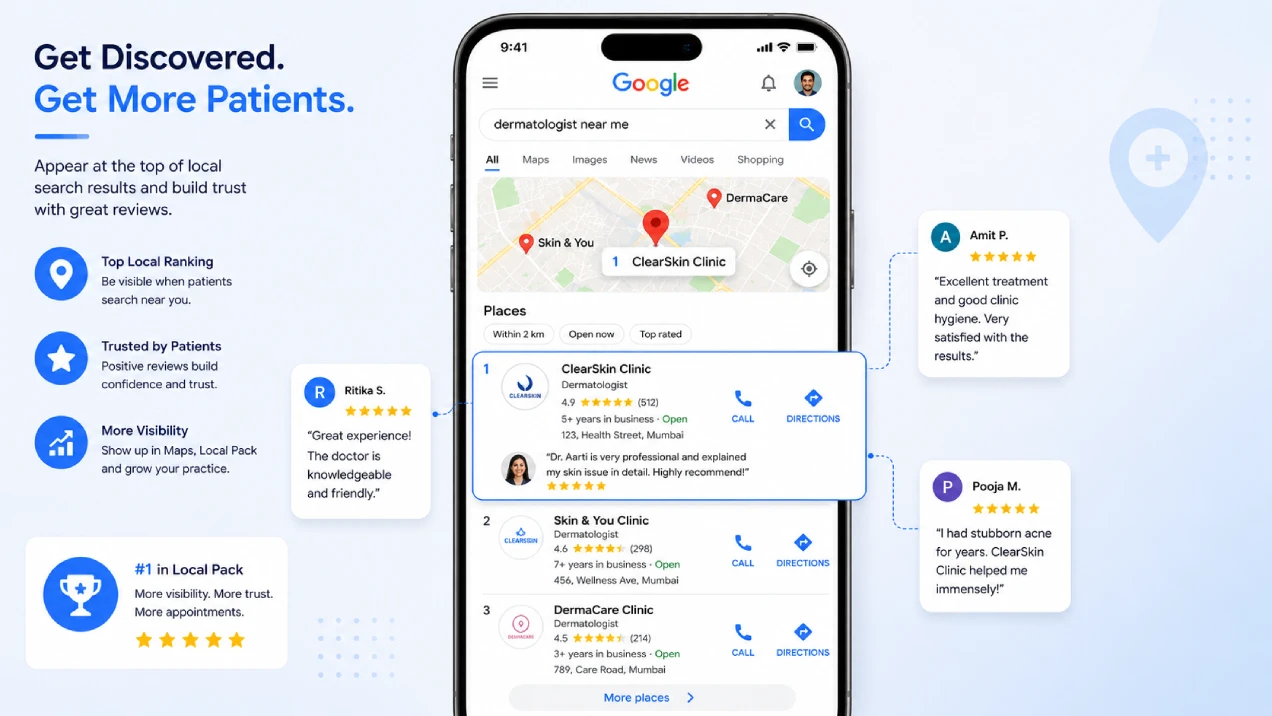
The Local Pack that appears for these searches is driven primarily by three factors that are distinct from standard SEO: Google Business Profile completeness and activity, NAP (name, address, phone) consistency across the web, and patient review volume and recency. A clinic can have a well-optimised website with strong technical SEO and still be absent from the Local Pack if these three factors are neglected.
Cannibalization note: This post covers hyperlocal tactics only: GBP, Google Maps, near-me queries, location pages, and review generation. If you are looking for the broader India-market keyword strategy for hospitals and clinics, read the healthcare SEO India guide which covers technical SEO, EEAT compliance, content strategy, and AI visibility for the full healthcare SEO funnel.
Google Business Profile for Doctors – The Foundation of Local Visibility
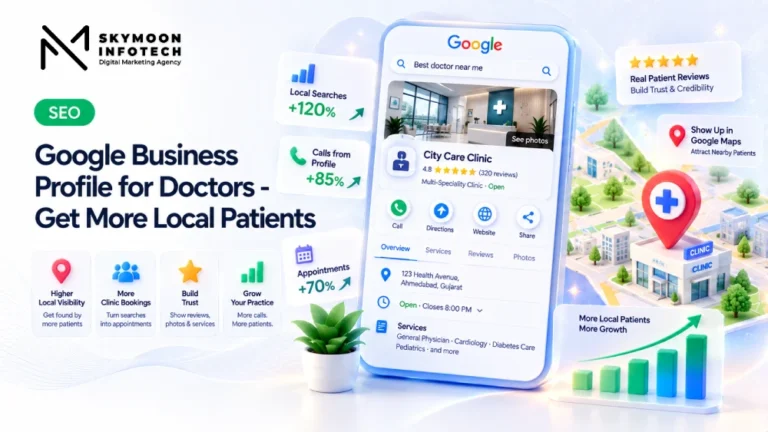
Google Business Profile for doctors is the single most controllable local ranking factor available to a medical practice. A verified, complete, and actively managed profile is the difference between appearing in the Local Pack and being invisible to patients searching nearby. Most clinics create a profile once and never return to it, which is exactly why this gap remains one of the easiest local SEO wins available in India.
Claiming and Verifying Your Medical Practice Profile
If you have not yet claimed your Google Business Profile, search for your clinic name on Google Maps. In many cases, a business listing already exists because patients or Google’s data sources created it. Claiming this existing profile is faster than creating a new one and preserves any reviews already attached to it. After claiming, verification typically requires a video verification of the clinic premises, confirming the business is real and located at the address provided.
Choosing the Right Primary Category for Your Practice
The primary category is the strongest single ranking signal in your Google Business Profile for local pack results. Choose the most specific category that describes your core practice, not the broadest available option. A cardiologist should set “Cardiologist” as primary, not “Doctor” or “Medical Clinic.” A multi-specialty clinic should use “Medical Clinic” as primary and add specialty categories (Gynecologist, Pediatrician, Orthopedic Surgeon) as secondary categories, which Google allows up to nine of.
A common and damaging mistake is category dilution: adding unrelated secondary categories because they seem prestigious or aspirational. If your clinic does not currently book patients for a specialty, do not add its category. Google’s algorithm uses category relevance to match your listing to search queries, and adding inaccurate categories weakens your relevance for your actual core speciality.
Optimising the Business Description for Patient Intent
Write your business description in patient language, not clinical language. Patients searching for local seo for dermatologists who have optimised their GBP descriptions report that using terms like “skin specialist near me,” “acne treatment,” and “pigmentation clinic” in their profile description drives more matched searches than using clinical terminology like “dermatological interventions” or “cutaneous conditions.” The description allows up to 750 characters: use it to name your specialities, your location specifics, and the types of patients you serve.
Google Business Profile Fields That Most Clinics Leave Empty
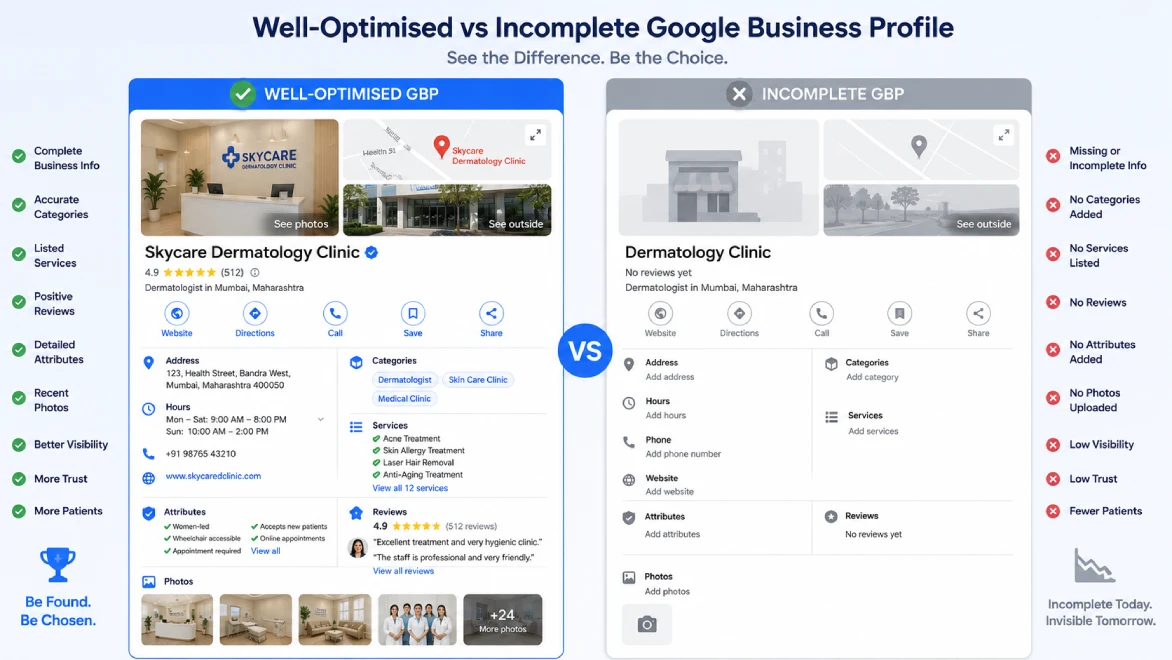
Beyond the basics (name, address, phone, hours), the fields that most medical practices leave incomplete have direct ranking impact:
- Services: List every bookable service individually with a patient-friendly name. An orthopaedic clinic should list “Knee Pain Treatment,” “Back Pain Consultation,” “Fracture Management” rather than just “Orthopaedics.”
- Attributes: Google allows health-specific attributes including appointment booking links, whether the clinic accepts new patients, wheelchair accessibility, and parking availability. These attributes appear in the Local Pack and influence click-through rates.
- Questions and Answers: The Q&A section of your profile allows anyone to post a question. The practice should proactively seed and answer the most common patient questions (consultation fee, whether a particular procedure is available, waiting times) before random users post inaccurate answers.
- Photos: Profiles with regular photo uploads receive significantly more direction requests and clicks than profiles with no photos. Add clinic exterior, reception, consultation rooms, and doctor profile photos. Google favors profiles that add new photos consistently over profiles that added one batch of photos on setup day.
- Google Posts: Publishing a post weekly keeps the profile active. Posts about new services, health awareness topics, or doctor availability tell Google the listing is maintained and signal to patients that the practice is current.
NAP Consistency – Why Your Address Has to Match Everywhere
NAP consistency refers to having the exact same Name, Address, and Phone number across every online platform where your clinic appears. Google cross-references your GBP data against these external directory listings as a trust signal. Discrepancies, even minor ones like “Clinic” vs “Cl.” or a phone number with versus without the STD code, reduce Google’s confidence in the accuracy of your GBP data and can suppress your Local Pack ranking.
Key Indian Directories for Medical Practices
For clinics and hospitals in India, the platforms that carry the highest weight for NAP signal are Google Business Profile (first and most important), Practo, 1mg, Lybrate, Justdial, and IndiaMART for diagnostic labs. Ensure that the clinic name appears identically across all of them, matching the name on your registration certificate. If the clinic is registered as “Sharma Eye Care Centre” it should not appear as “Dr Sharma Eye Clinic” on Practo and “Sharma Eye Hospital” on Justdial.
Handling NAP Consistency for Multi-Location Practices
Local seo for medical practices with multiple branches requires a separate Google Business Profile for each physical location. Each profile should carry the unique address and phone number for that branch specifically, the same primary category across all branches unless specialities genuinely differ between locations, and photos that show the specific branch, not generic stock images. A multi-location practice that uses a central call centre number across all branches (rather than a branch-specific number) weakens NAP consistency because the phone number no longer matches the geographic location.
Your competitors might be outranking you for a fixable reason
Most sites lose the majority of their potential traffic to issues that take days, not months, to fix. Our free audit tells you what those are.
No commitment, just a clear picture of where you stand.
Location Pages – Do You Need a Separate Page for Each Clinic Branch?
Yes, a separate location page is required for each physical branch of a multi-location practice if you want that branch to rank independently in local search. Local seo for medical practices with more than one branch fails most often at this single point: a single generic “Find Us” page listing three clinic addresses does not give Google enough location-specific content to serve that page for location-modified queries in each city or neighbourhood.
What Each Location Page Needs to Include
An effective location page for a medical practice branch is not simply a copy of the main service page with the city name swapped out. Google is highly effective at detecting thin, templated location pages and will either not index them or refuse to rank them for local queries. Each location page should include:
- The branch-specific NAP in text (not just embedded in an image), matching the GBP data exactly
- An embedded Google Map showing the specific branch location
- Details about the doctors available at that branch (not a generic “our team” section)
- Specialities and services available specifically at that location, since multi-specialty chains often have different service availability per branch
- Patient-written testimonials attributed to that specific branch, where NMC-compliant
- LocalBusiness or MedicalOrganization schema markup with the accurate geo-coordinates for that branch
The schema markup piece is covered in detail in the schema section below. For the technical implementation framework for clinic websites, Skymoon’s healthcare SEO services include location page architecture as part of the full local SEO package.
Patient Reviews SEO – Building Review Velocity the Compliant Way
Patient reviews seo is the practice of building a consistent flow of patient reviews that improves both local search rankings and the patient’s first impression of the clinic. Review count, review recency, and response rate are all ranking signals in the Local Pack algorithm. A clinic with 12 reviews from three years ago will consistently lose to a competitor with 6 more recent reviews from the last 90 days, even at similar overall rating levels.
How to Generate Patient Reviews Without Violating NMC Guidelines
The National Medical Commission Code of Medical Ethics Regulations restricts how medical practitioners can solicit patient engagement. In practice, this means:
- You can ask patients to share their experience, but you cannot offer incentives (discounts, gifts, free services) in exchange for a review
- Reviews that make comparative claims (“better than any other cardiologist in the city”) cannot be published without violating NMC guidelines
- Patient testimonials used specifically to solicit new patient appointments are restricted, meaning review content should reflect a genuine patient experience, not be structured as an advertisement
Within these boundaries, the following methods build review velocity without compliance risk: a QR code in the discharge area that opens your Google review link directly; a WhatsApp message sent after a completed appointment (not a medical consultation) asking if the patient would like to share their experience; and a printed slip given with the appointment receipt stating “If you found our service helpful, a Google review helps other patients find us.”
Responding to Reviews – What to Say and What to Avoid
Respond to every review within 48 hours, both positive and negative. For positive reviews, a short acknowledgment is sufficient. For negative reviews, the response must never reveal patient information (even confirming that someone visited your clinic is a privacy disclosure under DPDPA 2023), never make counter-claims about treatment quality, and should invite the reviewer to contact the clinic directly to resolve the concern. A calm, professional response to a negative review is more effective at maintaining patient trust than attempting to dispute the review content publicly.
Review compliance reminder: Never buy reviews, swap reviews with other practitioners, or post reviews from clinic staff accounts. Google detects patterns like review bursts from the same IP or device, and penalises the entire listing. The penalty for fake review detection can include suspension of the Google Business Profile entirely.
Local SEO for Dermatologists – A Worked Example
Local seo for dermatologists illustrates how the principles in this guide apply to a single-specialty practice. Dermatology has strong near-me search intent across India for queries including “skin specialist near me,” “acne treatment clinic near me,” and “pigmentation removal dermatologist in [city].” These queries trigger Local Pack results rather than organic results, which means GBP optimisation is the primary lever.
| GBP Element | Weak Version (Hurts Rankings) | Strong Version (Supports Rankings) |
|---|---|---|
| Primary Category | “Medical Clinic” | “Dermatologist” or “Skin Care Clinic” |
| Business Description | “We offer comprehensive dermatological services.” | “Skin specialist in Ahmedabad. We treat acne, pigmentation, hair loss, and psoriasis. IADVL-registered dermatologist. Same-day appointments available.” |
| Services Listed | “Dermatology” as a single entry | “Acne Treatment” / “Pigmentation Removal” / “Hair Loss PRP” / “Psoriasis Management” / “Mole Removal” each listed individually |
| Patient Language | “Cutaneous inflammatory conditions treated.” | “We treat pimples, dark spots, dandruff, and skin rashes.” |
| Review Ask Timing | Never asked | WhatsApp message 2 days after non-medical appointment (facial, cleanup, or follow-up check) |
The same framework applies to local seo for medical professionals in other specialities. Replace the dermatology-specific services with your own, and the approach scales directly.
Schema Markup for Local Medical SEO – MedicalOrganization and Physician
Schema markup tells search engines the structured meaning of your content rather than just its words. For local seo for doctors, the two most important schema types are MedicalOrganization (for the clinic as an entity) and Physician (for individual doctor profiles). Google’s structured data documentation covers both types in full. The practical implementation requires the following fields at minimum:
MedicalOrganization Schema (for the clinic)
The MedicalOrganization type extends LocalBusiness with healthcare-specific fields. At minimum, include: name (matching GBP name exactly), address with PostalAddress sub-schema, telephone (matching GBP telephone exactly), openingHoursSpecification with actual hours per day, hasCredential for NABH or NABL accreditation numbers where applicable, geo with latitude and longitude coordinates, and sameAs linking to the clinic’s GBP URL and Practo listing.
Physician Schema (for individual doctors)
Physician schema identifies an individual doctor as a distinct entity from the clinic. Key fields are: name, medicalSpecialty using the Schema.org MedicalSpecialty taxonomy, worksFor referencing the clinic’s MedicalOrganization, and hasCredential listing the doctor’s registration number with the Medical Council of India. Linking a doctor entity to the clinic entity through schema helps Google’s knowledge graph understand the practitioner-practice relationship, which supports both the clinic’s and the individual doctor’s visibility in local searches.
BreadcrumbList and Speakable Schema
BreadcrumbList helps Google understand the page’s position in the site hierarchy, which supports correct display of page paths in the SERP. Speakable schema marks the sections of a page that are most appropriate for text-to-speech extraction by voice assistants. For a local SEO guide, mark the definition sections and the most direct FAQ answers as speakable targets, since voice-based near-me searches are disproportionately high in the local healthcare query category.
AI Overviews and Local Search – What Changed for Medical Practices in 2026
AI Overviews from Google appear prominently for many informational queries in 2026. However, for provider-intent local searches (queries like “best cardiologist near me,” “dental clinic in Bangalore”), Google appears to de-emphasize AI Overviews in favor of the Local Pack. The reasoning is practical: a patient searching for a nearby doctor needs a map, a phone number, and current hours, not a paragraph summary. The Local Pack delivers that more directly than an AI-generated answer.
Ready to turn this into an actual growth plan?
Our team builds strategies across SEO, paid advertising, AI search visibility, and website performance, matched to your budget and your goals, not a generic package.
- A real thirty minute call, not a sales pitch
- Recommendations specific to your business
- A short list of what to fix first
This means that for the specific query types that drive new patient discovery, local SEO signals (GBP, NAP, reviews, location pages) remain the primary ranking mechanism. AI search visibility is more relevant for the informational stage of the patient journey, such as when a patient is researching treatment options before choosing a provider. For the informational and AI visibility strategy that covers that upstream funnel, the GEO vs AEO vs AIO guide explains the technical distinctions between generative engine optimization, answer engine optimization, and AI Overview optimization for healthcare content.
Local SEO for Doctors – Priority Actions by Practice Type
The most common question from new clients is how to rank higher on google maps for doctors. The answer comes down to three levers: GBP completeness, NAP consistency, and review velocity. Local SEO priorities shift depending on whether you run a solo practice, a multi-specialty clinic, or a multi-location chain. The table below maps the highest-return actions for each context.
| Practice Type | Highest-Return Local SEO Actions | Key Pitfalls to Avoid | Timeline for Initial Results |
|---|---|---|---|
| Solo practitioner / single-location clinic | Complete and verify GBP; list all services individually; add 5 new patient photos per quarter; generate 2-3 reviews per month | Using a generic category like “Doctor” instead of your specific speciality; leaving the services section blank | 30-60 days for Local Pack appearance; 60-90 days for top-3 positioning in low-competition localities |
| Multi-specialty clinic (single location) | Primary GBP category = primary revenue speciality; secondary categories for all active specialities; separate service listings per speciality; doctor profiles with individual Physician schema | Category dilution with specialities not currently booked; using one generic doctor photo for all specialists | 60-90 days for stable Local Pack appearance; 3-4 months for speciality-specific keyword matching |
| Multi-location practice / hospital chain | Separate GBP per branch with branch-specific NAP; individual location pages per branch; location-specific photo sets; per-branch review strategy | Using headquarters phone number across all branches; identical templated location pages; cross-posting the same photos to all branch profiles | 90-120 days per branch; older branches with more reviews stabilise faster than newly opened branches |
| Local SEO for medical practices (diagnostic labs/pathology) | Strong category selection (Medical Laboratory, Pathology Laboratory); online test booking link in GBP; location page per collection centre; NAP consistency with 1mg and Practo lab listings | Using the hospital or clinic primary category instead of a lab-specific category; not linking to the online booking system in the appointment URL field | 45-75 days for Local Pack appearance; test-specific queries stabilise within 90 days |
Frequently Asked Questions – Local SEO for Doctors and Clinics
How do I optimize my Google Business Profile for a medical practice?
Start by claiming and verifying your listing, then set your primary category to the most specific medical specialty that fits your practice. Fill out every field: add individual services with patient-friendly names, set up attributes (appointment links, wheelchair access), upload clinic photos quarterly, and post a Google Business Profile update at least once per week to signal an active listing to both Google and visiting patients.
How to rank higher on Google Maps for doctors?
Ranking higher on Google Maps for doctors requires three consistent actions: maintaining a fully completed Google Business Profile with an accurate primary category, building NAP consistency across Practo, Justdial, and all major directories so your address and phone number match identically everywhere, and generating a steady flow of new patient reviews at 2 to 4 per month. Recency of reviews matters as much as total count.
How many patient reviews do I need, and how do I get more?
There is no fixed number, but a clinic with under 10 reviews will rarely rank in the Local Pack for competitive queries in major Indian cities. Focus on review velocity: 2 to 4 new reviews per month consistently is more effective than a burst of 20 reviews followed by nothing for six months. Ask patients via WhatsApp after non-medical appointments and provide a direct link to your Google review page to reduce the friction of leaving a review.
What is the difference between local SEO and general healthcare SEO?
Local SEO targets near-me and location-modified patient searches and is primarily driven by Google Business Profile, NAP consistency, and patient reviews. General healthcare SEO targets broader informational and procedure-based queries and is driven by website content, technical SEO, and backlinks. The healthcare SEO India guide covers the full broad strategy; this guide covers the hyperlocal tactics that support Local Pack rankings specifically.
How long does local SEO take to bring in new patients?
For a solo clinic or single-specialty practice in a low-competition locality, Local Pack appearance can happen within 30 to 60 days of a fully completed and verified Google Business Profile. Top-3 positioning in that Local Pack takes 60 to 90 days with consistent review generation. In high-competition localities like central Mumbai or South Delhi, expect 3 to 6 months for stable Local Pack positioning.
Where to Start with Local SEO for Your Clinic
The highest-return starting point for any medical practice is a complete and verified Google Business Profile with the correct primary category, all services listed individually, and a simple system for collecting 2 to 4 patient reviews per month. For practices that already have the basics in place and are ready to build a full local SEO system including schema markup, location pages, and review management, Skymoon’s healthcare digital marketing services cover the full implementation. To discuss your specific clinic’s situation, book a free consultation and we will audit your current GBP data, NAP consistency, and review profile before recommending next steps.
Let's turn this into results for your business.
SEO, paid advertising, AI search visibility, website design, and conversion optimization, all under one roof, all pointed at the same goal: revenue.