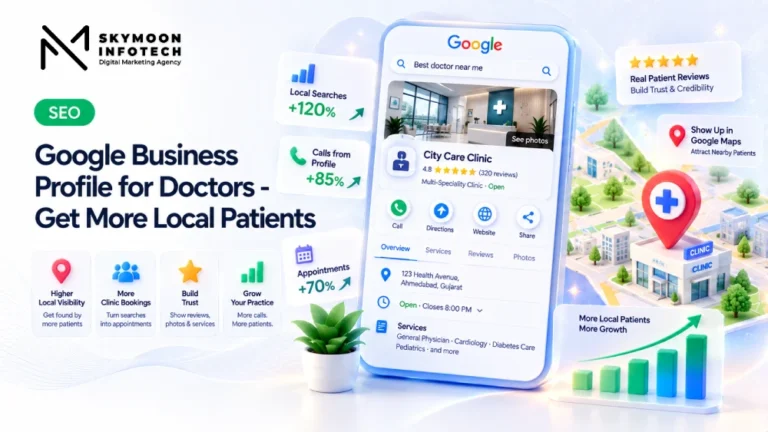

Healthcare SEO India is no longer optional for hospitals, clinics, and medical practices that want to grow. Over 77% of patients in India now search online before booking a healthcare appointment, and the practices appearing on page one of Google capture most of those inquiries. If your hospital or clinic is not visible when patients search, your competitors will be.
This guide covers everything a healthcare provider or their marketing team needs to know about healthcare SEO India in 2026: what it means in a medical context, why it works differently from general SEO, how to build a strategy, and how to optimize for both Google and AI search engines like ChatGPT and Perplexity.
The SEO checklist that finds what is actually holding you back
Twenty seven checks covering technical SEO, on page structure, and link strategy. The same list our team runs before quoting any new client.
Who this guide is for: Hospital administrators, clinic owners, healthcare marketing managers, and digital agencies managing SEO for medical clients in India.
What Is Healthcare SEO India?
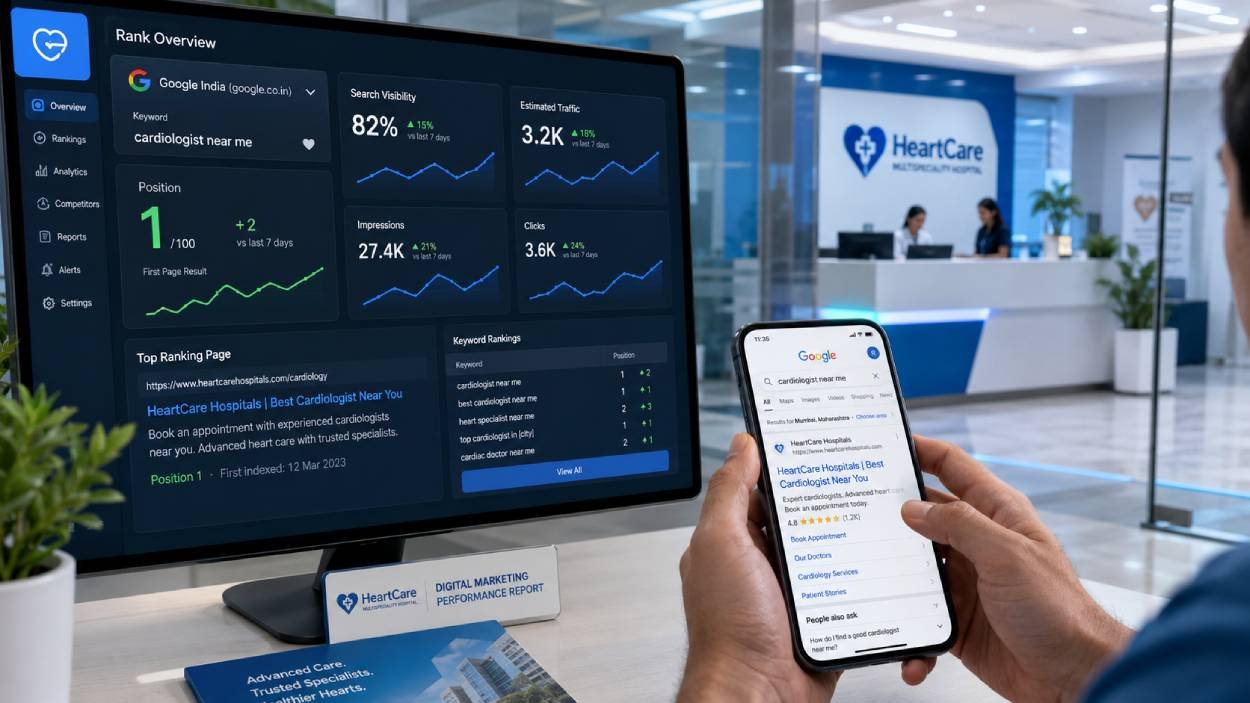
Healthcare SEO India refers to the process of optimizing hospital and clinic websites to appear at the top of Google and AI search results when patients search for medical services. Unlike general SEO, healthcare SEO India operates under strict E-E-A-T (Experience, Expertise, Authoritativeness, and Trustworthiness) requirements because medical content falls under Google’s Your Money or Your Life (YMYL) category.
Medical websites in India must meet a higher quality standard than other industries. Google’s own guidance on creating helpful, reliable, people-first content makes clear that pages should demonstrate clear sourcing and evidence of real expertise. This means that content written or reviewed by licensed medical professionals consistently outranks generic marketing copy.
Key difference: General SEO rewards helpful content. Healthcare SEO India rewards verified expertise. A physiotherapy clinic blog written by the treating physiotherapist will outrank content written by a generic content writer, even if both use the same keywords.
SEO for Hospitals in India – Why It Works Differently
SEO for hospitals in India comes with compliance constraints that do not apply to most other industries. The National Medical Commission’s Code of Medical Ethics Regulations governs how medical practitioners can advertise. Hospitals cannot make comparative claims, promise specific outcomes, or publish testimonials that violate ethical guidelines.
This does not mean SEO is out of reach. It means the strategy has to be built on education, not promotion. The hospitals that rank best for SEO for hospitals in India consistently publish genuinely useful content: procedure explanations, preparation guides, symptom checkers, and doctor profiles that establish authority without crossing NMC boundaries.
| Aspect | General SEO | Healthcare SEO India |
|---|---|---|
| Content standard | Helpful and relevant | Helpful, verified, and YMYL-compliant |
| Author requirement | Any skilled writer | Medical professional review required |
| Advertising limits | None (legal) | NMC ethics code applies |
| Trust signals | Reviews and backlinks | NABH accreditation, doctor credentials, citations |
| Local SEO priority | City-level | Locality and specialty-level targeting |
| AI search factors | Standard | Source credibility weighted more heavily |
Medical SEO India – What Sets It Apart
Medical SEO India differs from general healthcare SEO in one important respect: it covers the full range of clinical content, not just hospital marketing pages. This includes condition pages, drug information, diagnostic explainers, and second-opinion content. Medical SEO India success depends on getting these pages reviewed by a licensed clinician before publication, every time, with no exceptions for time pressure.
A common mistake in medical SEO India is treating clinical content the same way as a service page. A page explaining “symptoms of dengue fever” carries direct health risk if it is wrong. Google’s quality systems treat this differently from a page describing your hospital’s visiting hours, and so should your editorial process.
A practical workflow for medical SEO India separates content into two tracks. Track one covers clinical and condition-specific pages, which require a licensed reviewer before publishing and a documented review date on the page itself. Track two covers operational and service pages, such as visiting hours, billing, or insurance information, which can move through a faster editorial process since they carry lower health risk if a minor detail is briefly outdated.

SEO for Doctors India – The Patient Acquisition Angle
SEO for doctors India operates at the individual practitioner level rather than the institution level, and this distinction matters for compliance. The NMC ethics code restricts individual doctors from directly soliciting patients, which means SEO for doctors India campaigns work best when structured around the hospital or clinic brand, with the doctor’s profile, credentials, and patient education content supporting that brand rather than standing alone as a personal advertisement.
Done correctly, SEO for doctors India drives high-intent traffic: patients searching for a named specialty in a specific city are close to booking. A cardiologist profile page that ranks for “cardiologist in Ahmedabad” converts at a meaningfully higher rate than a generic hospital homepage targeting the same city.
Healthcare Digital Marketing India – Where SEO Fits
Healthcare digital marketing India is a broader discipline than SEO alone. It includes paid search, social media, email, and reputation management. SEO is the foundation of healthcare digital marketing India because it captures patients at the exact moment they are searching, with no ongoing cost per click. For hospitals running a combined strategy, see how Skymoon’s healthcare PPC services complement organic SEO by capturing high-intent procedure searches that take longer to rank for organically.
The sequencing matters for hospitals with limited budget. Healthcare digital marketing India typically delivers the fastest measurable return when SEO and local listings are addressed first, since these build a compounding asset that keeps generating inquiries without ongoing spend. Paid channels then fill the gap for high-intent procedure terms that would otherwise take six to twelve months to rank organically, giving the hospital visibility on day one while the organic strategy matures in the background.
Hospital SEO India – The 6-Part Strategy Framework for 2026
Building a hospital SEO India strategy requires six connected components. Skipping any one of them produces gaps that slow rankings and reduce patient inquiries.
1. Technical Foundation
Hospital websites in India frequently have slow page load times, broken internal links, and missing schema markup. Fix your technical foundation before producing any new content. For a full technical checklist, see how to build an SEO friendly website. Priority items for hospital SEO India include:
- Page speed: LCP under 2.5 seconds on an Indian mobile network (test on a 4G connection, not broadband)
- HTTPS: Every page must be on a secure connection. Google penalizes mixed content warnings on medical sites more heavily than on other verticals
- Mobile-first indexing: Over 85% of Indian patients search from a smartphone
- Schema markup: Article, FAQPage, MedicalOrganization, and BreadcrumbList schema are the minimum for a hospital site
- AI crawler access: Ensure GPTBot, ClaudeBot, PerplexityBot, and Google-Extended are allowed in robots.txt for AI Overview eligibility
2. EEAT for Healthcare Websites
EEAT for healthcare websites is the single most important ranking factor for medical content in India. Google’s helpful content guidance asks whether a page demonstrates clear sourcing and evidence of the expertise involved. For hospital sites, practical steps to strengthen EEAT for healthcare websites include:
Your competitors might be outranking you for a fixable reason
Most sites lose the majority of their potential traffic to issues that take days, not months, to fix. Our free audit tells you what those are.
No commitment, just a clear picture of where you stand.
- Add author bios with medical qualifications (MBBS, MD, DNB) and registration numbers
- Include last-updated dates on all clinical content
- Cite peer-reviewed sources and government health bodies (ICMR, WHO India, NMC)
- Get NABH accreditation details on your about and contact pages
3. Keyword Strategy and Content Architecture
Effective hospital SEO India requires targeting three keyword tiers simultaneously: broad educational terms (healthcare SEO India), specialty and procedure terms (cardiologist in Ahmedabad), and local intent terms (best pediatrician near me in Surat). Build a hub-and-spoke architecture. Your main SEO services page should link out to specialty content, and specialty content should link back to relevant service pages. This structure distributes authority throughout the site and creates clear topical clusters that Google can parse.
4. Local SEO for Clinics India
Local SEO for clinics India is where most healthcare practices see the fastest ranking improvements. Google Maps and the Local Pack appear above organic results for queries like “dermatologist near me” and “best eye hospital in Pune.” Local SEO for clinics India requires:
- A fully completed and verified Google Business Profile with accurate NAP (name, address, phone) data
- Consistent NAP across Practo, 1mg, Lybrate, Justdial, and all directories
- Location-specific landing pages for each city or locality the clinic serves
- Schema LocalBusiness or MedicalOrganization markup with geo-coordinates
- Regular Google Business Profile posts with practice news, health tips, and doctor availability
5. Patient Acquisition SEO India
Patient acquisition SEO India focuses on high-intent queries that signal a patient is ready to book. These keywords typically include terms like “best cardiologist for treatment in Bangalore” or “affordable IVF clinic near me in Delhi.” This tier of patient acquisition SEO India converts at the highest rate and should anchor your conversion-focused content.
Structure these pages around a clear conversion path: symptom to condition to treatment to booking. Pair this with conversion rate optimization work on the landing page itself, since ranking for a high-intent term only matters if the page converts once the patient arrives.
6. AI Search Visibility
In 2026, a growing number of Indian patients use ChatGPT, Perplexity, and Google AI Overviews to research symptoms and find healthcare providers. Healthcare SEO strategy 2026 must include optimization for these platforms, not just traditional Google search.
AI search engines extract answers from structured, authoritative pages. For a full breakdown of how Skymoon’s generative engine optimization service approaches AI citation structure, the principles below apply directly to healthcare content. To get cited in AI-generated health answers:
- Write definition blocks: 40-60 word self-contained answers for every major health question your content covers
- Include comparison tables: for example, comparing treatment options or specialist types
- Add statistics with cited sources: AI systems strongly favor content backed by peer-reviewed data
- Implement FAQ schema on every article with clinical information
AI Visibility Stat: According to Princeton’s GEO study (KDD 2024), healthcare content with cited sources receives 40% higher visibility in AI-generated answers. Content with comparison tables gets 33% more AI citations.
Healthcare SEO Strategy 2026 – What Has Changed
Healthcare SEO strategy 2026 differs from the playbook hospitals used even two years ago in three specific ways. First, AI Overviews now appear for a large share of medical queries in Indian English search results, which means optimizing for traditional rankings alone is no longer sufficient. Second, mobile-first indexing is fully enforced, so any hospital site still treating mobile as an afterthought is losing rankings outright. Third, Google’s quality systems weight author credentials and review dates more heavily than they did before, which raises the bar on EEAT for healthcare websites specifically.
A healthcare SEO strategy 2026 audit should check all three of these areas before investing in new content. Fixing a technical or trust gap delivers faster returns than publishing additional articles on top of a weak foundation.
SEO for Healthcare Providers – Beyond Hospitals and Clinics
SEO for healthcare providers extends beyond hospitals and clinics to diagnostic labs, physiotherapy centers, home healthcare services, telemedicine platforms, and individual allied health professionals. SEO for healthcare providers in these categories follows the same E-E-A-T principles but often faces less competition than hospital-level keywords, making it a faster path to page-one rankings for smaller providers.
A diagnostic lab pursuing SEO for healthcare providers should prioritize test-specific content (what a particular blood test measures, how to prepare for it, what results mean) over generic “best diagnostic lab” pages. This pattern holds across most healthcare provider categories: specific, useful content consistently outperforms broad self-promotional pages.
How to Rank Hospital Website on Google
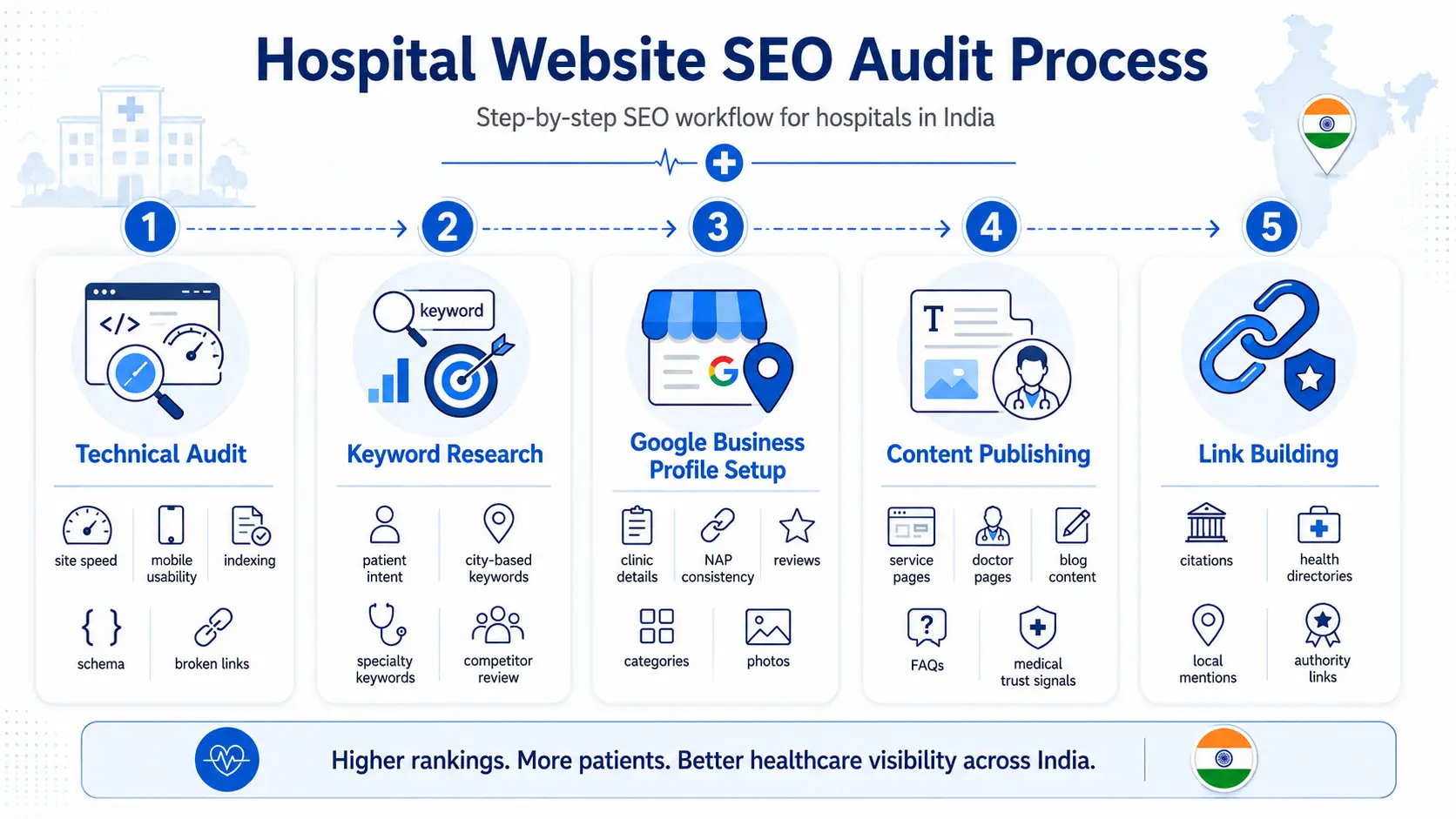
Ranking a hospital website on Google requires combining technical quality, content authority, local signals, and consistent link building. Here is the step-by-step process for how to rank hospital website on Google:
- Complete a technical SEO audit: crawl errors, duplicate content, missing meta tags, Core Web Vitals scores, and schema implementation
- Map your keyword clusters: start with your specialties and procedures, then expand to supporting educational content
- Fix or create your Google Business Profile: this is your fastest local ranking signal
- Publish at least two pieces of medical content per month, each reviewed or authored by a licensed medical professional
- Build local citations on Indian health directories: Practo, 1mg, Lybrate, Medlife, Healthgrades India
- Earn backlinks from medical associations, NABH listing pages, health news portals, and medical journals
- Monitor AI search: check ChatGPT and Perplexity monthly for your specialty terms and optimize pages that should be cited but are not
Common Mistakes That Cost Hospitals Their Rankings
Most medical websites in India lose rankings to the same set of avoidable mistakes. Review this list and correct any that apply to your site.
| Mistake | Why It Hurts | Fix |
|---|---|---|
| No author credentials on medical content | Fails EEAT for healthcare websites evaluation – quality raters flag anonymous medical advice | Add doctor name, qualification, registration number, and review date to every clinical article |
| Blocking AI crawlers in robots.txt | GPTBot and ClaudeBot are blocked on most Indian hospital sites – invisible to AI Overviews | Add all major AI bot user-agents as Allow in robots.txt |
| Duplicate location pages | Multiple pages targeting “hospital in Chennai” with identical content trigger thin content penalties | Create unique 500+ word content for each location page |
| Missing FAQPage schema | FAQs are present but not marked up – Google cannot extract them for PAA boxes | Implement FAQPage schema on every article |
| Keyword-only title tags | “Best Heart Hospital India – Quality Care” loses to titles with genuine intent match | Rewrite titles to match the specific intent behind the query |
Healthcare SEO India – Content Types That Convert Patients
Not every page format performs equally well for healthcare SEO India. Hospitals that treat every page as a generic service description miss the formats that consistently rank and convert. Five content types do most of the work in a mature healthcare SEO India content plan.
Procedure explainer pages walk a patient through what a treatment involves, what to expect before and after, and typical recovery timelines. These pages target hospital SEO India terms at the procedure level and consistently earn featured snippets because they answer a specific question in a structured, scannable format.
Doctor profile pages support both SEO for doctors India and EEAT for healthcare websites simultaneously. A profile that lists qualifications, registration number, years of practice, and areas of focus gives Google a clear authority signal and gives the patient the reassurance needed to book.
Condition and symptom pages capture the earliest stage of a patient’s search journey, often before they have decided which specialist to see. These pages should link forward into procedure pages and doctor profiles, and where it fits naturally, into Skymoon’s content marketing service for hospitals that need ongoing production support rather than a one-time content sprint.
Cost and benchmark pages address the question almost every Indian patient asks before booking: what will this cost. Healthcare SEO India content that publishes a realistic cost range, even a broad one, outperforms pages that avoid the topic entirely, because patients trust transparency over vague reassurance.
Ready to turn this into an actual growth plan?
Our team builds strategies across SEO, paid advertising, AI search visibility, and website performance, matched to your budget and your goals, not a generic package.
- A real thirty minute call, not a sales pitch
- Recommendations specific to your business
- A short list of what to fix first
Comparison pages, such as “laparoscopic versus open surgery” or “IVF versus IUI,” serve both patient acquisition SEO India and AI search visibility at once. These pages are exactly the structured, comparison-table format that AI Overviews and Perplexity prefer to cite, which means they do double duty: ranking on Google and getting surfaced in AI-generated answers.
Where Healthcare SEO India Fits Into Your Broader Strategy
Healthcare SEO India rarely works in isolation. Hospitals that pair organic SEO with structured citation work for AI platforms see faster compounding results. For a deeper look at how the three disciplines interact, see our guide on GEO vs AEO vs AIO, which breaks down how generative engine optimization, answer engine optimization, and Google AI Overviews each play a distinct role in healthcare visibility. If you want a direct assessment of where your hospital or clinic site currently stands, book a free consultation with Skymoon Infotech and we will walk through a working audit of your current rankings and AI visibility gaps.
Frequently Asked Questions About Healthcare SEO in India
How long does healthcare SEO India take to show results?
Healthcare SEO India typically shows measurable results within 3 to 6 months for local search and 6 to 12 months for competitive national terms. Factors that speed up results include technical fixes applied in month one, consistent content publishing at a rate of two articles per month, and active Google Business Profile management.
How much does SEO for hospitals in India cost?
SEO for hospitals in India ranges from Rs 15,000 to Rs 80,000 per month depending on the scope, competition level, and content volume required. Single-specialty clinics targeting one city can start effectively at Rs 20,000-30,000 per month. Multi-specialty hospitals competing in major metros typically need Rs 50,000 or above to see material results.
Does medical SEO India work for small clinics and single-doctor practices?
Medical SEO India works very effectively for small clinics because local search competition is often low. A single-doctor dermatology practice in Surat can realistically rank in the Local Pack within 60 to 90 days by optimizing their Google Business Profile, adding five genuine patient reviews per month, and creating two location-specific pages with the doctor’s credentials prominently displayed.
What is the difference between healthcare SEO India and regular SEO?
Healthcare SEO India applies all the principles of regular SEO and adds a layer of EEAT compliance specific to YMYL content. Medical websites must demonstrate that content is written or reviewed by credentialed professionals. Regular SEO does not impose this requirement. Google holds medical content to a higher quality standard because incorrect medical information can directly harm readers.
How does EEAT for healthcare websites affect hospital rankings?
EEAT for healthcare websites is the highest-weighted quality factor on medical sites. Quality raters check whether content has demonstrated experience, expertise, authoritativeness, and trustworthiness. Hospitals with NABH accreditation, doctor-authored content, and citations from medical journals consistently outrank hospitals with generically written marketing pages, even when the marketing pages have stronger backlink profiles.
Can a clinic do SEO for doctors India without a dedicated marketing team?
A clinic can start SEO for doctors India without a dedicated team by focusing on three actions: completing and verifying the Google Business Profile, publishing one educational article per month written or reviewed by the treating doctor, and ensuring NAP consistency across the top five Indian health directories. These three steps alone can produce page-one local rankings for many specialty and location combinations within 90 days.
What keywords should hospital SEO India target first?
Hospital SEO India should target three keyword tiers first: specialty and procedure terms (e.g., “laparoscopic surgery cost Ahmedabad”), local intent terms (e.g., “eye hospital near me in Pune”), and educational terms that build authority (e.g., “what is dengue fever symptoms”). Combining all three tiers creates a content strategy that captures patients at every stage of their search journey.
Let's turn this into results for your business.
SEO, paid advertising, AI search visibility, website design, and conversion optimization, all under one roof, all pointed at the same goal: revenue.