
How does chatgpt choose sources? Most guides on how to get cited by chatgpt treat ChatGPT as a generic AI search system and apply the same general GEO checklist: publish structured content, add schema, earn backlinks. That advice is not wrong, but it misses three ChatGPT-specific mechanics that determine whether your page is even retrievable for live citation, let alone selected.
ChatGPT has two distinct modes that produce fundamentally different citation outcomes: training-data recall and live web retrieval. The general GEO overview at the GEO vs AEO vs AIO guide covers the broader strategic picture, and the 2026 AI SEO trends guide covers the broader AI search strategy.
Get found by ChatGPT, Gemini, and Google AI Overviews
Eighteen steps to prepare your business for how people are searching now. Our internal AI search readiness guide, free.
This post is the platform-specific deep dive on ChatGPT live citation mechanics that neither covers: which crawler controls live citation, why Bing indexing matters more than Google ranking for this specific platform, what the ~15% citation rate means for your strategy, and what the platform-specific chatgpt citation checklist looks like in practice.
What this post covers and does not cover: This post covers ChatGPT live-retrieval citation mechanics: OAI-SearchBot, Bing Webmaster Tools, the training-mention vs citation distinction, and the ~15% citation rate. It does not cover general GEO strategy, llms.txt, or schema best practices. Those are in the GEO vs AEO vs AIO guide.
OAI-SearchBot vs GPTBot vs ChatGPT-User: Which One Actually Controls Citations
OpenAI operates three distinct crawlers with three distinct functions. Conflating them is the most common technical mistake in ChatGPT search optimization.
| Crawler | What It Does | Controls Live Citation? | How to Allow/Block It |
|---|---|---|---|
| GPTBot | Collects web content for model training data | No ; training data only. Blocking it prevents your content from appearing in future model versions but does NOT prevent live citation. | Disallow: /GPTBot in robots.txt to exclude from training |
| OAI-SearchBot | Powers ChatGPT’s live web search. Retrieves pages in real time when a user triggers a search mid-conversation. | YES ; this is the only crawler that determines whether your page can be retrieved and cited in a live ChatGPT answer. | Disallow: /OAI-SearchBot blocks live citation. Allow by default (no entry needed) to remain citable. |
| ChatGPT-User | Fetches a specific URL that a user has explicitly shared in their conversation. | Only for that specific URL in that specific conversation ; not a general citation mechanism. | No robots.txt control needed for this use case |
The critical implication for robots.txt for ChatGPT: blocking GPTBot does not block live citation. Many sites that added “Disallow: /GPTBot” after early ChatGPT privacy concerns have inadvertently left OAI-SearchBot unrestricted (correct behaviour for citation eligibility) or incorrectly assumed that GPTBot blocking solved the citation problem. The only entry in robots.txt that controls live citation eligibility is the OAI-SearchBot directive.
OpenAI’s crawler documentation confirms this separation. For most sites that want to be cited by ChatGPT: GPTBot can be blocked or allowed based on training-data preferences; OAI-SearchBot should be allowed (either explicitly or by default); ChatGPT-User requires no action.
Why Bing Webmaster Tools Matters More Than Google for ChatGPT Citations
ChatGPT’s live search runs through Bing, not Google. When OAI-SearchBot retrieves pages to potentially cite in a live ChatGPT answer, it queries Bing’s index. A page can rank on page one of Google and be completely absent from ChatGPT citation if it is not indexed or is poorly indexed in Bing.
The implication for bing webmaster tools chatgpt citations is direct: a page can rank on page one of Google and be completely absent from ChatGPT citation if it is not indexed in Bing. This creates a specific gap for sites that have invested heavily in Google-specific SEO but have never verified their Bing indexing.
The practical check takes under 10 minutes: open Bing Webmaster Tools, verify site ownership (if not already done), check the URL inspection tool for your most important pages, and review the crawl report for any indexing errors. For sites with technical SEO problems on Bing (blocked by Bing’s crawler, slow to index, crawl errors), these are the first items to fix before any content-level chatgpt search optimization effort will matter.
Bing Webmaster Tools provides a URL submission tool, a crawl report, and an SEO reports tab that surfaces Bing-specific issues. The submission API can be used to notify Bing of new or updated content faster than waiting for passive recrawl. Bing’s crawl frequency for most sites is slower than Google’s, which means recently updated pages may not surface in ChatGPT citations for days or weeks after Google has indexed the update.
Bing Webmaster Tools setup for ChatGPT citation: Verify site ownership. Submit XML sitemap. Use URL submission tool for highest-priority pages. Check IndexNow implementation for faster Bing pickup. Review crawl report monthly for error patterns. These are not optional for any site treating ChatGPT citation as a measurable KPI.
Training Mention vs Live Citation: They Produce Completely Different Outcomes
ChatGPT can reference a brand, a product, or a concept in two fundamentally different ways, and the distinction determines whether a link or citation appears.
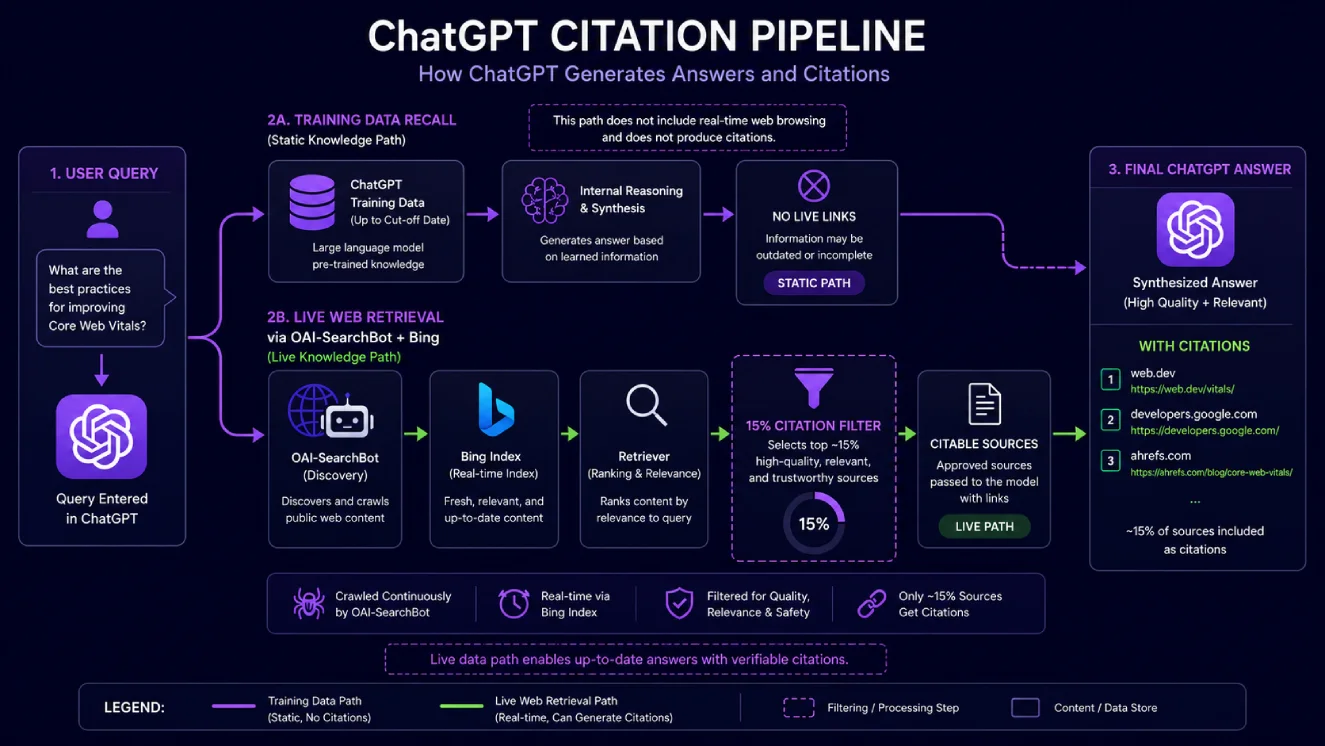
A training-data mention occurs when ChatGPT generates a response from its pre-trained knowledge. The model may mention your company, describe your product accurately, or cite your research findings. No link appears. No real-time retrieval happened. The model learned this information from web content during training and is reproducing it from memory. Training mentions cannot be tracked with referral analytics because no HTTP request was made to your server.
A live citation occurs when a user’s query triggers ChatGPT to perform a live web search mid-conversation. OAI-SearchBot retrieves candidate pages from Bing’s index. ChatGPT then selects a subset of those retrieved pages to cite in its answer. A citation in this mode produces a link, and a user clicking that link generates a trackable referral visit in GA4. This is the mechanism that shows up in your ChatGPT referral traffic.
The ~15% citation rate: Of the pages OAI-SearchBot retrieves for a given query, roughly 15% are actually cited in the final ChatGPT answer. The rest are used as context for generating the answer but not linked. This means being retrievable is necessary but not sufficient. The page still needs to provide the most direct, clearly structured answer to the query among the retrieved set to earn citation.
Would ChatGPT even recommend your business right now?
AI powered search is changing how people find companies like yours. Our free assessment shows exactly where you stand today.
Get My Free AI AssessmentNo commitment, just a clear picture of where you stand.
This 15% selection rate is why content structure matters at the retrieval stage, not just the indexing stage. ChatGPT is selecting from a candidate pool. The selection factors favor pages that answer the specific query directly in the first relevant passage, provide a specific data point or named source that the generated answer can cite, and structure that answer in a format ChatGPT can quote cleanly.
Why Your Website Is Not Being Cited by ChatGPT
The question “why isn’t my website cited by chatgpt” despite good Google rankings has four consistent answers. Check them in order:
- OAI-SearchBot is blocked or not allowed. Check robots.txt for any Disallow directives that would prevent OAI-SearchBot from crawling. If OAI-SearchBot cannot access the page, it cannot retrieve it for live citation regardless of content quality.
- The site is not indexed in Bing or has Bing crawl errors. Google ranking does not transfer to Bing indexing. Check Bing Webmaster Tools specifically. A site absent from Bing’s index is absent from ChatGPT’s retrieval pool entirely.
- The content is present in ChatGPT’s training data but not being retrieved in live search mode. This produces the scenario where ChatGPT mentions the brand accurately but provides no link. The fix is ensuring OAI-SearchBot can access the current version of the page and that Bing is indexing it with recent content.
- The page is retrieved but not selected. The page appears in OAI-SearchBot’s candidate pool but the ~15% selection filter favors a competitor whose answer is more direct, more specific, or better structured. The fix is passage-level content improvement: does the first 100 words of the relevant section directly answer the query ChatGPT was asked? Google’s guidance on creating helpful, reliable content (which shapes E-E-A-T standards generally) also applies to ChatGPT source-selection behavior, because both systems favor first-hand expertise with verifiable attribution.
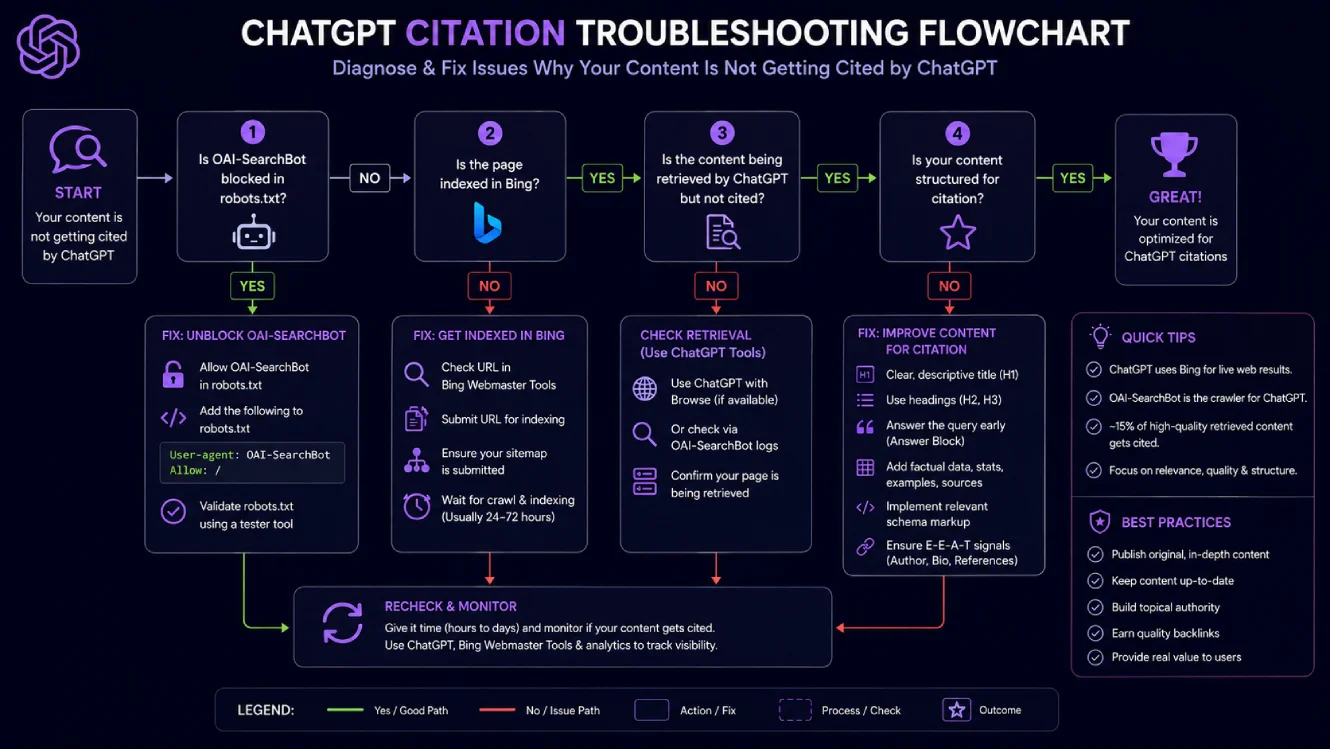
The ChatGPT Citation Checklist: Platform-Specific Items Only
This checklist covers only the items specific to ChatGPT live citation. General GEO items (schema markup, E-E-A-T authorship, factual density, FAQ structure) are covered at the GEO vs AEO vs AIO guide. Do not duplicate them here.
1. Verify OAI-SearchBot is allowed in robots.txt. Open your robots.txt file. Search for any Disallow directives. Confirm that OAI-SearchBot has no blocking rule, either explicitly (User-agent: OAI-SearchBot / Allow: /) or by default (no User-agent: OAI-SearchBot entry at all means it is allowed). If GPTBot is blocked for training-data reasons, that is acceptable; confirm OAI-SearchBot is untouched. The oai-searchbot vs gptbot distinction is what makes this check non-obvious.
2. Claim and verify your site in Bing Webmaster Tools. Bing Webmaster Tools site verification via XML file, meta tag, or CNAME record. Submit your XML sitemap. Run URL inspection on your 5 most important pages. Resolve any crawl errors before proceeding to content-level optimization.
3. Submit highest-priority pages via Bing’s URL submission tool. Use the URL submission feature in Bing Webmaster Tools to manually notify Bing of updated pages. Bing recrawls less frequently than Google; manual submission accelerates indexing for pages you have recently updated for ChatGPT citation purposes.
4. Implement IndexNow on your CMS. IndexNow is a protocol supported by Bing (and other engines) that pings search engines immediately when content is published or updated. Bing-native pickup via IndexNow means updates propagate to ChatGPT’s retrieval pool faster. Plugins exist for WordPress, and API integrations are available for custom platforms.
5. Put the direct answer to your target query in the first 100 words of each section. ChatGPT selects pages from a ~15% citation pool based on answer directness. A section heading followed by background context before the actual answer is a citation barrier. The direct answer to the question the heading poses must appear in the first 100 words of that section, before supporting context.
6. Establish third-party corroboration on Reddit, Quora, and Q&A platforms. ChatGPT’s source selection weights third-party corroboration. A brand that appears only on its own domain is a weaker citation candidate than one that appears in genuine Reddit discussions, Quora answers, or independent reviews where real users describe or recommend the product or service. This is not manufactured presence: it is earned third-party credibility that ChatGPT can reference as independent verification.
7. Refresh key pages on a 2-3 month cadence with genuinely updated information. ChatGPT weights recency as a real signal for time-sensitive queries. A page updated with new data, new statistics, or new examples within the last 2-3 months outperforms an equivalent page that has been static for 18 months when both are retrieved for the same query. The dateModified schema field on Article markup should reflect the actual update date.
8. Track ChatGPT referral traffic in GA4 as a direct citation measurement. Create a custom channel group in GA4 that captures referral traffic from chatgpt.com, chat.openai.com, and chatgpt.com/share. This is the direct output metric for live citation. Training-data mentions produce no referral traffic. If your ChatGPT referral channel shows zero sessions after implementing items 1-7, recheck OAI-SearchBot access and Bing indexing before revisiting content structure.
ChatGPT vs Perplexity Citation Mechanics: Key Differences
Understanding the chatgpt vs perplexity citation rate difference explains why platform-specific optimization matters. ChatGPT and Perplexity are the two dominant AI search platforms for live citation in 2026, but their citation mechanics differ in ways that affect optimization priority.
| Factor | ChatGPT (with search enabled) | Perplexity |
|---|---|---|
| Index source | Bing (primary) | Bing + proprietary index + real-time crawl |
| Crawler to allow | OAI-SearchBot | PerplexityBot |
| Training vs live | Training mentions (GPTBot) and live citations (OAI-SearchBot) are separate | All citations are live retrieval (no training-only mode) |
| Citation selectivity | Approximately 15% of retrieved pages cited | Higher citation rate ; Perplexity typically cites more sources per answer |
| Link display | Cited sources shown as numbered references | Cited sources shown as inline numbered links and a sources panel |
| Content freshness weight | Moderate recency bias for time-sensitive queries | High recency bias ; Perplexity indexes and retrieves very recent content aggressively |
| Bing Webmaster Tools needed? | Yes ; Bing indexing is prerequisite for live ChatGPT citation | Partially ; Bing indexing helps but PerplexityBot also crawls independently |
The chatgpt vs perplexity citation rate difference explains why platform-specific optimization matters: ChatGPT cites roughly 15% of retrieved pages while Perplexity typically cites a higher proportion.
For most brands optimizing chatgpt search optimization first, the Bing Webmaster Tools setup and OAI-SearchBot verification in steps 1-4 of the checklist are the highest-leverage starting actions because they address the retrievability gate before any content-level work matters. For Perplexity, allow PerplexityBot in robots.txt and ensure fresh content is being published regularly.
Frequently Asked Questions: Getting Cited by ChatGPT
What is the difference between OAI-SearchBot, GPTBot, and ChatGPT-User?
GPTBot collects web content for model training and does not affect live citation. OAI-SearchBot powers ChatGPT’s live web search and is the only crawler that determines whether a page can be retrieved and cited in a real-time ChatGPT answer. ChatGPT-User fetches a specific URL a user explicitly shares in conversation. Only blocking OAI-SearchBot actually prevents live citation.
Ready to turn this into an actual growth plan?
Our team builds strategies across SEO, paid advertising, AI search visibility, and website performance, matched to your budget and your goals, not a generic package.
- A real thirty minute call, not a sales pitch
- Recommendations specific to your business
- A short list of what to fix first
Does ranking well on Google mean ChatGPT will cite you?
Not directly. ChatGPT’s live retrieval runs through Bing, not Google’s index. A page ranking on page one of Google but absent from Bing’s index will not be retrieved or cited by ChatGPT in live search mode. Bing Webmaster Tools verification and Bing-specific indexing are independent prerequisites that Google ranking does not fulfill.
Why does ChatGPT mention my brand but never link to me?
That is a training-data mention, not a live citation. ChatGPT learned about your brand during model training and reproduces that knowledge from memory. No real-time retrieval happened, so no link appears and no referral traffic is generated. Live citations only occur when OAI-SearchBot retrieves your current page and ChatGPT selects it to cite. The fix is ensuring OAI-SearchBot can access the page and Bing has indexed it.
What percentage of retrieved pages does ChatGPT actually cite?
Roughly 15% of pages retrieved by OAI-SearchBot for a given query are actually cited in the final ChatGPT answer. The rest provide context for generating the response but receive no link. This 15% selection rate means content structure at the passage level matters beyond mere indexing. Pages whose relevant sections answer the query directly in the first 100 words are selected more consistently.
Does content need to be updated frequently to stay cited by ChatGPT?
Yes for time-sensitive queries. ChatGPT treats recency as a real signal when the query involves current information. A 2-3 month refresh cadence with genuinely updated facts, new statistics, or new examples outperforms equivalent static pages on time-sensitive queries. The dateModified field in Article schema should reflect the actual update date, not the original publish date, to signal freshness accurately.
Applying This to Get ChatGPT to Recommend Your Website
Getting chatgpt to recommend your website consistently requires the platform-specific foundation (OAI-SearchBot access, Bing indexing, fresh content) before any content-level work compounds. The checklist above is sequenced by dependency: steps 1-4 are retrievability gates; steps 5-8 are citation-selection improvements.
Attempting steps 5-8 on a page that fails steps 1-4 produces no result. Skymoon’s GEO service covers the full ChatGPT and Perplexity citation optimization stack for brands that want measurable LLM referral traffic as a tracked channel.
For the broader AI search strategy covering Google AI Overviews, AEO, and the full platform set, the AEO service page covers the answer-engine layer that complements ChatGPT-specific citation work.
To review your current OAI-SearchBot configuration, Bing indexing status, and ChatGPT referral baseline, book a free AI visibility audit and we will run the diagnostics before recommending a prioritized action sequence.
Let's turn this into results for your business.
SEO, paid advertising, AI search visibility, website design, and conversion optimization, all under one roof, all pointed at the same goal: revenue.