
Healthcare SEO keywords are not a list you download and distribute to a content team. For a hospital network with 20 departments, 150 physicians, and facilities in 6 cities, a flat keyword list is an architecture problem dressed up as a content problem. The real challenge is building a keyword taxonomy that gives each department, each physician profile, and each location a distinct ranking surface without every page competing against every other page on the same domain.
This guide covers the enterprise keyword architecture decisions that generic hospital SEO guides do not address. Two things this guide does not cover: if you need the India-specific keyword strategy with NMC compliance and local SEO for clinics, the healthcare SEO India guide covers that ground in full. If you need individual physician local SEO, the local SEO for doctors guide covers that separately. This post is for multi-specialty, multi-location hospital groups who need a keyword taxonomy that scales across their full site architecture.
The SEO checklist that finds what is actually holding you back
Twenty seven checks covering technical SEO, on page structure, and link strategy. The same list our team runs before quoting any new client.
Who this guide is for: Marketing directors, digital leads, and SEO vendors at hospital groups with multiple departments, locations, and physician directories. Assumes SEO fundamentals. The architecture decisions here apply at 10 departments or 100.
Who this guide is for: Marketing directors, digital leads, and SEO vendors at hospital groups with multiple departments, locations, and physician directories. Assumes SEO fundamentals. The architecture decisions here apply at 10 departments or 100.
Why Generic Hospital Keyword Lists Fail Enterprise Networks
A single-specialty clinic can rank on 15 to 20 core terms. A hospital network needs a keyword taxonomy spanning specialties, locations, physicians, and conditions, and the terms that work for one department actively cannibalize the others if they share a URL or compete from different pages without clear differentiation.
The competitive dynamic for head terms makes the problem concrete. Broad terms like “hospital near me,” “best hospital,” or “multi-specialty hospital” are dominated by listing aggregators, established health systems, and Wikipedia. An individual hospital group spending budget chasing those terms competes against Wikipedia, WebMD, and the NHS simultaneously. The keyword research for healthcare websites that actually generates patient appointments focuses on specific procedure plus location combinations that competing chains are not optimized for.
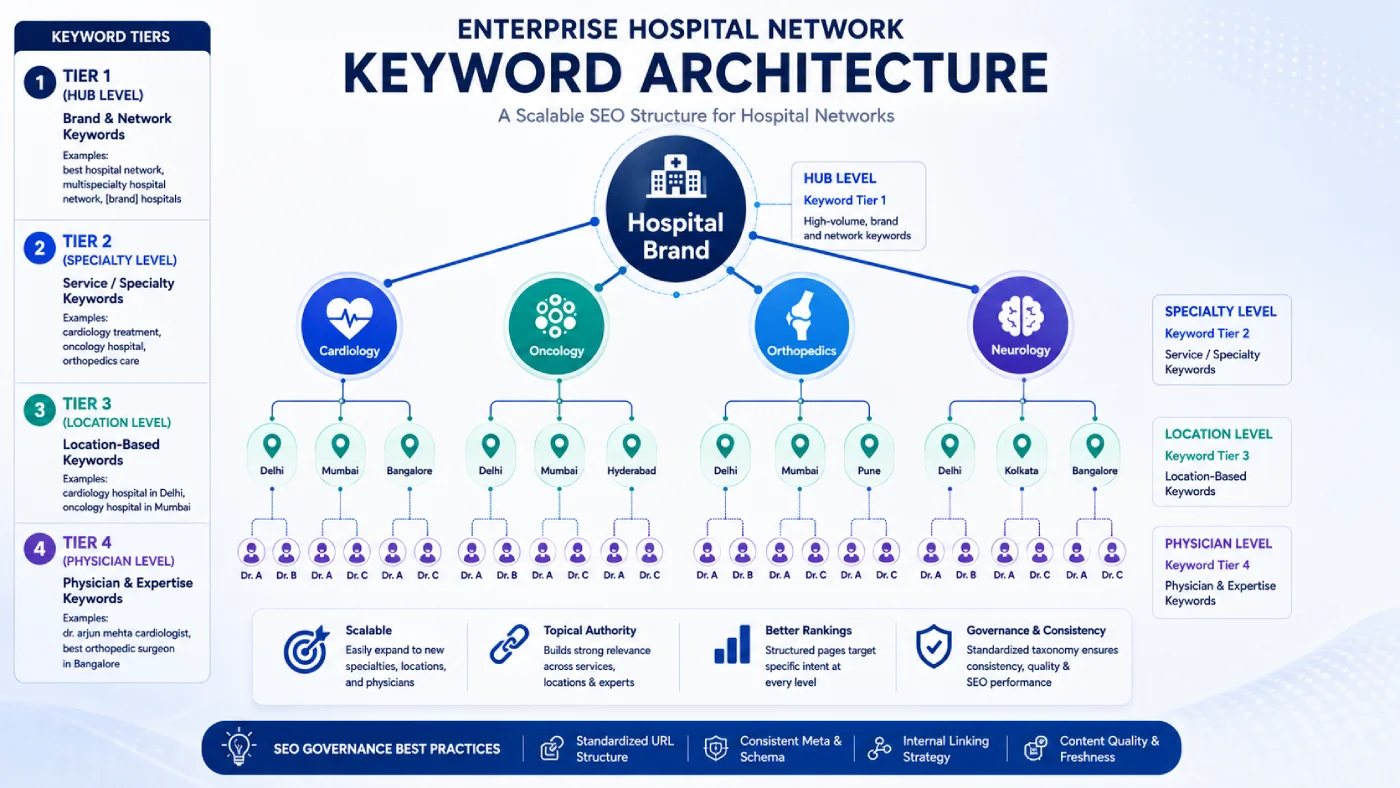
The architecture solution is a hub-and-spoke model applied at three levels simultaneously: the hospital brand page as the hub, service line or specialty department pages as spokes, and individual procedure, physician, and location pages as leaves. Each level targets distinct keyword tiers. Head terms on the hub, mid-tail on spokes, long-tail on leaves. When this is built correctly, the site does not compete with itself.
Healthcare SEO Keyword Architecture Framework: Specialties, Locations, Physicians
A documented hospital seo keyword strategy solves three problems simultaneously: it prevents different pages from competing for the same queries, it gives the content team a clear scope for each page, and it ensures that keyword authority compounds across the domain rather than fragmenting across unrelated pages. The framework below organizes healthcare SEO keywords into four tiers.
Tier 1: The Hospital Hub: Brand and Institutional Keywords
The hospital hub page targets brand terms, institutional authority queries, and the broadest specialty cluster terms. These pages compete on domain authority and brand recognition, not long-tail specificity. Healthcare SEO keywords at this level include: “[Hospital Name] [City],” “multi-specialty hospital [City],” and condition-cluster terms like “cancer treatment hospital” or “heart hospital.” These terms have high search volume and high KD, which means they function as brand signals rather than primary patient acquisition drivers. Set expectations accordingly.
Tier 2: Service-Line Keyword Clusters
Service line keyword mapping healthcare begins at the department level and expands outward, not the other way around. Service-line pages are the primary patient acquisition layer for most hospital networks. Each specialty or department page targets a keyword cluster built around three axes: procedure terms, condition terms, and symptom terms. A cardiology department page should simultaneously serve the patient searching “heart bypass surgery,” the patient searching “symptoms of blocked arteries,” and the patient searching “best cardiologist for valve replacement.” These are the same funnel, served by one department, requiring three distinct content surfaces.
Seo keywords for hospital departments are most effective when structured around patient decision journeys rather than the hospital’s departmental org chart. A patient does not search “Department of Thoracic Surgery.” They search “lung cancer treatment options” or “chest surgery hospital.” Building department pages around how patients think about their condition, not how the hospital organizes its staff, is the single most common structural gap in hospital keyword architecture.
| Specialty | Procedure-Level Keywords | Condition-Level Keywords | Symptom-Level Keywords |
|---|---|---|---|
| Cardiology | “heart bypass surgery hospital,” “TAVR procedure near me” | “coronary artery disease treatment,” “heart failure specialist” | “chest pain specialist,” “irregular heartbeat doctor” |
| Oncology | “chemotherapy treatment center,” “radiation therapy hospital” | “breast cancer treatment options,” “lung cancer specialist” | “unexplained weight loss doctor,” “cancer screening near me” |
| Orthopedics | “knee replacement surgery hospital,” “spine surgery specialist” | “ACL tear treatment,” “herniated disc specialist” | “knee pain doctor,” “back pain specialist hospital” |
| Neurology | “epilepsy treatment center,” “stroke care hospital” | “Parkinson’s disease specialist,” “multiple sclerosis treatment” | “severe headache specialist,” “numbness in hands doctor” |
Each service line then breaks further into seo keywords for multi-specialty hospital environments where the same hospital offers both a neurology department and a neurosurgery department. These require distinct keyword clusters with clear canonical structure to prevent the two pages from competing against each other. The architecture decision: neurology owns non-surgical condition management; neurosurgery owns surgical procedures. Overlapping terms go on the parent specialty hub with internal links to both.
Tier 3: Location-Specific Long-Tail Strategy
The seo keywords for hospitals and clinics differ most dramatically at the location tier. Multi-location hospital networks face a specific duplicate-content risk that single-location hospitals do not: near-identical location pages where only the city name changes. A hospital network with facilities in Houston, Dallas, and Austin that builds identical department pages with city name swaps will either be flagged for thin content or see the pages cannibalize each other’s rankings in local search.
Your competitors might be outranking you for a fixable reason
Most sites lose the majority of their potential traffic to issues that take days, not months, to fix. Our free audit tells you what those are.
No commitment, just a clear picture of where you stand.
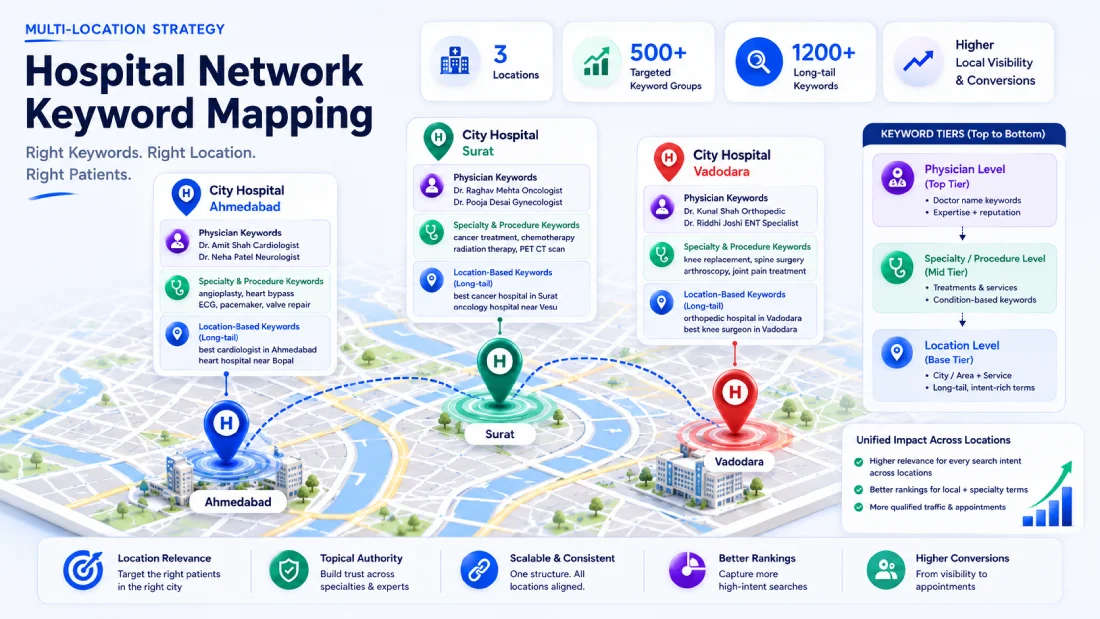
The hospital website keyword taxonomy for multi-location networks requires location pages to earn their distinction. Each location page should: target location-specific long-tail terms that reflect the actual catchment area (neighborhoods, suburbs, landmarks), name the physicians specifically available at that facility, list the services exclusive to or notably strong at that location, and include location-specific patient trust signals (local accreditations, local language support if relevant, local parking and transit directions). Generic location pages with swapped city names are not an SEO strategy.
Physician Directory SEO Keywords and Schema
Physician profiles are the most underperforming page type in most hospital websites. They exist as staff listings rather than patient acquisition pages. A physician directory page that targets only the doctor’s name is missing the keyword surface that actually drives patient appointments: name plus specialty plus city, specialty plus location terms for doctors without strong personal brand recognition, and condition terms for the doctor’s primary clinical focus.
Schema.org Physician schema markup combined with Google’s structured data documentation enables physician profile pages to surface in AI Overviews and Knowledge Panel results. The minimum required fields are: name, medicalSpecialty (using the Schema.org MedicalSpecialty taxonomy), worksFor (referencing the hospital’s MedicalOrganization schema), and hasCredential listing the physician’s board certification or registration. Physician pages with a complete schema regularly outperform those without it in local pack and AI-cited answer results for “best [specialty] doctor in [city]” queries.
Physician directory seo keywords fall into two tiers. The first tier is branded: the doctor’s name plus specialty and city for patients who have received a referral or have heard of the physician. The second tier is unbranded: specialty plus condition plus city for patients who are searching for a type of specialist without a specific doctor in mind. Both tiers need to be served by the physician profile page. Most hospital physician directories serve only the first tier and miss the patient acquisition opportunity entirely.
The Referral Keyword Segment: Targeting HCPs, Not Just Patients
A keyword segment most hospital SEO strategies miss entirely is the referring physician segment. For many hospital specialties including oncology, neurosurgery, and transplant medicine, the primary referral source is another doctor, not a patient searching Google. The search behavior of a primary care physician looking for a specialist to refer a complex case to is different from a patient searching for treatment options.
Patient acquisition keywords for hospitals focus on the consumer search journey. HCP referral keywords focus on clinical decision-making queries: “oncology tumour board referral guidelines,” “pre-surgical clearance cardiologist referral,” “stroke protocol neurology consult,” and “expedited appointment pathway for complex orthopaedic cases.” These are low-volume, high-intent commercial queries that most hospital websites have zero content for.
Building the HCP referral segment requires a distinct content section, often under a “For Healthcare Professionals” navigation node, with content written at clinical decision-making depth rather than patient-friendly language. This segment produces referral relationships rather than direct appointments, which means conversion tracking requires CRM integration rather than just form submissions. The SEO effort is justified by the volume of procedures each referring physician generates.
| Keyword Tier | Patient Acquisition | HCP Referral |
|---|---|---|
| Intent | Research + appointment booking | Clinical decision + patient routing |
| Examples | “best knee replacement surgeon Chicago,” “IVF clinic near me” | “expedited referral pathway oncology,” “peer-to-peer consult cardiology” |
| Content type | Procedure pages, patient testimonials, cost estimates | Clinical protocols, referral forms, physician bios with board certs, tumor board info |
| Conversion event | Online appointment request or call | Referral form submission, physician-to-physician call |
| SEO volume | Higher volume, higher competition | Lower volume, near-zero competition, high intent |
| Landing page | Patient-facing service line pages | Dedicated “For Physicians” section |
Best SEO Keywords for Medical Practice: Priority Sequencing for Limited Budgets
For hospital networks earlier in their SEO journey with a limited content budget, keyword architecture should be built sequentially rather than simultaneously. Google’s guidance on creating helpful, reliable content rewards topical depth in a subject area over thin coverage across many topics. This means it is better to build complete keyword coverage for cardiology than to publish one thin page for each of 20 departments.
The priority sequencing for best seo keywords for medical practice in a hospital network context follows this logic: start with the highest-volume procedure in the hospital’s revenue mix, build complete keyword coverage for that specialty (hub page, procedure pages, physician pages, location pages), wait for GSC impressions to indicate which specific queries are gaining traction, then expand coverage based on impression data rather than estimated keyword volume.
A practical medical seo keywords list structured by priority tier looks like this: Tier 1 (immediate, high commercial intent) includes specific procedure plus city terms and speciality plus symptom terms for your highest-revenue service lines. Tier 2 (3-6 months, authority-building) includes condition education content, clinical comparison terms (“open vs minimally invasive [procedure]”), and physician name plus speciality terms. Tier 3 (6-12 months, topical authority) includes symptom clusters, research and innovation content, and HCP referral content. Building all three tiers for one speciality before expanding to the next produces compounding topical authority rather than thin coverage across the entire hospital.
AI Search and Healthcare SEO Keywords in 2026
Hospital keyword architecture intersects with AI search visibility in one specific way: AI Overviews and ChatGPT select sources based on passage-level answer quality, topical authority signals, and schema markup, not primarily on keyword match. A hospital keyword taxonomy built around the framework above, with complete department coverage, physician profiles with Physician schema, and condition-plus-procedure content depth, produces the topical authority that AI citation systems favour. The GEO vs AEO vs AIO guide covers the specific AI visibility mechanics for healthcare content. This post focuses on the keyword architecture decisions that precede those AI optimization efforts.
Frequently Asked Questions – Healthcare SEO Keywords
How do you organize SEO keywords across multiple hospital departments?
Build a hub-and-spoke structure: the hospital brand page as hub, specialty or service-line department pages as spokes, and procedure, physician, and location pages as leaves. Each department gets its own keyword cluster targeting procedure terms, condition terms, and symptom terms separately. No two department pages should target the same primary keyword, and clear canonical structure prevents internal competition.
What keywords should a hospital target first with a limited content budget?
Prioritize the hospital’s highest-revenue specialty first and build complete keyword coverage for it: hub page, procedure pages, physician profiles, and at least one location variant. Use GSC impression data after 60-90 days to identify which specific queries are gaining traction before expanding to the next specialty. Spreading thin coverage across all departments simultaneously delays traction everywhere.
Ready to turn this into an actual growth plan?
Our team builds strategies across SEO, paid advertising, AI search visibility, and website performance, matched to your budget and your goals, not a generic package.
- A real thirty minute call, not a sales pitch
- Recommendations specific to your business
- A short list of what to fix first
Should physician profile pages target different keywords than department pages?
Yes. Department pages target specialty procedure and condition cluster terms. Physician profile pages target name-plus-specialty-plus-city terms for branded searches, and specialty-plus-condition-plus-city terms for unbranded patient searches. Using Physician schema on profile pages also enables AI Overview and Knowledge Panel appearances for physician-specific queries that do not require a click to a department page.
Do hospital groups need separate keyword strategies per location, or one shared list?
Separate location-specific long-tail terms are required per facility to avoid duplicate-content problems across near-identical location pages. Each location page should name the specific physicians at that facility, list exclusive or flagship services, and include location-specific trust signals. A shared keyword list with only the city name swapped produces thin-content pages that Google will not rank independently.
What is the difference between keyword strategy for a single clinic and a hospital network?
A single clinic can rank on 10 to 20 core terms. A hospital network needs a keyword taxonomy spanning specialties, locations, physicians, and conditions, requiring a documented hospital website keyword taxonomy that prevents internal competition. Single-clinic strategies scaled to a hospital network cause page-level cannibalization across dozens of department pages targeting overlapping terms from the same domain.
Building Your Hospital Network’s Keyword Architecture
The framework above applies whether the network has 5 departments or 50. The sequencing matters more than the scale: build complete keyword coverage for the highest-revenue specialty first, establish the architectural pattern (hub, spoke, leaf, physician, location), then expand outward. A hospital network that builds correctly for one specialty and gets measurable organic traction in 90 days has proof of concept for the full taxonomy.
Skymoon’s healthcare SEO services cover the full implementation for hospital networks at different stages of this architecture, from initial keyword taxonomy to department-level content production and physician schema rollout.
For a discussion of your specific network’s structure, book a consultation and we will map the keyword architecture against your site’s current structure before recommending next steps.
Let's turn this into results for your business.
SEO, paid advertising, AI search visibility, website design, and conversion optimization, all under one roof, all pointed at the same goal: revenue.