
Healthcare website design is where patient trust is won or lost before a single appointment is booked. A patient searching for a cardiologist in Ahmedabad or a gynaecologist in Pune does not have the luxury of visiting the clinic before deciding whether to trust it. Your website is the first clinical impression, and 73% of urban Indian patients now use it to evaluate a healthcare provider before reaching out.
Most healthcare websites in India fail at the same predictable set of problems: slow load times on mobile networks, missing trust signals, forms that break on Android, and clinical content that Google flags as low E-E-A-T. This guide covers the specific design decisions that determine whether a hospital or clinic website builds patient confidence and drives appointments, using healthcare website design best practices drawn from real patient behaviour and verified performance data.
Is your website actually built to convert?
Twenty two checks covering Core Web Vitals, user experience, and conversion paths. The exact list we run before every website audit.
Who this guide is for: Hospital administrators, clinic owners, dental practice managers, and healthcare marketing teams responsible for website design or redesign decisions in India.
Why Healthcare Website Design Is Different from Standard Web Design
Healthcare website design differs from standard web design in three fundamental ways. First, every page is classified by Google as YMYL (Your Money or Your Life), which means the search engine applies its strictest E-E-A-T evaluation criteria to medical content. Second, the patient visiting a hospital website is in a higher-anxiety state than a shopper browsing e-commerce, which makes trust signals non-optional rather than nice-to-have. Third, healthcare websites in India must comply with NMC advertising guidelines and the Digital Personal Data Protection Act (DPDPA 2023), which restrict how patient data is collected and how provider claims are presented.
These three factors combine to make healthcare website design a specialised discipline. Google’s guidance on creating helpful, reliable, people-first content explicitly identifies medical websites as requiring a higher quality standard, with content demonstrably produced or reviewed by credentialed professionals. A generic web design approach applied to a hospital website produces pages that look functional but fail both patient trust tests and search quality evaluations.
Trust Signals: The Non-Negotiable Foundation of Healthcare Website Design
Trust signals are the design elements that tell a patient, within the first 10 seconds of landing on a page, that this practice is legitimate, credentialed, and safe to contact. In healthcare website design, these signals carry more weight than in any other vertical because the patient is about to make a decision that affects their health.
Doctor and Staff Credentials
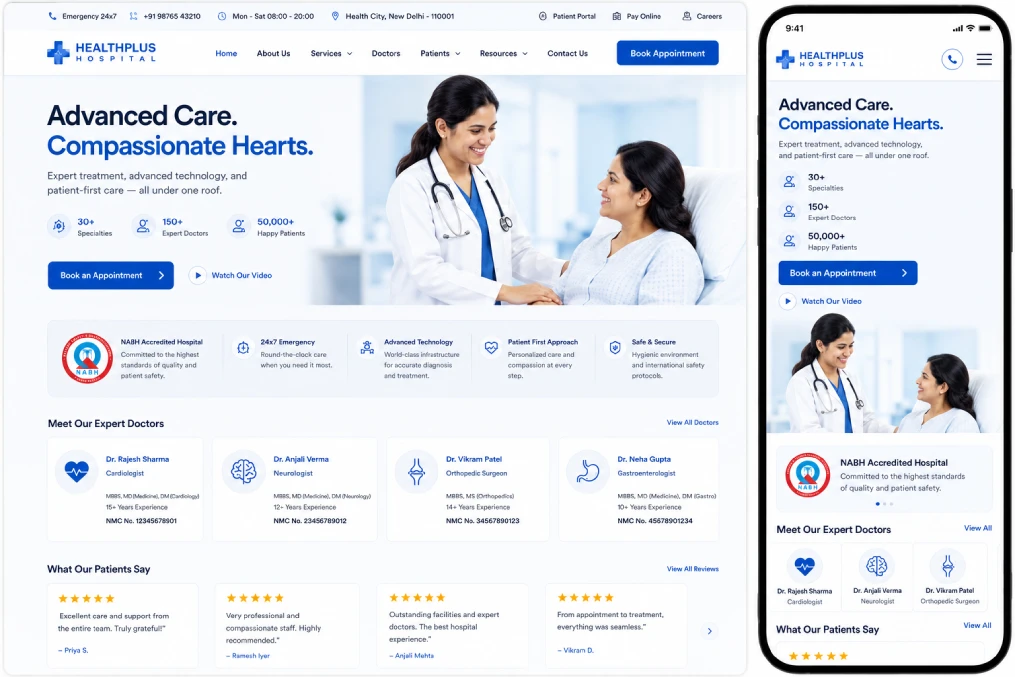
Every doctor profile on a hospital or clinic website should display the practitioner’s name, degree (MBBS, MD, MS, DNB), specialty, and registration number. The registration number is particularly important because it is verifiable through the NMC’s national register, which means it functions as a trust signal for informed patients. A healthcare website design that buries credentials in a general “About” page, or worse, omits them entirely, signals to both patients and Google that the practice does not meet credentialed content standards.
Accreditation and Certification Badges
NABH accreditation, NABL certification for labs, and ACHSI recognition are not just compliance requirements. They are design assets. In healthcare website design, accreditation badges placed in the header or near the primary CTA reduce the patient’s perceived risk and increase appointment form fill rates. Skymoon’s own client data across healthcare campaigns shows that NABH badge placement near a booking CTA consistently improves conversion rate.
Patient Reviews and Testimonials
Patient reviews embedded directly on the website, rather than simply linked to Google Business Profile or Practo, give healthcare website design a local credibility layer that AI systems also favour. Per NMC Code of Medical Ethics Regulations, reviews must not make outcome guarantees or comparative claims against other providers. A testimonial reading “Dr. Sharma’s care was excellent and I recovered well” is compliant. “Dr. Sharma is better than any other cardiologist in Ahmedabad” is not.
![Medical website design showing doctor credentials, NABH accreditation, and patient testimonials as trust signals]](https://skymooninfotech.com/wp-content/uploads/2026/07/Medical-website-design-showing-doctor-credentials.webp)
Mobile-First Healthcare Website Design and Core Web Vitals
Over 85% of Indian patients searching for healthcare providers use a smartphone, typically on a 4G connection. This single fact determines the technical priority order for healthcare website design: mobile performance first, desktop second. A hospital website that loads beautifully on a MacBook but takes 6 seconds to display the appointment form on a mid-range Android device is failing most of its patients before they ever see the page.
Google’s Core Web Vitals documentation specifies three measurable thresholds that healthcare websites must meet: Largest Contentful Paint (LCP) under 2.5 seconds, Interaction to Next Paint (INP) under 200 milliseconds, and Cumulative Layout Shift (CLS) under 0.1. These are measured using real user data from Chrome devices, not lab simulations. A medical website design that passes desktop Lighthouse checks but fails on a 4G Android device scores poorly on the field data that Google actually uses for ranking.
Specific Mobile Optimisation Priorities for Hospital Website Design
Hospital website design for Indian patients requires specific mobile optimisations that go beyond generic responsive design:
- Click-to-call phone numbers that activate on tap, not just copy the number to clipboard
- WhatsApp chat integration as a primary contact option, since over 70% of Indian patients prefer WhatsApp over contact forms
- Appointment forms with a maximum of four fields on mobile: name, phone, specialty, preferred date. Every additional field reduces conversion rate measurably
- Images served in WebP format with explicit width and height attributes to prevent Cumulative Layout Shift
- Google Maps embed with a static image fallback to avoid the INP penalty from heavy JavaScript map loads
For the technical implementation details that go beyond the design layer, our guide to building an SEO-friendly website covers the Core Web Vitals optimisation stack including WP Rocket configuration, CDN setup, and image compression workflows that Skymoon uses on healthcare client sites.
Medical Website Design and E-E-A-T: Content That Google Trusts
Medical website design that ranks on Google must demonstrate E-E-A-T (Experience, Expertise, Authoritativeness, and Trustworthiness) on every page, not just the homepage. This is not a branding exercise. It is a structural design requirement that affects how Google evaluates every page on your domain.
Author Attribution on Every Clinical Page
Every service page, condition page, and blog post on a medical website design must display a named author with verified medical credentials. Google’s web.dev guidance on Core Web Vitals sits within a broader framework that rewards websites demonstrating real human expertise. An oncology department page written by “Admin” or “Editorial Team” without a named doctor reviewer will consistently underperform against the same page with a named oncologist, their MBBS and MD credentials, and a last-reviewed date.
Last-Reviewed Dates on Clinical Content
Medical information becomes outdated. Treatment protocols change. Drug interactions are updated. A medical website design that publishes clinical content without a last-reviewed date visible near the top of the page sends a signal to both Google quality raters and patients that the information may not be current. A visibly updated date, paired with a doctor attribution, is one of the highest-return E-E-A-T improvements a hospital website can implement.
Condition and Treatment Pages as E-E-A-T Assets
Condition pages (“What is Type 2 Diabetes?”), procedure pages (“What to Expect from Knee Replacement Surgery”), and FAQ content clusters are the content formats that generate the most E-E-A-T authority for a medical website design. They demonstrate genuine expertise rather than self-promotion, answer the questions patients actually search for, and create topical depth that allows service pages to rank more competitively.
Hospital Website Design: Specific Requirements for Multi-Specialty Institutions
Hospital website design for multi-specialty institutions introduces complexity that single-specialty clinic websites do not face: navigating dozens of departments, hundreds of doctors, multiple locations, and simultaneous patient audiences ranging from emergency care seekers to elective procedure researchers. Getting this architecture wrong is the most common structural failure in hospital website design across Indian multi-specialty chains.
Information Architecture for Hospital Website Design
A hospital website should structure navigation around patient intent, not departmental organisational charts. A patient searching for a cardiologist does not want to navigate through “About Us > Medical Team > Cardiology > Dr. Sharma”. They want a search bar, a specialty dropdown, or a prominent “Find a Doctor” entry point. Hospital website design that mirrors the hospital’s internal org chart produces a patient experience that mirrors filing a bureaucratic application, not seeking healthcare.
Your website might be losing customers before they even scroll
Slow load times, confusing navigation, and weak calls to action quietly cost businesses real revenue every month. See exactly what yours is missing.
No commitment, just a clear picture of where you stand.
The practical information architecture that works for hospital website design in India: a flat primary navigation with six or fewer items, a prominent site search bar, a specialty-first landing page structure where each department page functions as a standalone patient entry point, and a doctor finder tool that allows filtering by specialty, location, and language spoken.
Multi-Location Hospital Website Design
Hospitals with multiple locations face a hospital website design challenge that directly affects local search performance: how to structure location pages so each one ranks independently in its city while still conveying institutional brand consistency. Each location page needs its own Google Business Profile data, its own city-specific content, its own set of departmental specialists, and its own schema markup with accurate geo-coordinates. Generic location pages that swap only the city name produce thin content that rarely ranks.
Dental Clinic Website Design: Trust, Procedures, and Local Visibility
Dental clinic website design follows the same trust-first principles as hospital website design but serves a patient audience with a specific fear profile: dental anxiety is the primary barrier to conversion for most dental practices, and dental clinic website design must actively address this anxiety through design choices, not just copy.
Procedure-Level Content in Dental Clinic Website Design
Dental clinic website design produces the highest conversion rates when each major procedure (implants, veneers, Invisalign, root canal) has its own dedicated page with a consistent structure: what the procedure involves, what to expect during and after, a realistic cost range, the dentist’s credentials in this procedure, and a before-and-after gallery. The gallery is particularly important for dental clinic website design because cosmetic dental patients make their decision partly on visual evidence of outcomes.
Cost Transparency in Dental Clinic Website Design
Indian dental patients consistently search for cost information before booking. A dental clinic website design that publishes a clear cost range, even a broad one (e.g., dental implants starting from Rs 18,000 per implant), outperforms competitor pages that avoid the topic by directing to a “contact us for a quote” form. Transparency on cost is both a patient trust signal and an SEO advantage, as procedure-plus-cost queries are high-intent and relatively low-competition.
Clinic Website Design for Small Practices and Solo Practitioners
Clinic website design for single-doctor practices and small multi-doctor clinics operates at a different scale than hospital website design, but the design priorities are similar. Trust signals matter at least as much, because a solo practitioner has no institutional brand to anchor patient confidence. The doctor’s own credentials, the clinic’s Google reviews, and the patient experience design of the website carry the full weight.
For small practice clinic website design, three elements consistently drive the most improvement in patient inquiries: a professional doctor photo prominently displayed above the fold on mobile, a click-to-call button or WhatsApp link in the mobile sticky header, and at least three Google review snippets embedded on the homepage. For a full guide to how these design decisions interact with local search rankings, see our healthcare SEO India guide, which covers the local signals that determine Google Local Pack placement for clinics.
Clinic website design does not need to be expensive to be effective. A well-structured WordPress site with Elementor Pro, correct schema markup, a verified Google Business Profile, and a mobile-first design built around three conversion goals (call, WhatsApp, form) will outperform a more elaborate website that misses these fundamentals.
DPDPA-Compliant Healthcare Website Design in India (and What HIPAA-Compliant Means for Indian Practices)
Healthcare website design in India must comply with the Digital Personal Data Protection Act 2023 (DPDPA), India’s equivalent of international patient data protection regulations. Practitioners researching “hipaa compliant website design” are typically looking for the same underlying requirement: a website that handles patient information securely, collects only what it needs, obtains explicit consent, and stores data according to defined retention rules.
HIPAA (the US Health Insurance Portability and Accountability Act) does not apply to Indian healthcare providers unless they serve US-based patients or operate in the United States. The applicable Indian regulation is the Digital Personal Data Protection Act 2023 (DPDPA), administered by the Ministry of Electronics and Information Technology. For practical healthcare website design purposes, DPDPA compliance requires:
- Explicit consent checkboxes on all patient contact forms, appointment booking forms, and newsletter signups
- A clearly accessible Privacy Policy page explaining what data is collected, why, and how long it is retained
- Opt-in design for remarketing pixels: no pre-ticked boxes, no assumed consent for Meta Pixel or Google Ads remarketing from a contact form submission
- A data deletion mechanism: patients must be able to request that their submitted information be erased
- SSL/HTTPS on every page – a minimum requirement, not an optional upgrade, for any page that collects patient data
Telemedicine Website Design: Building Patient Confidence for Virtual Consultations
Telemedicine website design solves a conversion problem that in-person clinic websites do not face: a patient visiting a telemedicine site must book an appointment with a doctor they cannot physically see in a facility they cannot physically visit. The entire trust burden falls on the website design.
Effective telemedicine website design concentrates on four specific design decisions that address this trust gap directly:
- Video consultation preview: a short explainer showing what a video consultation looks like, which platform is used, and what patients need to have ready. This removes uncertainty about the process itself, which is one of the primary conversion barriers for first-time telemedicine users.
- Doctor selection with video profiles: beyond static photos and credentials, telemedicine website design benefits from short (30-60 second) introductory videos from each consulting doctor. Patients booking a telemedicine appointment are making a decision based almost entirely on perceived trust, and a brief video from the doctor makes that decision significantly easier.
- Clear pre-consultation requirements: what devices work, what internet speed is needed, what documents to have ready. Telemedicine website design that buries this information in a FAQ or an email confirmation loses patients who are uncertain about the technical requirements.
- Post-consultation follow-up clarity: what happens after the consultation, how prescriptions are shared, whether physical documents are issued. These questions drive cart-abandonment in telemedicine booking flows and should be answered directly on the booking page, not hidden in a terms document.
Conversion-Focused Healthcare Website Design: Turning Patient Visits Into Appointments
Healthcare website design that generates traffic but does not convert is one of the most common and expensive problems in Indian healthcare marketing. A hospital website ranking on page one for twenty keywords means nothing if the appointment form has ten required fields, the phone number is not clickable on mobile, and the page takes 7 seconds to load on a 4G connection.
Conversion-focused healthcare website design starts with a single question for every page: what is the one action a patient should take when they land here? Every design decision then flows from that answer. Healthcare CRO services layer systematic testing on top of this design foundation, but the foundational conversion design must come first.
The Three-CTA Structure for Healthcare Website Design
Hospital and clinic websites serve patients at different stages of their decision journey simultaneously. An emergency patient needs a phone number immediately. A research-stage patient needs to understand which department to contact. A ready-to-book patient needs a frictionless appointment form. Healthcare website design that serves all three with the same single CTA (“Contact Us”) fails at least two of the three audiences on every page.
A practical three-CTA structure for healthcare website design: a sticky mobile header with click-to-call and WhatsApp icons for immediate-intent patients; a section-level “Book Appointment” button for service and doctor profile pages targeting ready-to-book patients; and an inline “Learn More” link within condition and procedure pages for research-stage patients who are not yet ready to book.
Form Design in Healthcare Website Design
Appointment forms are the highest-friction conversion element in healthcare website design. The five-field form (name, phone number, email, specialty, preferred date/time) converts at consistently higher rates than longer forms across clinic types and specialties. Every additional field reduces form completion rate. If the practice does need additional information before the appointment, collect it in a post-booking confirmation email or phone call, not in the booking form itself.
Schema Markup in Healthcare Website Design: Ranking and AI Visibility
Schema markup is the part of healthcare website design that most Indian hospital and clinic websites get wrong or skip entirely. Correct schema implementation directly affects featured snippet eligibility, Google AI Overview citation probability, and Local Pack data accuracy.
For healthcare website design, the minimum required schema stack is: MedicalOrganization or LocalBusiness (with the most specific applicable subtype, such as Dentist or Physician), Article schema with named author and review date on all clinical content, FAQPage schema on every page with a FAQ section, and BreadcrumbList schema for navigation clarity. For a detailed implementation walkthrough, the healthcare SEO service page covers schema requirements within the broader technical SEO framework Skymoon applies to healthcare client sites.
Ready to turn this into an actual growth plan?
Our team builds strategies across SEO, paid advertising, AI search visibility, and website performance, matched to your budget and your goals, not a generic package.
- A real thirty minute call, not a sales pitch
- Recommendations specific to your business
- A short list of what to fix first
One implementation note that matters specifically for healthcare website design and AI visibility: as of 2026, Google’s FAQPage rich results are no longer shown for most websites in standard search results (deprecated May 2026). FAQPage schema is still worth implementing because it gives AI search systems like ChatGPT and Perplexity a structured question-and-answer format that is easier to extract and cite than unstructured prose. Do not use this schema as the basis for a promised rich result in a client deliverable.
Healthcare Website Design: Feature Requirements by Practice Type
Healthcare website design requirements vary significantly by practice type. This table summarises the priority features for each context covered in this guide.
| Practice Type | Highest Priority Design Elements | Key Compliance Requirement | Primary Conversion Goal |
|---|---|---|---|
| Hospital (multi-specialty) | Specialty navigation, doctor finder, multi-location pages, department-level content | DPDPA consent on all forms, NABH badge display, NMC-compliant claims | Appointment booking or departmental inquiry form |
| Single-specialty clinic | Procedure pages, doctor credentials, before/after gallery (where applicable) | Procedure-specific disclaimers, no outcome guarantees | Click-to-call or WhatsApp for first contact |
| Dental practice | Procedure pages with cost ranges, anxiety-reducing design, before/after gallery | No comparative claims, outcome language must be realistic | Booking form or free consultation CTA |
| Small / solo practitioner | Doctor photo above fold, Google reviews embedded, simplified contact flow | NAP consistency across GBP, Practo, Justdial | WhatsApp or phone call for first appointment |
| Telemedicine platform | Video consultation explainer, doctor video profiles, platform clarity | DPDPA consent, data handling transparency, session recording disclosure | Online booking with slot selection |
| Diagnostic lab / pathology | Test catalogue, location-specific pages, sample collection information | NABL certification display, no diagnostic guarantees | Online test booking or lab inquiry form |
Frequently Asked Questions About Healthcare Website Design
What should a healthcare website design include as minimum requirements?
A healthcare website design should include a mobile-first responsive layout, click-to-call and WhatsApp contact options, doctor profiles with verified credentials and registration numbers, DPDPA-compliant contact forms with explicit consent checkboxes, NABH or NABL accreditation badges where applicable, and schema markup covering at minimum MedicalOrganization, BreadcrumbList, and FAQPage types.
How is medical website design different from general business website design?
Medical website design applies E-E-A-T (Experience, Expertise, Authoritativeness, and Trustworthiness) requirements that do not apply to most business websites. Medical content is classified by Google as YMYL, meaning every page is evaluated against stricter quality criteria. Author credentials must be displayed, last-reviewed dates must be visible on clinical content, and no unsubstantiated health outcome claims can be made.
What makes a hospital website design effective for patient conversion?
Effective hospital website design for patient conversion requires a clear information architecture that organises content around patient intent rather than institutional org charts, mobile-optimised forms with a maximum of four to five fields, prominent trust signals including doctor credentials and NABH accreditation near conversion points, and a Core Web Vitals score that meets Google’s thresholds for LCP, INP, and CLS on 4G mobile devices.
What is the Indian equivalent of HIPAA compliant website design?
The Indian equivalent of HIPAA compliant website design is DPDPA 2023 compliance, governed by the Ministry of Electronics and Information Technology. DPDPA requires explicit patient consent before data collection, a clear privacy policy, an opt-in mechanism for marketing uses of patient data, and a process for patients to request data deletion. HIPAA applies to US-based providers or those treating US patients specifically.
How much does healthcare website design cost in India?
Healthcare website design in India ranges from Rs 30,000 to Rs 2,50,000 depending on the complexity, number of pages, integration requirements, and compliance work involved. A single-specialty clinic website built on WordPress with correct schema markup and DPDPA compliance typically falls in the Rs 40,000 to Rs 80,000 range. A multi-specialty hospital site with doctor finder, multi-location pages, and booking integration starts from Rs 1,00,000 upward.
What schema markup is required for a healthcare website in India?
The minimum schema markup for a healthcare website in India is MedicalOrganization or LocalBusiness, Article schema with named author and dateModified on all clinical pages, FAQPage schema on pages with FAQ sections, and BreadcrumbList for navigation. Multi-specialty hospitals should also implement Physician schema for doctor profiles, and OpeningHoursSpecification within the LocalBusiness markup for each department or location.
Does telemedicine website design need different technical requirements?
Telemedicine website design has higher trust requirements than physical clinic websites because patients cannot verify the provider’s environment directly. The most important additional requirement is a clear explanation of the consultation process, including the platform used, technical requirements for patients, how prescriptions are shared, and a pre-consultation data consent form that complies with DPDPA 2023 data handling rules.
Where to Start With Your Healthcare Website Design
Healthcare website design done correctly is not a one-time project. It is a foundation that determines how every SEO effort, every paid campaign, and every referral converts once the patient lands on your site. If your current hospital or clinic website has structural trust gaps, slow mobile performance, or DPDPA compliance issues, fixing these before investing further in traffic acquisition delivers the highest return. For a structural review of how healthcare website design sits within the broader patient acquisition system, explore Skymoon’s healthcare web design services, or book a free healthcare audit and we will review your current site against the design, compliance, and SEO requirements covered in this guide.
Let's turn this into results for your business.
SEO, paid advertising, AI search visibility, website design, and conversion optimization, all under one roof, all pointed at the same goal: revenue.