
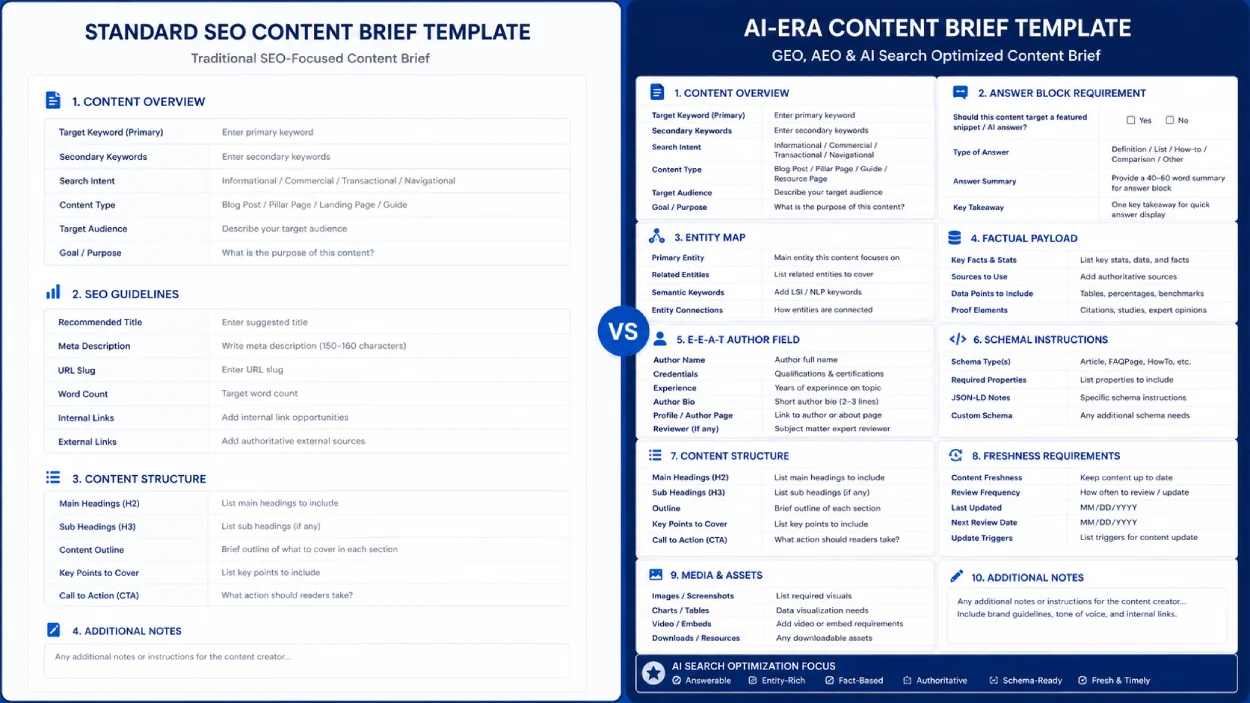
A standard seo content brief (keyword, intent, word count, heading skeleton, competitor references) produces content that ranks reasonably well in blue-link search and gets ignored by every LLM citation system. The brief itself is the problem. It tells writers what to write but not what AI systems need to extract and cite. An seo content brief for ai search is a different document: it specifies not just what to write but what to make extractable.
This post covers the 7 fields a content brief must include for the finished article to be cited by ChatGPT, Perplexity, and Google AI Overviews. If you need context on why AI search systems evaluate content differently from Google’s traditional ranking algorithm, the GEO vs AEO vs AIO guide covers that foundation. What follows assumes you already understand the distinction and need to know what to put in the brief.
The SEO checklist that finds what is actually holding you back
Twenty seven checks covering technical SEO, on page structure, and link strategy. The same list our team runs before quoting any new client.
Who this is for: SEO managers, content strategists, and agency writers who already produce briefs and need to know which fields to add for the AI search era. Not a beginner’s guide to brief-writing; the standard elements are assumed.
Why Traditional Content Briefs Fail AI Search
AI search systems evaluate content at the passage level, not the page level. Google’s ranking algorithm scores a full page against a query. LLMs and AI Overview systems scan individual passages for extractable, verifiable answers, and skip pages where those passages do not exist or are buried.
Research from Princeton University’s 2024 GEO study found that content incorporating statistics, citations, and quotations saw AI citation rates improve by 37-40% compared to content without these elements. The implication for brief design is direct: the brief must specify where and how these elements appear, because writers following a standard SEO brief have no instruction to include them. A traditional seo content brief optimized for the ranking algorithm produces content that is visible in search and invisible to AI retrieval systems. The two requirements overlap but are not the same, and the 2026 AI SEO trends guide covers the strategic picture. This post is about the document you hand to a writer.
Generic brief elements (keyword target, search intent, word count, heading structure, internal link placements, meta title, meta description) are still necessary. They are not sufficient. The 7 fields below are the ones that convert a standard seo content brief into one that produces AI-citable content.
The 7 Elements a Content Brief Must Include for AI Citation
Element 1: Answer-First Block Requirement
What it is: a mandatory instruction in the brief that every section must open with a direct, complete answer to its heading question before adding supporting context. Featured snippet and AI Overview extraction systems pull the first complete answer they encounter. Writers who front-load supporting context and bury the actual answer are producing content that AI retrieval skips.
What goes in the brief field: specify the minimum and maximum word count for the answer block (40-60 words for most informational queries), require it to appear before any supporting context, and flag the heading it applies to. Do not leave this as a general style note: pin it to specific sections.
[BRIEF FIELD] Answer Block Requirement: H2 “What is X” section: open with a 40-60 word direct answer before any context. Example: “X is [definition in one sentence]. [Why it matters in one sentence.] [What the reader should do with this information in one sentence.]”
Element 2: Entity Map
What it is: a required brief field listing the specific named entities the writer must reference in the article. Entities include named people, brands, studies, statistics, events, and organizations. LLMs use entity relationships to assess credibility. Content that names the right entities in context earns higher citation likelihood than content that paraphrases the same ideas without attribution.
Entity mapping content brief seo is a genuine gap in most briefing workflows. Writers instructed to “reference authoritative sources” make different choices than writers given a specific list of entities and told which ones to cite in which section. The brief removes the ambiguity.
[BRIEF FIELD] Entity Map: Section “How Google AI Overviews Select Content”: MUST cite Princeton GEO Study 2024 (Aggarwal et al.), Google Search Central documentation on E-E-A-T, and SearchEngineLand’s 2026 citation analysis. Do not paraphrase without attribution.
Element 3: Factual Payload
What it is: a brief requirement to include a minimum number of verifiable claim-data-source triplets per section. A verifiable triplet is: a specific claim, the data point that supports it, and the named source. “AI Overviews now reach over 2 billion monthly users (Google, 2026)” is a triplet. “AI search has grown significantly” is not.
Google’s guidance on creating helpful, reliable content explicitly rewards content demonstrating first-hand experience and expertise. For AI retrieval systems, factual density with verifiable sourcing is the closest operational signal to that standard. Three triplets per major section is a reasonable target for most informational content.
[BRIEF FIELD] Factual Payload: Minimum 3 verifiable triplets per H2 section. Format: [Claim] + [Data] + [Source, Year]. Example: “Pages with answer-first structure see 37-40% higher AI citation rates (Princeton GEO Study, Aggarwal et al., 2024).” No unattributed statistics.
Element 4: E-E-A-T Author Field
What it is: a mandatory brief field specifying the author credential line that must appear on the published article, not left to the editor to add post-production. Author attribution is an E-E-A-T signal that affects both Google’s quality evaluation and LLM citation selection. Anonymous or team-attributed content is a weaker citation candidate on YMYL and expertise-adjacent topics.
The brief field should specify: author name, relevant credential or role (e.g., “Senior SEO Strategist, Skymoon Infotech”), any registration or certification number where applicable (this matters more in healthcare, legal, and financial content), and a sameAs link to the author’s professional profile or other published work.
Your competitors might be outranking you for a fixable reason
Most sites lose the majority of their potential traffic to issues that take days, not months, to fix. Our free audit tells you what those are.
No commitment, just a clear picture of where you stand.
[BRIEF FIELD] Author Field: Published byline: [Name], [Role], [Company]. Credential: [Relevant qualification]. Link: [Author profile URL or LinkedIn]. Note: Healthcare content requires NMC registration number. Do NOT publish without author attribution.
Element 5: Content Freshness Requirements
What it is: a required brief field that sets a maximum age for any statistic or data point used in the article, and mandates a visible last-updated date on the published page. LLMs have a strong recency bias. AI systems selecting content to cite prefer pages with recent dateModified schema values and content that references 2025-2026 data over content using figures from 2022-2023.
At Skymoon, we specify a 12-month maximum stat age for all AI-era content briefs. Statistics older than 12 months must either be replaced or flagged in the brief with a note that the writer should search for a more recent equivalent. The last-updated date field in the brief becomes a published requirement, not an editorial afterthought.
[BRIEF FIELD] Content Freshness: Max stat age: 12 months from publish date. Any statistic older than 12 months: replace or flag with [NEEDS 2026 SOURCE]. Last-updated date: REQUIRED on publish. dateModified schema must reflect the actual update date. Do not publish without both.
Element 6: FAQ Schema Instructions
What it is: schema markup instructions baked directly into the brief, not left as a post-production task for editors or developers. FAQPage schema should be planned at the brief stage because the questions determine what the writer produces, not the other way around. When schema is post-production, editors add FAQ markup to whatever questions already appear in the article, which often produces weaker citation candidates than questions specified in advance based on PAA data and AI query research.
Google’s structured data documentation covers the FAQPage and HowTo schema types. Both should appear as required fields in the brief when the content structure supports them. Note that Google deprecated FAQPage rich results for most non-government sites in May 2026. Implement for AI system citation value (ChatGPT, Perplexity still parse it) but do not promise rich results to clients or stakeholders.
[BRIEF FIELD] Schema Instructions: FAQPage schema required: include these 4 Q&As as marked sections (see FAQ list in brief). HowTo schema: apply to the numbered steps in Section 3. Article schema: include author, datePublished, dateModified. Publisher: implement all schema in JSON-LD before publish – not post-production.
Element 7: Passage-Level Heading Structure
What it is: a brief requirement that each H2 and H3 heading must function as a standalone answer prompt, not just as a section label. “How to write a content brief for llm citation” is a passage-level heading. “Content Briefs” is not. The distinction matters because AI retrieval systems scan headings to identify what question a passage is answering. A heading that does not contain a question or a clear answer prompt is not a retrieval anchor.
The brief should evaluate each proposed heading against this test before the writer receives it: if someone asked this heading as a question to an AI assistant, would the passage below it be a satisfying answer? If not, the heading needs rewriting. This single check improves LLM citation eligibility more reliably than any other structural change to the brief.
[BRIEF FIELD] Heading Structure Rule: Every H2 and H3 must function as a standalone question or answer prompt. Test: can this heading be typed into ChatGPT or Perplexity and answered by the passage below it? If no, rewrite the heading. No section labels disguised as headings (e.g., “Introduction”, “Overview”, “Background”).
Skymoon’s Content Brief in Practice: A Real Example
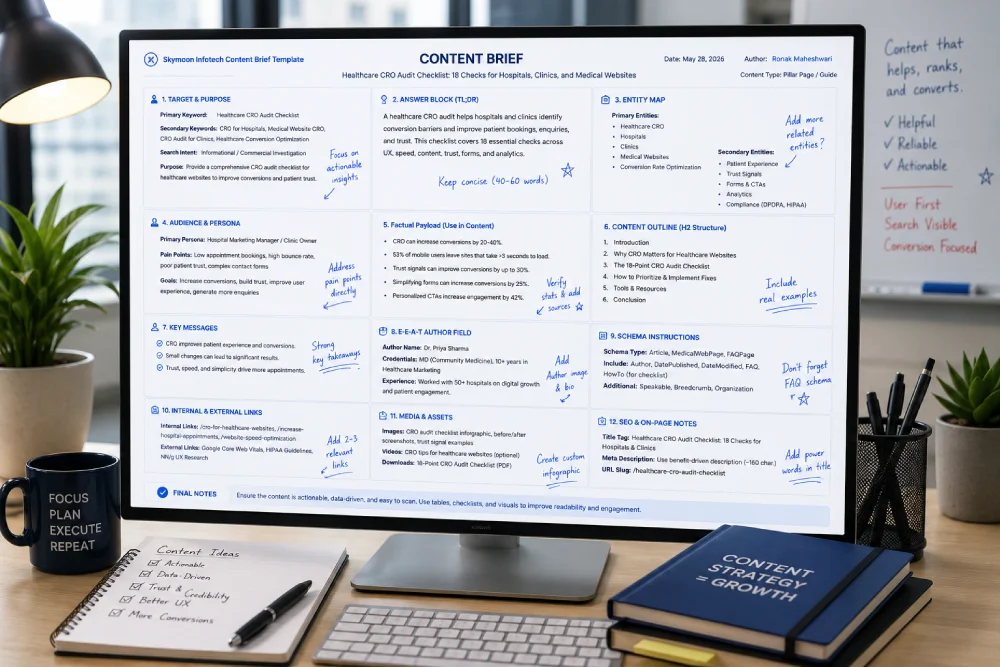
Here is a content brief example from Skymoon, showing how we structure the AI-era section of a brief using a real brief produced for a healthcare content client in 2026. Client details are anonymised. The structure is not.
The standard brief elements (keyword research, SERP intent analysis, heading skeleton, internal link map, meta draft) are completed first. The 7 elements above are then added as a second layer, a brief-within-a-brief that the writer carries into each section.
| Brief Field | Standard SEO Brief | Skymoon AI-Era Addition |
|---|---|---|
| Primary keyword | Healthcare website design best practices | Same – no change |
| Answer Block Requirement | (Not specified) | H2 “What Makes Healthcare Website Design Different”: 40-60 word direct answer before any supporting prose. First paragraph must complete the definition. |
| Entity Map (mandatory) | (Not specified) | Must cite: NMC Code of Medical Ethics 2002 (URL), DPDPA 2023 (MeitY source), Google Core Web Vitals documentation. Section-level assignments specified. |
| Factual Payload | (Not specified) | Min 3 verified triplets per H2. All stats dated 2024-2026. No unattributed figures. Format: claim + data + [source, year]. |
| E-E-A-T Author Field | (Not specified – added by editor) | Brief specifies: MBBS-qualified reviewer required for clinical claims. Author byline: [Name], [Role], NMC Reg No. [X]. Must appear before publish. |
| Content Freshness | (Not specified) | Max stat age 12 months. Any 2023 or older figure: replace or flag [NEEDS 2026 SOURCE]. Last-updated date field: mandatory on publish. |
| Schema Instructions | (Post-production task) | Brief lists FAQPage Q&As (4 specified). Article schema fields: author, datePublished, dateModified. HowTo: apply to numbered checklist section. JSON-LD, not microdata. |
| Heading Structure Audit | (Not specified) | Each H2/H3 evaluated against standalone-answer test before writer receives the brief. Three headings were rewritten during brief QA on this project. |
This brief produces content that passes our internal AI-readiness check before publishing: we manually prompt ChatGPT and Perplexity with the primary query and each FAQ question, then verify whether our content surfaces. On the healthcare website design post, four of the seven FAQ sections were surfaced in AI Overview responses within six weeks of publish. The content brief is the variable that changed.
How to Measure If Your Brief Is Producing AI-Citable Content
Three metrics tell you whether the brief changes are producing AI citation results. This measurement framework applies to any content brief for perplexity chatgpt citation or AI Overview targeting:
- AI citation rate: tracked via Peec AI, Otterly AI, or SEMrush AI Visibility. These tools monitor whether your content appears in AI-generated responses for your target queries. This is the direct output metric. Check weekly for the first 90 days after publishing AI-era content.
- AI-referred traffic in GA4: create a custom channel group for referral traffic from chatgpt.com, perplexity.ai, claude.ai, and gemini.google.com. This captures readers who clicked through from an AI citation to your page. LLM referral traffic is the fastest-growing referral category for content sites in 2026.
- Manual prompt testing: once per month, type your target query and each FAQ question directly into ChatGPT and Perplexity. Screenshot whether your content is surfaced, cited, or paraphrased. This is the cheapest and most direct test available. Content briefs for perplexity chatgpt citation that are working show up here first, before tracking tools report the volume.
For tool recommendations: Peec AI, Otterly AI, and the SEMrush AI Visibility tool are covered in detail on the AI SEO tools guide. T12 does not review tools, only the measurement framework.
Frequently Asked Questions
What Should a Content Brief Include to Get Cited by AI Search?
What should a content brief include beyond the standard elements (keyword, intent, word count, heading skeleton)? An AI-era seo content brief must include: an answer-first block requirement (40-60 words per section, before supporting context), an entity map naming specific people, studies, and brands the writer must cite, a factual payload of three verifiable claim-data-source triplets per section, and FAQ schema instructions. Without these, the article gives LLMs nothing structured to extract.
Does a traditional SEO content brief still work in 2026?
Traditional briefs (keyword, intent, word count, heading outline, meta) remain necessary but are no longer sufficient. AI search systems evaluate content at the passage level, not the page level. A brief that does not specify answer-first structure, entity density, or schema requirements produces content that may rank in blue-link search but gets skipped by LLM citation logic. The two requirements overlap but are not the same.
Ready to turn this into an actual growth plan?
Our team builds strategies across SEO, paid advertising, AI search visibility, and website performance, matched to your budget and your goals, not a generic package.
- A real thirty minute call, not a sales pitch
- Recommendations specific to your business
- A short list of what to fix first
What is an entity map in a content brief?
An entity map is a required brief field listing the specific named entities the writer must reference: named people, brands, studies, events, and statistics. LLMs use entity relationships to assess credibility. Entity mapping content brief seo practice means content that names the right entities in context earns higher citation likelihood than content covering the same ideas without attribution. The brief removes the ambiguity of “reference authoritative sources.”
What is the difference between a standard SEO brief and an AI-era content brief?
A standard brief optimizes for Google’s ranking algorithm and click-through from blue links. An AI-era seo content brief adds requirements targeting LLM retrieval: passage-level answer structure, factual density with verifiable triplets, FAQ schema, entity authority signals, and content freshness markers. The two are complementary. For the underlying GEO and AEO strategy that these briefs support, see the GEO vs AEO vs AIO guide.
Can a content brief template serve both human writers and AI generation runs?
Yes. The same brief now governs both because LLM-optimized requirements produce better human writing too. Answer-first structure, entity maps, and factual payloads make any article clearer and more credible regardless of who or what writes it. The brief is format-agnostic. The output requirements are the same whether the first draft comes from a human writer or an AI generation run that the writer then edits.
The SEO Content Brief Checklist for 2026
The seo content brief checklist 2026 version adds seven fields to any existing brief workflow: an answer-first block requirement, an entity map, a factual payload specification, an E-E-A-T author field, content freshness requirements, schema markup instructions, and a passage-level heading structure audit. These are not optional extras. They are the difference between content that participates in AI search and content that does not.
The content brief for writers following this structure produces articles that hold up in both traditional Google ranking and LLM retrieval. The post-production on-page elements (technical SEO, internal link validation, canonical tags, image optimization) remain unchanged. For a post-production SEO check, the
on-page SEO checklist covers everything that happens after the writer delivers the draft. The brief is the pre-production layer. Once you have both, the gap between what you publish and what AI systems cite closes substantially.
At Skymoon, we build this brief structure into every content engagement we take on. If you want the 7-element brief applied to your own content programme, the content marketing service page covers how we structure the brief, production, and citation-measurement cycle for clients. Or book a free consultation to discuss your specific content stack.
Let's turn this into results for your business.
SEO, paid advertising, AI search visibility, website design, and conversion optimization, all under one roof, all pointed at the same goal: revenue.